The first version of Cloudian was hiding inside a company that had run out of road. Gemini Mobile Technologies built messaging systems for giant telecom carriers. Its software knew how to absorb the data bursts produced by camera phones, keep services alive and store the messages people had stopped deleting. Then the financial crisis arrived, capital-equipment purchases stopped, and the customers went quiet.
For two or three years, Gemini could barely sell anything new. Maintenance and support kept the lights on. Michael Tso, then the technical leader who understood which skills the company could not afford to lose, became the person charged with cutting roughly two-thirds of the staff. Key engineers left afterward. Customers had to be reassured, then reassured again. Startup histories usually compress this sort of episode into one clean arrow on a timeline. Tso has described it more accurately: messy.
The interesting part is what the survivors did next. They did not discard the engineering built for carrier-scale messaging. Tso and co-founder Hiroshi Ohta followed its most durable capability - distributing and storing enormous quantities of data - into a different market. By 2011, the team had commercially released Cloudian, software that let service providers build multi-tenant storage using the same S3 interface popularized by Amazon Web Services.
01 / The productAmazon's grammar, your address
Cloudian's central product, HyperStore, is object storage. Rather than organizing information in a familiar tree of folders, object systems keep each item - an image, medical scan, video, log, model checkpoint or document - with an identifier and metadata. That flat structure is useful when a dataset has billions of pieces and must spread across nodes, racks or data centers.
The differentiator is less exotic than the architecture: HyperStore speaks S3. An enterprise can use applications written for the dominant cloud-storage interface while running the underlying capacity in its own facility, at the edge, in a partner environment or across several sites. Data can also be tiered into public clouds. In the simplest phrase, it is S3 grammar at the customer's address.
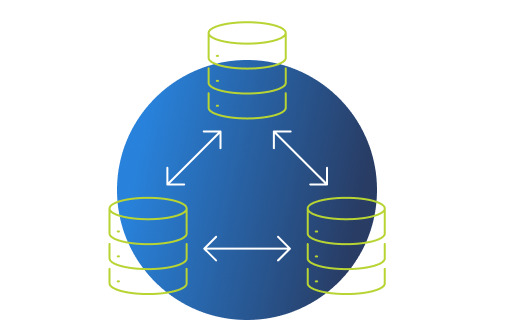
HyperStore is sold as software for standard servers and as integrated appliances. HyperStore 8 adds unified file and object access, useful for organizations whose old applications still expect SMB or NFS folders while newer tools expect buckets. HyperIQ watches health, capacity and operations. HyperCare adds support and optional remote management. Object Lock creates immutable copies for backup systems from partners such as Veeam and Rubrik, making stored data harder for ransomware to rewrite.
02 / The new wagerAI has a feeding problem
Cloudian's AI pitch begins with an unfashionable observation: a GPU without a steady stream of data is an expensive object warming the room. Training and inference systems repeatedly read source documents, vectors, embeddings, model checkpoints and results. Moving those assets through file gateways, memory layers and temporary high-speed tiers adds delay, power use and administrative work.
The company has been collapsing those layers. HyperStore supports NVIDIA GPUDirect Storage, designed to provide a more direct path between storage and GPU memory. Cloudian reported sustained throughput above 200 GB per second from one tested HyperStore configuration in 2024. In 2025 it paired storage with the Milvus vector database, so content can be indexed and retrieved for AI applications near where it is stored.
The larger move is HyperScale AI Data Platform, an integrated system built around NVIDIA accelerated computing, networking and enterprise AI software. It can ingest documents, create embeddings, run vector search and power retrieval-augmented generation in an on-premises environment. A packaged document assistant is the opening application; video analysis and other blueprints are expected to follow. In 2026, Cloudian said HyperStore achieved NVIDIA-Certified Storage status.
“It's easier to move the AI to the data than it is to move huge datasets.”Michael Tso, co-founder and CEO
This is where Cloudian sits in the market: below the chatbot and beside the GPU, competing to be the durable data layer. Its rivals include public object stores from AWS, Microsoft and Google; storage incumbents such as Dell, NetApp and IBM; newer data platforms including VAST and Pure; and software-led alternatives such as Scality, MinIO and Ceph. Cloudian's case gets stronger when a buyer needs S3 compatibility, local control, several sites, enterprise support and a path into public cloud at the same time.
03 / The buyerWho needs a private cloud in 2026?
Cloudian sells to the organizations that produce awkward data: hospitals with medical images, manufacturers with sensor streams, broadcasters with footage, banks with regulated records, governments with sovereignty rules, researchers with genomic files and retailers with giant analytics archives. MIT News reported that the company was helping about 1,000 organizations worldwide in 2025.
Named users include the U.S. National Library of Medicine, Osaka University, Belgium's Ziekenhuis Oost-Limburg and the Liverpool School of Tropical Medicine. One unnamed global retailer with more than 200,000 employees deployed a multi-petabyte Cloudian data lake across three data centers on HPE GreenLake for Splunk analytics. Cloudian said that installation cut storage cost by more than 50 percent compared with the retailer's traditional enterprise-storage alternative. Because the customer is anonymous and the comparison is vendor-reported, treat it as a case study, not a universal rate card.
04 / The billWhat does all this cost?
There is no useful public sticker price. Cloudian invites buyers to request a quote, and the real bill changes with raw versus usable capacity, flash or disk, replication or erasure coding, network design, support and the number of sites. Historic material advertised economics as low as half a cent to one cent per gigabyte per month, but those figures relied on particular hardware and protection assumptions. They are helpful as evidence of the pitch, not as a 2026 shopping cart.
The quote has more than one knob
The financial argument is not merely cheaper disks. It is predictable capital spending, fewer migrations between capacity and performance tiers, reduced public-cloud egress and a shared platform for backup, archive, analytics and AI. The counterargument is equally real: operating storage demands people, facilities, upgrades and careful capacity planning. Cloudian removes some complexity; it does not repeal infrastructure.
05 / The scar tissueWhat failed first - and what changed their minds
The predecessor's technology did not fail first. Its market did. Telecom carriers stopped approving new capital equipment during the financial crisis. Gemini had a concentrated customer base, long purchasing cycles and a product tied to discretionary expansion. That combination turned a macro shock into an existential event.
Two observations changed the founders' minds. Cloud computing was becoming the default way to rent infrastructure. At the same time, mobile data was growing faster than wide-area network capacity. The team concluded that enterprises would need cloud-style storage, but the bytes could not all make a cheap, instant trip to a distant public region. Their old messaging system had already proved they could distribute data under pressure. Cloudian became a new company, bought Gemini's assets and took venture funding where Gemini had been self-funded.
The experience also became culture. Tso teaches new hires the “three Ms” - my product, my client, my company - and the “three Hs” - hungry, humble, honest. The words risk sounding like lobby vinyl until one hears where they came from: the person who knew every engineer's skills also had to decide who would lose a job. At Cloudian, the slogan is supposed to remember the cost of being overconfident.
What a reader can steal
- Inventory the capability that survived the old market, not merely the features of the old product.
- Find the physical constraint customers cannot wish away. For Cloudian, data grew faster than networks.
- Adopt the interface buyers already use. S3 compatibility lowered the learning and migration burden.
- Make the boundary conditions explicit. Local control wins only when scale, sovereignty, latency or egress justify operating infrastructure.
This playbook would not work if Gemini's expertise had been too specific to telecom, if S3 had not become a broad standard, or if bandwidth and public-cloud economics had made data location irrelevant. It also does not grant Cloudian an automatic win in AI. Enterprises can choose managed cloud services, specialized parallel file systems or integrated platforms from much larger vendors. Cloudian must prove that combining object storage, vector retrieval and accelerated compute is simpler in production, not just tidier on a diagram.
06 / The verdictThe unglamorous layer gets interesting
Cloudian has spent more than a decade selling an argument whose vocabulary keeps changing. First it was private cloud, then hybrid cloud, then ransomware-resilient storage, then the data lake. Now it is sovereign AI. Beneath every label is the same wager: data accumulates faster than organizations can comfortably move it, and they will pay for one durable, S3-compatible place to keep it useful.
That consistency is a strength and a risk. The company has credible storage machinery, a network of partners and evidence that regulated, data-heavy customers value control. It also operates in a market crowded with public clouds, incumbents and open-source alternatives. The new AI platform stretches Cloudian upward, from the bucket into the application pipeline. If customers want packaged AI beside their private data, the move is logical. If they prefer to assemble the stack themselves or rent it by the token, Cloudian remains what it has long been: the quiet shelf beneath the noisy future.