A rocket launch is a short event with a long memory. At NASA’s Kennedy Space Center, cameras record what engineers will want to inspect after the applause has stopped. In Quantum’s account of an older imaging workflow, film had to travel out of state for processing. Getting a usable file took two days. The rocket, meanwhile, had been rather less patient.
The replacement joined Quantum’s StorNext storage to an IPV media catalog and an automated tape archive. New footage went onto disk; two archive copies were made; active files stayed handy while older material moved off the working tier. One tape copy was kept offline. The useful trick was making the images visible through the catalog wherever they lived.
- The job: store, find, share and protect large files that organizations cannot casually discard.
- The method: match working speed and long-term retention to different storage tiers.
- The customers: film crews, research institutions, government agencies and enterprise IT teams.
- The catch: cheap archive capacity still needs a retrieval plan.
This is a useful introduction to Quantum because its business is easily mistaken for a collection of boxes. It is better understood as a set of decisions about time. Which files must be available now? Which must remain available for years? What happens when the working copy disappears? A storage purchase becomes interesting once those questions stop having the same answer.
“It would take two days to get the film processed and available as a file.”
Jeff Wolfe, Abacus Technology
On the earlier Kennedy Space Center workflow
Give every byte a job
Quantum sells systems, software and services for unstructured data: video, images, audio, scientific datasets and other information that does not arrive neatly arranged in a database table. These files are often large, inconvenient to recreate and valuable long after their first use. The market includes people making television and people studying disease. Both can have excellent reasons to keep a file that nobody opened this morning.
StorNext handles shared access to large files, particularly streaming workflows such as editing and post-production. Its tiering capabilities connect working storage to other destinations. ActiveScale supplies S3-compatible object storage for repositories and data lakes. Scalar automates tape libraries. DXi reduces repeated backup data through deduplication. Each addresses a different part of the same organizational headache.
Conceptual tiers, not a prescribed configuration. A file can have copies in several places.
CatDV tackles the accompanying clerical problem. An archive full of unnamed or poorly tagged clips is a warehouse whose contents have lost their labels. The software catalogs assets, enriches metadata and orchestrates workflows, including AI-assisted tagging. Capacity answers “Can we keep it?” Cataloging answers “Can anyone find it?” Buying one does not settle the other.
Quantum also introduced Myriad, an all-flash, software-defined file and object platform, in 2023. It was built with technologies including Kubernetes and NVMe for demanding unstructured-data applications. The breadth matters: this is a company willing to sell fast flash and tape. The architectural argument is that their jobs differ.
The genome that outgrew the cupboard
Genomics England gives that argument a concrete shape. Its old network-attached storage held 21 petabytes and had reached its node-scaling limit. More capacity required a different design. Nephos Technologies assembled a performance tier using WekaIO, Mellanox networking and an ActiveScale object repository. The tiers could grow independently while presenting an integrated environment to researchers.
Quantum’s case study describes the object environment expanding from 40 petabytes to more than 100, with data distributed across three centers. It attributes a 75% reduction in storage cost per genome to Nephos. That is a reported result from this deployment, rather than a discount every buyer should expect. The revealing detail is the separation: working performance and long-term capacity no longer had to expand in lockstep.

Indexed to 100. Nephos reported a 75% reduction; this chart shows relative cost, not a disclosed purchase price.
There is a broader procurement lesson here. A capacity failure can be a design failure before it becomes a shortage of equipment. Ask what must scale together. If adding retained records forces an organization to buy performance it will seldom use, the invoice is quietly answering the wrong question.
A very modern job for an old medium
Tape is the amusing part of Quantum’s proposition. A technology associated with yesterday’s computing sits beside today’s discussions of AI. Scalar libraries use automation and management software to make cartridges part of an operational archive. Quantum offers capacity licensing that lets customers activate additional slots as requirements grow.
The attraction is a place to keep large volumes of infrequently used data without treating every retained byte as a live production workload. Tape can also support offline copies. That matters when a compromised online environment makes the supposedly convenient copy inconveniently unavailable.
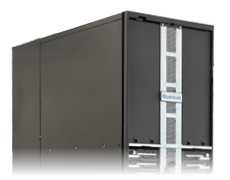 Scalar i7 RAPTOR
The tradeoff should be explicit. A tape archive is a poor place for the sole working copy of files that need immediate, unpredictable access. Retrieval involves the archive workflow and its available drives. Buyers should test actual recall times and simultaneous requests, rather than confuse a capacity figure with an access guarantee.
These are design considerations, not peculiarities to be wished away by a vendor. For a small collection with modest growth, a simpler service may be easier to run. For a large archive, the economics depend on retention duration, access frequency, staffing and the cost of moving data. “Cheaper per byte” is useful only after you know what those bytes must do.
The company had a storage problem of its own
Quantum began in 1980 with an eight-inch hard-drive design. It went public in 1982, sold its hard-drive business in 2001 and acquired ADIC in 2006. That acquisition brought StorNext, Scalar and deduplication technology into the portfolio. In 2020, it bought the ActiveScale business from Western Digital. The present company is the result of several deliberate changes in what it chooses to sell.
Its founder Dave Brown recalled people who “placed a high value on innovation.” Quantum’s careers material emphasizes collaboration and customer work. Those are the company’s own descriptions; the practical expression of its expertise appears in integration. At Kennedy, the exact system was configured and acceptance-tested before installation. When on-site performance differed, the team had a reference point for diagnosis.
The competitive field is crowded. Quantum names Dell/EMC, IBM and NetApp among enterprise storage rivals, with IBM and other suppliers competing in tape. Cloud services are alternatives too. Its distinction is the combination of file workflows, object repositories and archival systems, supported by a partner ecosystem. That is useful when the problem spans those layers. It is less persuasive when the buyer simply needs one uncomplicated place to put files.
Reported revenue, rounded. Products, service and subscription contracts, and royalties all contribute.
The business model combines equipment and software sales with support, subscriptions, services and royalties. It is enterprise procurement, with resellers and integrators often involved. A serious cost comparison includes implementation, networking, service coverage and the work of moving existing data. The hardware quote is the beginning of the arithmetic.
Quantum’s own arithmetic changed in June 2026. A private placement raised $100 million gross, led by funds managed by Two Seas Capital and Oaktree. Its subsequent quarterly filing reported approximately $94.6 million net proceeds and $57.8 million paid to extinguish term loans. Convertible notes also became equity. The transactions removed debt while changing shareholders’ ownership proportions.

The June quarter, reported as fiscal Q1 2027, produced $80.8 million revenue and $4 million adjusted net income. It also produced a $155.3 million GAAP net loss, primarily reflecting charges associated with restructuring the balance sheet. Both belong in the story. Improved adjusted earnings do not erase the reported loss, and the reported loss alone does not describe the quarter’s operating performance.
Before you buy another rack
Quantum’s September 2026 launch of Autonomous Data Management takes aim at the question that precedes the shopping trip: what data is actually here? The product assesses inactive, duplicated, outdated, orphaned and sensitive information, then applies configured policies to its management and placement. Its advertised role is continuing optimization rather than a one-time inventory.
The reader can copy the underlying discipline without buying the portfolio. Establish who owns the data. Agree how quickly each workload needs it back. Decide what must be retained and why. Test movement between tiers with representative files. Rehearse recovery, including the catalog and the permissions needed to use what comes back.
Storage vendors sell capacity. Organizations need continuity: the ability to return to a piece of work after its original moment has passed. Quantum’s useful idea is that preservation and speed can be purchased separately, then connected carefully. A file does not become worthless because it gets old. It may simply deserve a cheaper address.
Follow the files
Explore the systems, watch them at work, or follow the company’s next chapter.