The most revealing number in Spectra Logic's business is not 30 terabytes per LTO-10 cartridge, or the 294 petabytes its largest publicized installation can hold. It is 47 years. The Boulder, Colorado company has survived long enough to watch the personal computer arrive, the internet expand, the cloud eat corporate IT and artificial intelligence begin inhaling every dataset it can find. Through all of it, Spectra kept making machines that put files on tape.
That sounds stubborn until you meet its customers. Lawrence Livermore National Laboratory generates data behind some of the world's largest computers. ITV has decades of news, drama and sports footage. Universities have research files that grants or policy require them to retain long after the researcher has moved on. These organizations do not merely need storage. They need a memory system: economical enough to keep, open enough to migrate and detached enough that a compromised network cannot erase everything at once.
Spectra's wager is that cold data deserves infrastructure of its own. Flash handles the frantic present. Disk handles the working set. Tape handles the enormous, quiet past. Software is what stops that hierarchy from feeling like a museum.
01 / The jobSell the shelf, the robot and the map
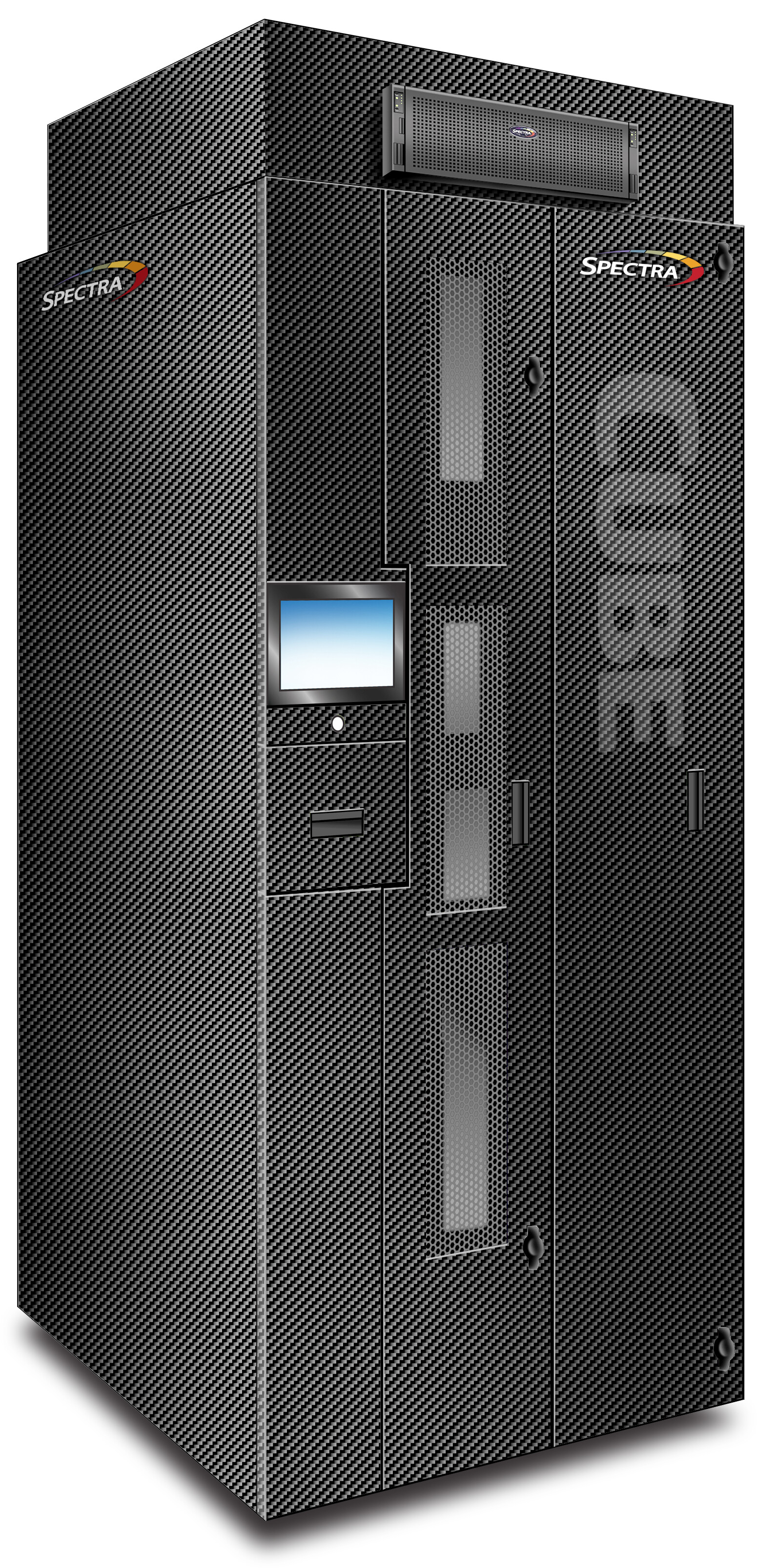
Spectra Logic is best known for tape libraries: cabinets filled with cartridges, drives and robotics that retrieve the right cartridge when software asks for a file. Its range stretches from the modular Spectra Stack through the Cube and T950 to TFinity Plus, built for multi-exabyte environments. These are not giant USB drives. They are automated warehouses where each box is a cartridge and the fork-lift is a precision robot.
The hardware is only one layer. BlackPearl Object Gateway gives applications an S3-like object interface and policies that can place data on flash, disk, tape or cloud. StorCycle scans file environments, identifies cold material and moves it to a cheaper tier while leaving a path back. BlackPearl Object Manager, formerly called Vail, coordinates objects across clouds and sites. Rio Media Suite is a subscription platform for broadcasters and production teams that need to archive and retrieve assets without turning every editor into a storage administrator.
That portfolio answers a simple objection to tape: nobody wants to operate it like 1997. Spectra's differentiation is not that it invented magnetic tape. IBM, Fujifilm and the LTO consortium drive the media technology. Spectra makes tape behave as one tier in a modern storage system, surrounded by object protocols, policies, catalogs, monitoring and migration services.
Lawrence Livermore shows what this looks like at the far end of the scale. Its computing operation has archived information since 1967, and some of that material is classified and retained indefinitely. The laboratory's public case study describes a 23-frame TFinity system with 128 IBM tape drives, 19,575 slots and capacity for up to 294 petabytes uncompressed. The installation replaced older library hardware and delivered at least 50 percent greater media density. Floor space matters when the neighboring supercomputers change every few years.
The part most buyers can copy is less photogenic: plan the migration before the old platform becomes an emergency. LLNL treats archive upkeep as continuing backend work, not a ceremonial box checked once a decade. New media generations pack more bytes into the same footprint, but someone must move those bytes, validate them and keep the namespace coherent. Spectra's interchangeable library architecture and support for multiple tape technologies are meant to make those transitions less disruptive.
A practical data-temperature map
The bars show the kind of capacity each tier is suited to hold, not benchmark results. The trick is moving data before expensive primary storage becomes a retirement home for unopened files.
02 / The breaking pointThirty petabytes, exposed
At the University of Utah's Center for High Performance Computing, the failure came first and the purchasing logic followed. Disk hardware had failed in the past. Meanwhile, roughly 30 petabytes of research data lacked a reliable archive. Senior IT architect Sam Liston described most of it as “flapping in the breeze.” The group needed a second copy, geographic separation and a price that did not simply duplicate its primary-disk bill.
“Now, I sleep easier at night knowing that our data is backed up in a Spectra Logic tape library.”Sam Liston · University of Utah CHPC
The university installed a Cube library, a BlackPearl Nearline Object Gateway, an OSW-2400 optical SAS switch and eight LTO-9 drives. Its public case study reports storage at $7 per terabyte, along with lower power use and support for the 3-2-1-1-0 backup discipline: three copies, two media types, one off-site, one offline and zero unverified errors.
What changed the team's mind was not tape nostalgia. It was arithmetic plus a scar. When primary disk had already demonstrated that it could fail, the upfront cost of a separate tape system looked different. Long retention made the operating economics matter more than the initial inconvenience. The reported $7 figure is a customer result, not a universal price list; staffing, software, capacity, refresh cycles and building costs can move it sharply.
03 / The reinventionOld media, new interfaces
ITV offers another useful before-and-after. Its legacy archive relied on Sony DigiBeta cassettes and a third party to deliver content for broadcast. The first thing to fail was not necessarily the tape. It was the workflow: slow retrieval, extra handling and dependence on an outside service were poor fits for distributed creative teams working against news and sports deadlines.
ITV moved to replicated archives across two sites, each combining a BlackPearl gateway with a T950 library. The environment stores about 30 petabytes on LTO and IBM TS media. Applications talk to an object interface; production teams can find and reuse material; the underlying cartridges can be refreshed across tape generations. A supposedly old medium remains underneath, but the operating experience no longer begins with a courier and a cassette label.
This is where Spectra fits in the market. Public-cloud archives are easy to begin using and difficult to predict at scale once retrieval, egress and long retention enter the spreadsheet. Disk appliances deliver quicker access but consume power continuously. Tape lowers media and energy costs for cold material, yet demands workflow planning and periodic migration. Spectra sells the integrated middle: its own libraries and gateways, software that decides placement, and services that help customers move without losing the catalog.
04 / The businessA private company that sells permanence
Nathan Thompson founded the business in 1979, at 19, while studying engineering at the University of Colorado. It began as Western Automation, acquired the assets of an interface company and took the Spectra Logic name in 1993. Thompson remains chairman and chief executive. The company is privately held and does not publish funding, valuation or audited revenue. A third-party estimate supplied with this profile puts annual revenue near $98 million and headcount around 380, but those figures should be treated as approximate.
Its model mixes capital equipment with recurring revenue: libraries and gateways, software licenses and subscriptions, certified media, maintenance, support and professional services. Channel partners extend its reach. A 2025 agreement made Fujifilm India a distributor. Integrations with Cohesity, NetApp, Arcitecta and a long roster of backup and media applications reduce the risk that a customer must replace its entire toolchain.
Cost comparisons require more honesty than a neat price-per-terabyte chart usually allows. Tape asks for drives, robotics, software, support and people who understand the archive. Cloud asks for monthly capacity charges and may add retrieval, request and data-movement fees. Disk asks for powered racks, cooling and periodic replacement. Tape's advantage grows when utilization is high, retention is long and retrieval is modest. Below that threshold, the operational simplicity of cloud or disk can be worth paying for.
Geyser Data changes the purchasing shape more dramatically. Their tape-as-a-service offering lets a customer buy archive capacity without installing a library, hiring specialists or accepting the whole capital expense at once. In March 2026, the partners announced a live London deployment, their first European provider location. It is a sensible response to tape's biggest commercial weakness: the economics improve with scale, but not every buyer wants the machinery required to reach it.
05 / What to stealDesign for temperature, not fashion
The copyable idea is not “buy tape.” It is to classify data by temperature and consequence. How quickly must this dataset return? How often is it actually opened? How painful would deletion be? How long must it survive? Teams routinely pay premium prices because those questions were never asked. A storage analyzer can identify files untouched for three years; an archive policy can then move them while preserving the catalog and a retrieval route.
A second lesson is to separate the interface from the medium. ITV's applications do not need to think in reels and cartridges. They request objects. That abstraction lets the archive underneath span disk, tape and cloud, and it makes future media migration less disruptive. A third is operational humility: archives are living systems. Cartridges age, formats advance, catalogs need protection and restores need testing. Buying a large cabinet once is not preservation.
It tends to work when…
- Data is measured in petabytes
- Retrieval is infrequent and predictable
- Retention runs for years or decades
- An offline copy improves cyber resilience
- The team can plan media migrations
It tends not to work when…
- Every request needs millisecond latency
- The dataset is small enough that simplicity wins
- Retrieval patterns are volatile
- No one owns catalog integrity or restore tests
- Upfront infrastructure cannot be justified
Nor is an offline cartridge magical ransomware armor. If the management plane, credentials or online copies are compromised, a poorly designed archive can still disappoint. Recovery depends on tested procedures, clean catalogs, multiple copies and people who know how to restore under pressure. The air gap is one control, not an absolution.
The market is crowded with credible alternatives: IBM and Quantum libraries, HPE tape systems, disk archives from enterprise vendors, public-cloud cold tiers and do-it-yourself stacks. Spectra's case is strongest when scale is large, retention is long and customers want one vendor to connect the robot to the object interface. It is weakest when convenience today matters more than economics over a decade.
06 / The long gameThe future keeps producing a past
AI makes Spectra's old argument newly relevant. Training, simulation and scientific instruments create torrents of data, but only a fraction stays hot. In 2025, the Texas Advanced Computing Center selected TFinity Plus libraries for the archive behind its Horizon supercomputer, planned at exabyte scale. The same year, Spectra brought LTO-10 support across its library portfolio, raising native cartridge capacity to 30 terabytes.
There is a pleasing irony here. The more futuristic the computer, the larger its past becomes. Someone must preserve the checkpoints, observations, training corpora and finished work that no longer belong on its fastest storage. Spectra Logic has spent nearly five decades waiting at that handoff. Its machines are not glamorous. They are where glamour goes when the project is over and the data still matters.