The earliest sales pitch for VAST Data came with a peculiar condition: the potential customer first had to promise not to hear it. Jeff Denworth would approach an organization, explain that his new company had something it could not disclose, and ask for a signed nondisclosure agreement. Only then could the conversation begin. The product was still being reasoned into existence. The company was in stealth. The proposition, even by the extravagant standards of enterprise technology, was large: perhaps the old bargains of the data center were not laws after all.
Denworth was the commercial outlier in a small room of systems thinkers. The architects spent roughly a year considering what the product ought to become over the next decade. He was the only person focused on taking that thinking outside. Before VAST surfaced publicly in 2019, he says the team spoke with about 300 to 400 organizations. It is an arresting number because customer interviews rarely survive the polishing of a founder myth. They look like administration. In this case, they were part of the invention.
His task was translation, but not the decorative sort. Distributed systems are difficult to photograph and still harder to buy on charm. Their advantages live in avoided compromises: less copying, fewer tiers, lower latency, a smaller bill, one less anxious operator at 2 a.m. Denworth had to turn an architecture into consequences, then carry the objections back to the people designing it. The bridge moved traffic both ways.
Act IAn apprenticeship in unfashionable machinery
Long before generative AI made data infrastructure dinner-table adjacent, Denworth was making a career among the boxes and file systems underneath computing. He began in business development at memory specialist Dataram in 1999. In 2004 he moved to Cluster File Systems, the company associated with Lustre, the open-source parallel file system built for the sort of workloads that make ordinary computers seem pleasantly idle. He joined DDN in 2006, first in platform solutions and then as vice president of marketing, working across high-performance computing, large-scale data and business development.
The long road to “AI infrastructure”
At CTERA, where he became senior vice president of marketing in 2014, the scenery shifted toward cloud services and enterprise file data. The through-line remained unglamorous and durable: where information sits, how it moves, what it costs to keep, and how a business makes it useful. His résumé became a compressed history of the field. Memory hardware gave way to parallel file systems, then high-performance storage, then cloud data services. AI did not interrupt that path. It enlarged the problem at the end of it.
Denworth studied marketing at The College of New Jersey, then still called Trenton State College. In a speaker biography, he joked that he completed the five-year course in less than five years, and helpfully clarified that the school was not affiliated with Trenton State Prison. The line is characteristic. Infrastructure prose can become a penal colony of acronyms. He prefers to leave a joke in the exercise yard.
“The original name of VAST Data was Random Reads. Terrible name, right?”Jeff Denworth, writing in 2024
Act IIThe name that knew where the company was going
Random Reads was indeed a terrible name, though it had the virtue of honesty. It described a performance pattern. It did not describe a destiny. The founders replaced it with VAST, a blend, Denworth has explained, of fast and big. More revealingly, they chose VAST Data rather than VAST Storage. The distinction supplied years of runway.
The original technical mission was sharp enough: make flash economical at enormous capacity and remove the tiered-storage pyramid that organizations had learned to tolerate. Fast data lived on expensive media; colder data descended through slower, cheaper layers. VAST proposed one tier. In Denworth’s blunt early formulation, the goal was to kill the hard drive. The ambition was not speed for its own sake. It was to keep much more data near the applications that might learn from it.
That argument arrived as deep learning began rewarding larger datasets. An architecture designed around capacity, efficiency and scale found itself beside a new class of appetite. Timing did not replace engineering, but it gave the engineering a plot. Denworth’s experience helped him see the pairing: interesting technology alone does not create disruption, and an application shift without supporting machinery stalls. Put the two together and a market may open.
VAST launched in 2019. The story widened by increments. Universal Storage became a broader data platform, with database services and an event-driven data engine entering the picture. It was not a sudden pivot so much as a noun fulfilling its early promise. Denworth described the approach plainly in 2023: keep a long-range view, then build toward it rather than trying to build Rome in a day. Grand architecture, small masonry.
Act IIIFrom a place for data to a system that acts
By 2026, Denworth was speaking about “continuous AI.” The phrase sounds as though a machine has discovered espresso, but his meaning is practical. Modern AI does not live in one clean episode called training, followed by a separate event called inference. Data arrives. Models respond. Their actions produce new information. Context accumulates. Agents call tools and one another. The loop continues, and each handoff between a storage system, database, stream processor and search index introduces delay, copies and its own idea of truth.
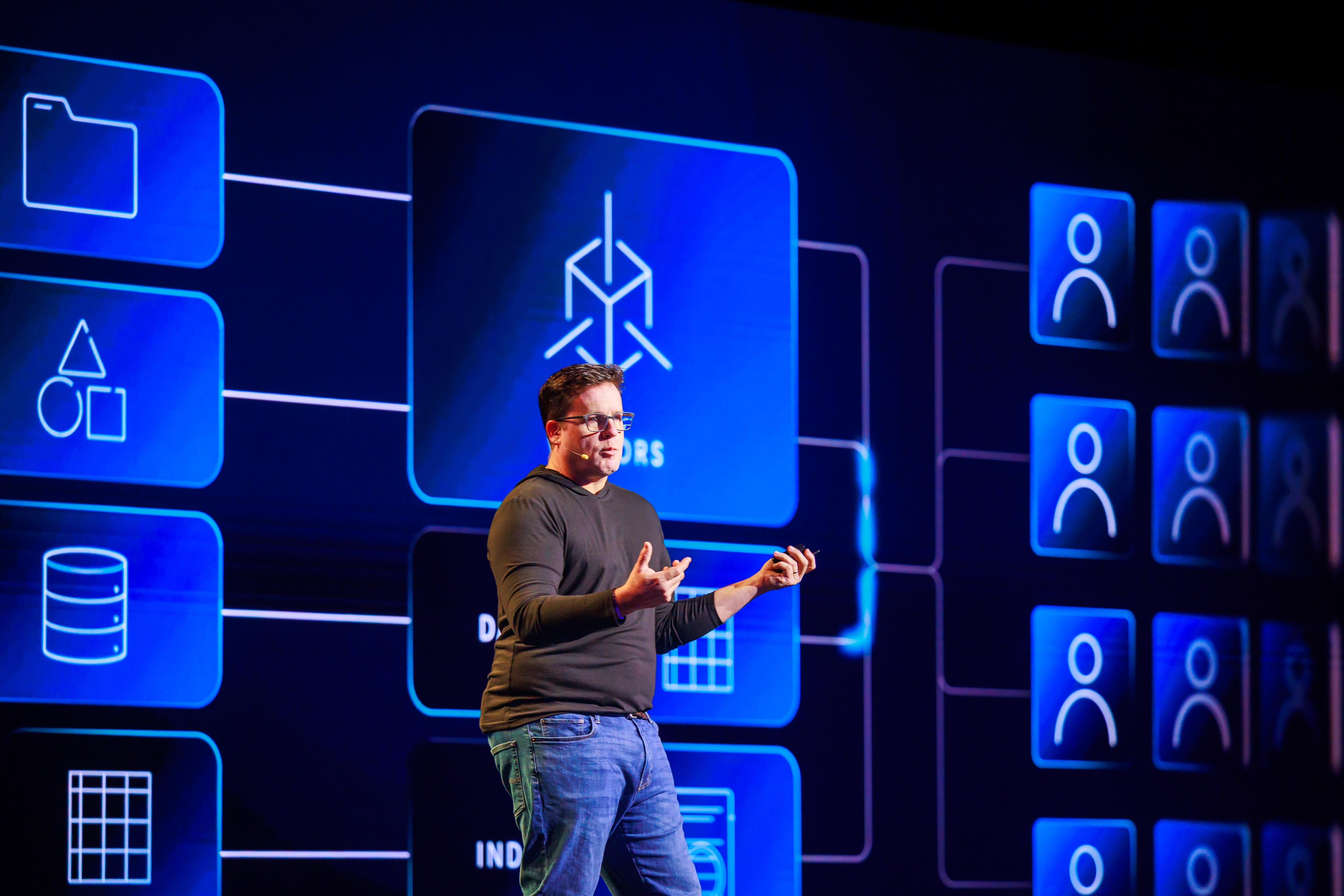
The continuous system Denworth describes
His public argument is that the boundaries should collapse. Computation should move closer to data. Events should trigger functions as they happen. Policy should govern every interaction inside the flow rather than arrive later as ceremonial paperwork. It is a much larger claim than “buy our storage,” yet it grows from the same discomfort with tiers and disconnected tools.
The corporate scorecard grew too. In April 2026, VAST announced a financing transaction of roughly $1 billion at a $30 billion valuation, alongside more than $4 billion in cumulative bookings and over $500 million in committed annual recurring revenue. Denworth wrote the company’s account of the milestone. He also noted, with the odd anti-theater of a business that says it is generating cash, that the new money would join earlier rounds in the bank. Fundraising was presented less as oxygen than as ballast.
Valuation is a market’s opinion on a date, not a personality test. The more useful measure of Denworth’s role is continuity. In the early days, he carried an unshowable system into conversations under NDA. Years later, he stood onstage with a luminous diagram, explaining how data, computation and agents might become a single operating loop. The diagram was more elaborate. The work was still to make invisible machinery feel consequential.
The public voiceA promoter who keeps the technical nouns
Denworth calls himself a “shameless promoter” in his X biography, alongside “Music Lover, Proud Papa and Lucky Husband.” The self-description disarms the usual suspicion attached to marketing. Yes, he is selling. He would also like to tell you exactly how the cache works. Professional recommendations describe a similar mixture: a deeply technical operator with a salesperson’s anxiety and an instinct for closing.
His style can be playful. Employees become VASTronauts. A blog post about write performance borrows its title from New Kids on the Block. When a program began reusing SSDs extracted from legacy systems, he asked whether the result should be called “Power(ed_by_)VAST.” The jokes do not conceal the machinery. They give an audience somewhere to stand while looking at it.
There is also a social detail that fits the customer-interview origin. In 2021, newly arrived in Austin, he explained that many VAST colleagues in Texas had joined during the pandemic without meeting anyone in the company. He had made it a goal to meet them. “Where we can make the personal touch we try to,” he said. For a man who sells enormous distributed systems, proximity retains its uses.
The bridge between an architecture and a market is built from questions before it is built from slogans.
The VAST story can be told through its valuations, its architecture or its customers. Denworth’s version is more revealing when read as a long apprenticeship. Each job gave him another dialect in which to discuss the same stubborn material: data at scale. When the AI boom arrived, he did not have to discover infrastructure. He had to explain why an old specialty had become a central concern.
That may be his most distinctive achievement. He has helped a deeply technical company keep two clocks at once. One measures the decade-long destination. The other measures the next useful release, the next customer objection, the next comprehensible sentence. Ambition likes the first clock. Companies survive by respecting the second.