The least glamorous component in an AI server may be the one quietly arguing with its most expensive component. A GPU wants data immediately. The CPU is busy. The network is fast enough to make every wasted cycle visible. Chelsio Communications has spent more than two decades designing cards and chips for precisely this quarrel. Its answer is blunt: stop asking the host processor to do so much traffic work.
From a low building in Sunnyvale, with a design center in Bangalore, the privately held company makes Ethernet adapters, SmartNICs, storage controllers and data processing units. These devices do not merely pass packets. Depending on the model, they can process TCP/IP, iSCSI, NVMe over TCP, RDMA, encryption, virtualization and traffic management before the work lands on the server CPU. Chelsio calls the architecture “Unified Wire,” a name that sounds like a cable and behaves more like an argument for consolidation.
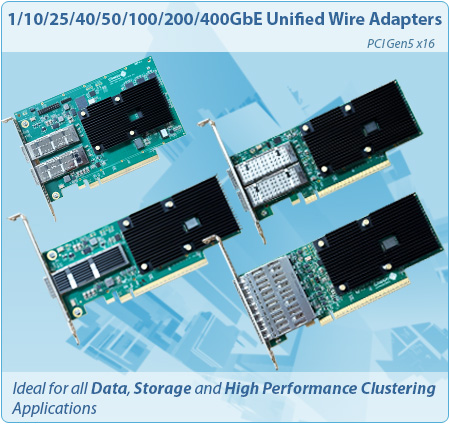
The July 2026 version of that argument is its seventh-generation AI Interconnect Platform. It ranges from S7 SmartNICs to T7 storage controllers and programmable DPUs, supports Ethernet speeds through 400Gb, and targets AI training, inference, cloud systems and disaggregated storage. The headline number is large. The more interesting promise is continuity: Chelsio says T7 can run software written for its T4, T5 and T6 generations without modification.
A traffic cop with a silicon résumé
A normal network interface card moves bits between a machine and a network. A Chelsio card is hired for a longer shift. It can place data directly into memory, execute protocol work, steer flows, encrypt traffic and accelerate storage access. That is useful when a server is moving so much information that processing the movement consumes resources meant for the application.
The offload bargain
The earliest customers were not prompt engineers. They were server makers, storage vendors, supercomputing centers and financial firms chasing low latency. Chelsio controllers have appeared in Netflix Open Connect storage and flash appliances. Dell shipped its adapters with Storage Center arrays. IBM developed a long OEM relationship around clusters and servers. Microsoft storage configurations used Chelsio iWARP for SMB Direct, Storage Spaces Direct and replication.
That customer list explains why the company talks about protocols the way a diner talks about sauces. It supports both iWARP and RoCEv2 flavors of RDMA, plus NVMe/TCP, NVMe over Fabrics, iSCSI, TLS, IPsec and conventional Ethernet. The bet is not that one protocol wins. The bet is that a buyer values one adaptable device while the argument continues.
The link gets faster. The CPU bill arrives.
What failed first was not necessarily the wire. It was the assumption that general-purpose CPUs could absorb an ever-growing protocol workload for free. At modest traffic levels, software networking is flexible and entirely sensible. At sustained high throughput, the host starts spending cycles on packet handling, data copies, interrupts, storage protocols and encryption. Faster links expose that tax.
Chelsio's first commercial era was 10Gb Ethernet, and the timing was awkward. In 2006, CEO Kianoosh Naghshineh acknowledged that the market had been “a long time coming.” Competitors were funded, iWARP was still proving itself, and customers could not always be produced on demand. The failure was a schedule: adoption did not match the industry's early excitement.
“Now's the time when people start placing their bets.”Kianoosh Naghshineh, during the 2006 Series D
Chelsio did not answer the delay with a dramatic pivot. It widened the usefulness of the same core idea. Early TCP offload gained storage, RDMA, virtualization, packet filtering and cryptography. The company moved from 10Gb to 40Gb, 100Gb and now 400Gb, while software accumulated around the silicon. What changed its market was not a sudden change of mind so much as the world generating workloads large enough to care.
The Terminator staircase
Hardware prices are visible. Integration costs are not.
Chelsio makes money the old-fashioned infrastructure way: it sells chips, adapter cards, cables and supporting software through OEMs, distributors, direct sales and an online store. Its public store makes part of the cost unusually concrete. At research time, a two-port 10Gb server-offload adapter was listed at $412; a half-size 40/50/100Gb Unified Wire card was $2,782. The newest T7 and S7 systems require sales quotes.
T520-SO-CR, a two-port 1/10GbE server-offload adapter listed online.
T62100-CR, a two-port 40/50/100GbE Unified Wire adapter listed online.
The card price is only the cover charge. Buyers also calculate driver support, qualification, cables, switches, engineering time and failure risk. Chelsio's counterargument is that offload can reduce CPU requirements and consolidate LAN, storage and cluster traffic onto Ethernet. The exact savings depend on workload; a card cannot rescue a system whose bottleneck is somewhere else.
The company itself was expensive to build. Contemporary reports describe an $11 million first round, $19 million more in 2002, $25 million in 2005, $12 million in 2006, $25 million in 2008 and $17 million in 2009. That is $109 million across the reported major equity rounds. The capital financed silicon cycles, drivers, interoperability and a sales channel during a market that matured slowly. Chelsio remains private, and no reliable public valuation is available.
04 / The differenceOne lineage instead of a drawer of accelerators
Chelsio competes with far larger portfolios: NVIDIA's ConnectX and BlueField products, Intel Ethernet adapters and IPUs, AMD Pensando, Broadcom and Marvell. Conventional NICs plus host software remain the simplest alternative. For some AI and HPC systems, InfiniBand is the other architecture in the room.
Its differentiation is unusually specific. Chelsio offers stateful, multi-protocol offload; supports both major Ethernet RDMA approaches; leans heavily into storage; and keeps one Unified Wire software lineage across multiple product generations. The T7 range also splits neatly by job. S7 SmartNICs use host memory for cost-sensitive deployments. Storage controllers add dedicated acceleration. DPU variants add programmable Arm cores and on-card memory for custom or compute-independent work.
The latest AI positioning follows naturally. Training clusters repeatedly synchronize accelerators and pull data from storage. Inference systems care about latency. Both can waste costly compute while data waits. Chelsio wants Ethernet to remain the common fabric and its card to handle congestion, placement and protocol chores. SmartNICs and storage controllers were available at the July launch; production DPU availability was scheduled for December 2026, so that part of the platform was still an evaluation story.
What another builder can steal
- Find a bottleneck customers pay for indirectly. Chelsio sells cards, but its pitch is reclaimed CPU time.
- Make upgrades respect old integration work. Compatibility from T4 through T7 reduces the fear around new silicon.
- Bundle around the customer's job, not an internal feature chart. Networking, storage and security travel together in real racks.
- Publish repeatable proof. Infrastructure buyers want throughput, latency, CPU utilization and exact test conditions.
When the clever card is the wrong card
Offload is not a universal tax refund. It works when protocol processing is material, traffic is sustained, latency matters, or the same Ethernet fabric must carry several kinds of work. It is especially legible in storage arrays, busy cloud servers, GPU clusters, content-delivery appliances and high-frequency trading systems.
It will not pay when the network is lightly used, an application is limited by storage media or business logic, or a basic NIC leaves ample CPU headroom. It can also fail organizationally: a specialized adapter without the right operating-system driver, firmware process, monitoring or staff familiarity becomes a very expensive green circuit board. Teams that depend on a proprietary fabric feature or an unsupported cloud instance cannot offload their way around availability.
That restraint is what makes Chelsio interesting. It is not selling magic. It is selling a place to move work when the host has more valuable things to do. AI has made that trade newly fashionable, because idle GPUs turn microseconds into dollars with unusual efficiency.
Chelsio enters this round with roughly 120 employees, more than 200 reported OEM platform designs and a product family spanning 10Gb cards still sold online to 400Gb hardware aimed at new clusters. Its size is a vulnerability beside the chip giants. It is also the reason the company's focus feels almost comically pure. Seven generations later, the thesis has barely changed: let the CPU compute. Let the network card earn its slot.
Go deeper