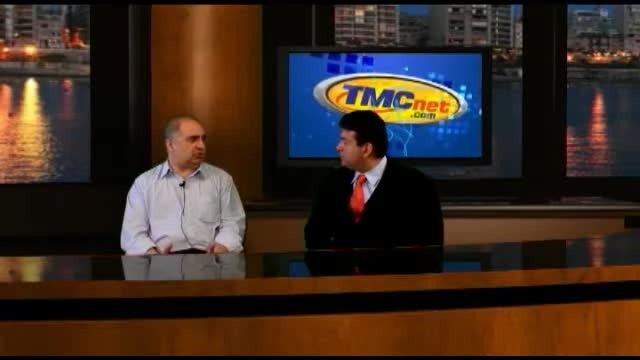
The curious thing about the future is how often it arrives dressed as an old bottleneck. In 2010, Kianoosh Naghshineh sat beneath the polite glare of studio lights in San Jose and explained that solid-state storage was moving the choke point back to the network. Disks were losing their mechanical pause. Servers were gaining cores. Virtualization was making one machine behave like many. The pipe between them all, he argued, would have to work harder without conscripting the CPU into traffic duty.
Sixteen years later, the expensive objects have changed. GPU clusters now dominate infrastructure conversations, and a processor waiting for data is a particularly costly form of still life. Yet Naghshineh's answer remains recognizably the same: use Ethernet, make the adapter smarter, and perform protocol work where it can be done without stealing cycles from the application.
That answer has occupied most of his professional life. As founder, president and CEO of Chelsio Communications, he has carried it from early 10 Gigabit Ethernet cards to a seventh-generation platform supporting 400Gb links, SmartNICs, storage controllers and data processing units. Trends kept changing their names. His architecture kept finding fresh employment.
A career spent deciding where the work belongs
Naghshineh's education put him on the electrical side of computing: a bachelor's degree in electrical engineering from Cornell, followed by a master's in the same discipline from Stanford. There is an unexpected line in the Cornell record. During the 1980-81 season, he appeared on the wrestling roster as a 142-pound freshman, listed from Tehran and Cleveland Heights High School. Before the protocols and patent diagrams, there was apparently time on the mat.
At Advanced Micro Devices, he worked in product engineering and in analog and digital circuit design for fiber distributed data interface networking. A patent filed in 1990 bears his name on a TTL-to-CML translator circuit, a device concerned with converting signals while limiting noise. The vocabulary is specialized, but the preoccupation is already familiar: get information across a boundary cleanly and efficiently.
The later patent trail reads like a slow zoom outward. One invention dealt with flow control inside a multiprocessor computer. Another reduced the overhead of direct-memory-access transfers between a host and an adapter. Chelsio-era filings described network interface controllers with packet buffers, several external connections and an optional forwarding engine. Across the documents, the unit of concern grows from a transition at an output pin to the coordinated movement of packets through an entire system. The recurring question is not simply how fast a component can run. It is how little needless work the surrounding machine must perform.
He later became one of the primary architects of Silicon Graphics' Origin supercomputer. Origin was a machine built around scale, shared memory and the problem of keeping many processors coherently connected. Naghshineh then led ASIC Designers Inc., an intellectual-property company supplying silicon cores to communications-system makers. By the time he founded Chelsio in 2000, he had worked at the level of circuits, systems and reusable chip design. The new company combined all three.
“This is the one bet we made early on - to invest in all the areas.”Kianoosh Naghshineh, 2010
One wire is easy to say
Chelsio called its idea Unified Wire. Data centers had accumulated separate paths for ordinary network traffic, storage and high-performance computing. Each path brought its own adapters, switches, management and expertise. Chelsio proposed running those jobs concurrently over Ethernet, while its silicon handled TCP, iSCSI, RDMA and other protocols away from the host processor.
The economics were as important as the circuitry. In that 2010 interview, Naghshineh ticked through the hoped-for result in almost shopkeeperly terms: fewer switches, fewer gateways, fewer software licenses, less power and fewer people required to tend separate fabrics. Technical elegance is pleasant. A lower bill that keeps working is persuasive.
The difficult part was breadth. Storage buyers, virtualization teams and cluster operators had different reasons to care, and convergence becomes rather pointless if only one constituency converges. Naghshineh called the strategy “an all-or-nothing type of a thing.” Chelsio invested across the categories, earning some revenue from each while waiting for the rest of the data center to catch up.
The company shipped a 10GBASE-CX4 copper adapter in 2004, promoted iSCSI and TCP offload, worked with operating-system vendors, and won placements in systems including HP Integrity servers. In 2009 its adapters connected Purdue's Coates cluster, announced at the time as the largest 10Gb Ethernet cluster and the largest iWARP installation. Each deployment made the same argument in a different accent: familiar Ethernet could carry more responsibility.
Even Chelsio's product names betray an appetite for consolidation. An adapter was expected to be a network interface, a storage accelerator and a cluster interconnect at once. Later generations added traffic management, packet filtering, virtualization and encryption. This is not minimalism in the chip-design sense; the silicon does more. It is minimalism one level up, where the operator sees fewer boxes, fewer special-purpose networks and fewer reasons to interrupt a running system. Naghshineh's pitch has always lived at both levels. The chip grows more elaborate so the data center can become less so.
The virtues of not starting over
Network speeds rise by replacing a number with a larger number, but customers inherit everything attached to the old one: drivers, firmware, applications, qualifications and habits. Naghshineh has repeatedly emphasized compatibility across generations. Chelsio's pitch is not merely that the next adapter runs faster. It is that software investment can travel with it.
That matters because silicon operates on an awkward calendar. A chip can take years to design and validate. A data-center standard can take years to settle. Once products ship, customers expect them to survive workloads that are less forgiving than a launch demonstration. The founder's job becomes a peculiar exercise in patience: anticipate the bottleneck, build before demand is obvious, and avoid making yesterday's customers pay for tomorrow twice.
10GbT5 era
40GbT6 era
100Gb2026
400Gb
His public comments have the temperament of an engineer keeping one eye on the invoice. Performance is discussed alongside power. Features travel with cost of ownership. Open standards matter because customers want choice, but also because a familiar switching fabric can prevent a forklift upgrade. Even the romance of supercomputing is translated into throughput, latency and utilization.
The recurring bottleneck: faster storage and more compute create more traffic; protocol processing consumes host resources; offload returns those resources to the workload. The applications change, but the loop remains.
AI gives the old thesis a new bill
By 2024, Chelsio's language had expanded to Kubernetes, cloud-native networking, NVMe over TCP, edge computing and AI. The company joined the Cloud Native Computing Foundation as a Silver member. It showed a T7 DPU designed to accelerate storage without a separate CPU. It launched an updated Unified Storage Server, then brought the seventh-generation architecture into focus.
In July 2026, Chelsio announced an AI Interconnect Platform across three product families: SmartNICs for cloud and AI deployments, storage controllers, and programmable DPUs for networking, storage and security. The architecture supports native 400Gb Ethernet, both iWARP and RoCEv2 forms of RDMA, NVMe/TCP, iSCSI, congestion management and crypto acceleration. Some products were immediately available; production DPUs were scheduled for December.
Naghshineh framed T7 as a standards-based alternative for AI interconnects. This is a commercial position, naturally, but it is also the straight continuation of the original bet. Open Ethernet supplies the common fabric. Dedicated silicon absorbs protocol and data-path work. Compatibility protects the accumulated software. The GPU is new. The instinct to spare the host is not.
“With T7, we are positioning Ethernet as a scalable, standards-based AI interconnect.”Kianoosh Naghshineh, 2026
A hundred years, give or take ninety
The end of the 2010 interview offers a small glimpse of the person inside the architecture. Naghshineh said Chelsio had turned profitable in the previous quarter. Then, with the cheerful overreach permitted to founders and weather forecasters, he announced, “We're going to be here another hundred years.”
The interviewer congratulated him and said he felt fairly comfortable about the next five or ten. The remaining ninety, he admitted, were harder to see. Both men laughed. It is a better exchange than a solemn speech about resilience. Semiconductor businesses already contain enough gravity.
Chelsio has not yet completed the hundred-year test. It has, however, completed something more useful than a slogan: more than a quarter-century of revisiting one technical premise without freezing it in time. The company moved from TCP and iSCSI offload to virtualization, flash storage, cloud-native systems, cryptography and AI. It kept the wire and changed what the silicon could do around it.
Naghshineh's story is therefore less about predicting a single future than recognizing a durable pressure. Compute grows. Storage accelerates. Applications distribute. The data between them asks to move, and the cost of moving it never disappears. Somewhere in that gap sits a network card, quietly applying for a larger job.