WhiteFiber had a problem that sounded almost insulting. It could buy powerful AI chips. It could put them in a data center. But getting them to work together meant confronting something less glamorous: the network. In its published account, earlier Ethernet alternatives struggled with packet loss, congestion, and inconsistent job performance. The arithmetic of AI was being interrupted by traffic.
- DriveNets separates networking software from the hardware beneath it.
- AT&T put its routing platform into production; WhiteFiber uses its AI fabric.
- The practical goal: more useful work from infrastructure you already paid for.
That is a useful place to begin with DriveNets, the Israeli company founded by Ido Susan and Hillel Kobrinsky in 2015. Its product lives between things people recognize: internet connections, servers, GPUs. Its proposition is easier to understand through the inconvenience it removes. A fast computer is a disappointing purchase when it keeps waiting for another fast computer.
The traffic jam between the chips
WhiteFiber’s account describes an attraction to InfiniBand, a widely used interconnect for demanding computing, alongside concerns about cost, multi-tenancy, and vendor dependence. Ethernet offered compatibility and choice. Yet choosing Ethernet did not automatically produce dependable performance. The network needed to behave like a coordinated system when many machines demanded attention at once.
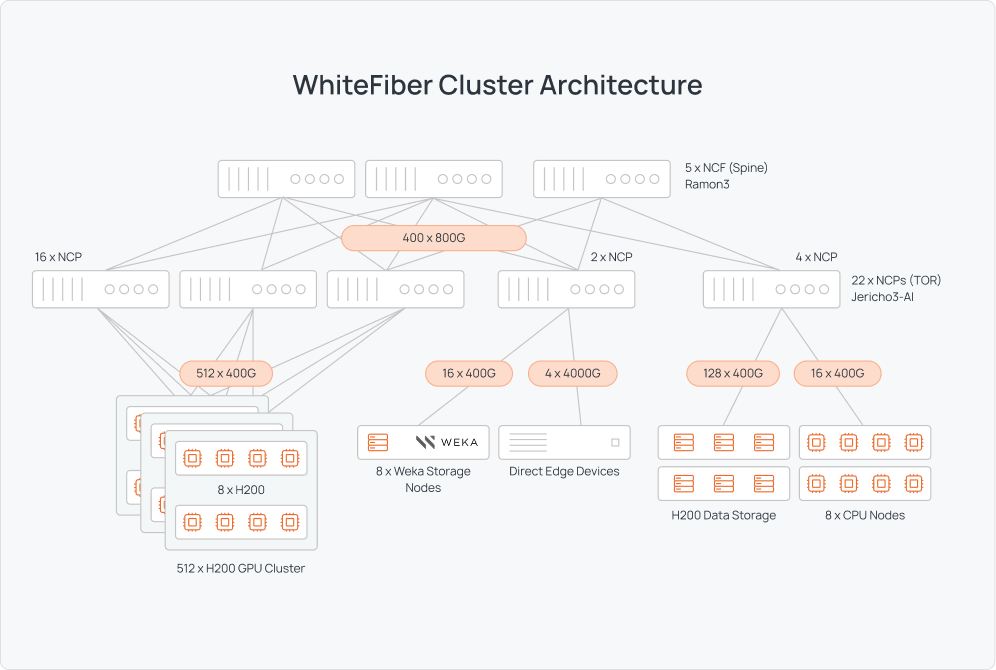
DriveNets supplied Network Cloud-AI, now marketed as AI Fabric. WhiteFiber combined it with HPE systems, NVIDIA H200 GPUs, and storage infrastructure. What changed was the traffic arrangement: a scheduled fabric coordinated movement through the network. The customer’s description of earlier trouble matters because it supplies a concrete reason for changing architecture. Nobody needed another abstract promise about openness.
Take the box apart
DriveNets arrived at AI through telecom routing. Network Cloud separates routing software from hardware and runs on standard white boxes: network equipment built around commercially available silicon. Software brings multiple components together as a logical system. Capacity can grow by adding building blocks, rather than treating one enclosed chassis as the boundary of the network.
The founders already understood the buyers. Susan had co-founded Intucell, acquired by Cisco for $475 million. Kobrinsky had founded Interwise, acquired by AT&T in 2007. Both had worked inside the organizations that a new networking supplier must persuade. That background helps explain their market knowledge; it does not, by itself, explain why customers deployed the product.
The stronger evidence arrived in September 2020, when AT&T’s core deployment became public. In March 2025, AT&T also documented DriveNets software in a 1.6-terabit-per-second optical transport trial over 296 kilometers. The test involved Broadcom-based white boxes and Ciena optics. The achievement belonged to a working chain of technologies, with DriveNets handling routing functions.
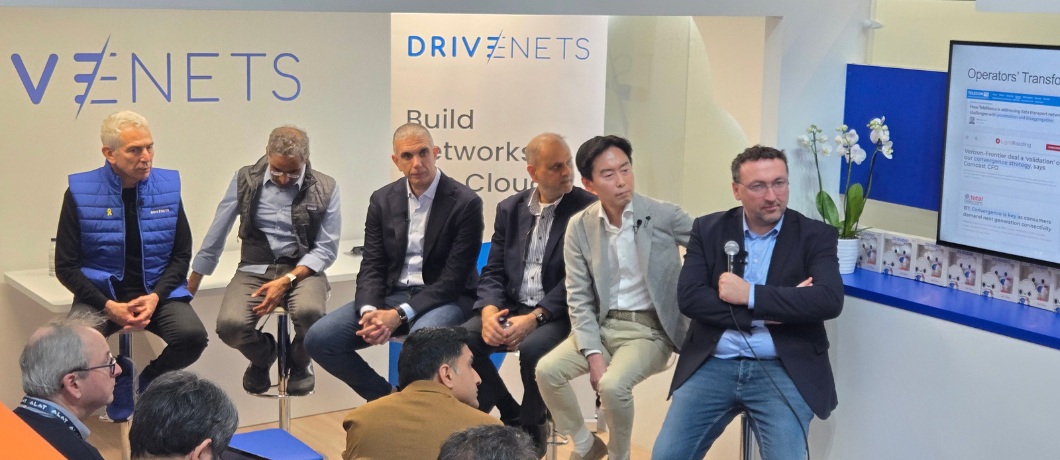
Comcast announced an expansion of its Janus trial with Network Cloud in March 2025, following an Atlanta trial in 2024. KDDI is another named operator. In October 2026, NEC Networks & System Integration announced delivery of DNOS-powered white-box routers to OPTAGE’s edge network in Japan. Its support included validation, design, and phased migration. Taking the box apart creates choices; somebody still has to assemble the system.
A timetable for Ethernet
DriveNets introduced its AI networking offering in 2023. The connection to telecom is architectural: separate components, coordinate them, and make the whole useful at scale. In scheduled fabric, packets become fixed-size cells whose passage through the internal fabric is coordinated. Endpoints retain Ethernet connections. WhiteFiber describes the shift as controlling congestion inside the fabric instead of reacting after trouble develops.
send work
FABRIC
coordinate traffic
receive data
Standard Ethernet at the endpoints. Scheduling inside the fabric.
WhiteFiber reports 97.5% peak bandwidth in its H200 case study. Read that as a result from a particular customer configuration, not a guarantee for every cluster. Storage, software, workload, and tuning remain part of the experiment. A network benchmark becomes much more interesting when it explains how the customer’s actual job behaves under load.
The next experiment stretches the system geographically. WhiteFiber, DriveNets, and WEKA reported linking H200 clusters at sites 52 miles apart, with 111.2 Tbps bandwidth and a 0.9-millisecond round trip. That opens an intriguing possibility when power availability limits one facility. Distance still imposes latency, however. A connected supercluster needs workloads that can tolerate the journey.
A customer becomes an investor
There is an unusual financial detail in AT&T’s 2025 annual report: a $620 million investment in DriveNets, described as a strategic partner in wireline network transformation. A customer buying into a supplier is evidence of a relationship with consequences. It does not tell us what a router deployment costs, or whether another buyer will achieve the same economics.
Series A includes its extension. Customer investment is separate.
DriveNets’s June 2026 Series D raised $410 million, led by Bessemer Venture Partners and Atreides Management, with AMD among the new investors. The company described total capital raised as $1 billion and said it had been cash-flow positive since 2025. A stated use for the new money was inventory: the physical equipment pipeline now matters alongside software development.
Buy useful work
DriveNets sells to operators and infrastructure builders, through software, networking platforms, and deployment and optimization services. Network Cloud has been marketed under a SaaS model. Its alternatives include integrated routing systems and, in AI, InfiniBand and competing Ethernet fabrics. The choice depends on operational skills, supported hardware, and the workloads being connected.
The lesson a reader can copy is a purchasing discipline: measure useful work before buying more components. Compare job completion time, utilization, and total operating cost under representative load. Include storage and software tuning. When compute or storage is the bottleneck, replacing the network may accomplish little. Open equipment also needs validated combinations and a workable support arrangement.
“The most expensive idle asset in the world right now is a GPU waiting on the network”
Ido Susan · CEO and co-founder
Susan’s line is a sales pitch, but it points to a sensible question. Before ordering the next rack of GPUs, find out what the current rack is waiting for.
Follow the connections
Explore DriveNets, its newsroom, the AMD architecture, and WhiteFiber’s cluster account.
Watch the WhiteFiber deployment webinar, operator panel, or DriveNets on YouTube. Follow LinkedIn, X, Facebook, and GitHub.