He Already Built
Two Networking Revolutions.
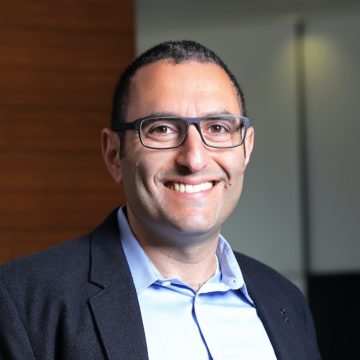
By the time Arista Networks went public in 2014 at a $4 billion valuation, Mansour Karam had been there for eight years - joining as the company's first business-side hire when the product was still being sketched out. He spent those years sitting next to early customers, writing down what they actually needed, and helping ship something that would eventually upend Cisco's data center dominance. He didn't found Arista. But few people alive understand better what it takes to build a networking company from nothing into something the industry can't ignore.
That apprenticeship left a mark. When Karam co-founded Apstra in 2014 - the same year Arista crossed the $4B finish line - he wasn't chasing the next cycle. He was solving a problem he'd been watching pile up since 2006: network management was still essentially hand-coded, error-prone, and divorced from intent. Apstra changed that. It introduced the concept of "intent-based networking" to the industry vocabulary, and built software that let operators say what they wanted the network to do rather than how to configure every switch to do it. Seven years later, Juniper Networks acquired Apstra - and Karam went with it, becoming GVP of Products for Juniper's Data Center division.
Most executives who land at a large company after selling their startup don't last long. The physics are wrong: you went from controlling everything to controlling one org chart box. Karam stayed long enough to understand that Juniper's scale and sales motion couldn't move fast enough for what was coming next. By October 2024, he was out the door and co-founding again - this time with Subhachandra Chandra, his CTO, who had his own career at Arista. The company they built: Aria Networks.
The name is not accidental. Karam plays piano. An aria is a solo vocal performance, typically the emotional centerpiece of an opera - technically precise, dramatically expressive, and built around a single voice carrying the whole room. That's the energy he wanted. Three "A" companies in a row - Arista, Apstra, Aria - and he'll tell you he's noticed the pattern too.
The problem Aria is built to solve is deceptively simple to state. GPU clusters used to train and run large AI models are only as useful as their weakest link. That link, increasingly, is the network connecting them. When one switch port gets congested, GPU utilization tanks - and GPU time is measured in dollars-per-hour at a scale that makes the math brutal. Aria's pitch is that a 1% improvement in Model Flop Utilization - the metric for how hard the GPUs are actually working - can offset the entire cost of its network infrastructure. A 10% gain in tokens per second is a 10% gain in revenue for an AI cloud operator.
Getting there requires what Aria calls Deep Networking: a combination of hardware switches built on Broadcom Tomahawk ASICs, a SONiC-based network operating system with proprietary enhancements, and a telemetry layer that captures data at 100 to 10,000 times the resolution of traditional network tools. The switches matter, but the telemetry is the product. Karam has been making the case since the company's launch that end-to-end path optimization - seeing and responding to congestion across the whole cluster in microseconds - is what separates Aria from anyone else selling Ethernet switches to AI data centers.
The investors who funded Aria's $125M Series A are not bet-hedging. Sutter Hill Ventures, Atreides Management's Gavin Baker, Valor Equity Partners, and Eclipse Ventures are writing conviction checks. Baker joined the board alongside Stefan Dyckerhoff from Sutter Hill. The April 2026 launch of Aria's Deep Networking platform - commercially available, generally released - marks the point where the company stops being a thesis and starts being a product.
Karam grew up with a background that spans continents: he studied Computer and Communications Engineering at the American University of Beirut before crossing to Stanford for his MS and PhD in Electrical Engineering. His doctoral research under Professor Tobagi touched multimedia networking and Internet telephony - foundational work for the era of packetized everything. He graduated into a networking industry that was just beginning to feel its own weight, joining Routescience in 2000, where his work on the product helped lead to an acquisition by Avaya. Then Arista. Then Big Switch Networks during the SDN wave. Then Apstra. The line is not straight, but it is unbroken: every stop was infrastructure, every stop was early, every stop was before the crowd arrived.
His Twitter bio cuts through the resume: "tech entrepreneur, investor, father, husband, insatiable reader, piano player." That last one keeps surfacing. There's something about a person who plays piano that makes you believe they understand patience - the discipline of practicing something that doesn't work until suddenly it does, the knowledge that getting the phrasing right requires attention to things other people skip over. Networking, at its hardest, is the same: invisible infrastructure that only gets noticed when it fails.
Mansour Karam has spent 25 years making sure it doesn't fail. Now he's betting that the AI era is the moment when finally, the network stops being the forgotten footnote and starts being the story.