There is something deliciously inconvenient about the idea of boiling liquid beside an expensive processor. We associate boiling with a pan left unattended. Accelsius asks data center operators to regard it as good engineering. Inside its NeuCool system, a dielectric refrigerant absorbs heat at the chip, turns into vapor, travels to a condenser and returns as liquid. The troublesome bubbling is doing useful work.
- NeuCool cools CPUs and GPUs directly with a phase-changing refrigerant.
- Accelsius sells equipment plus the engineering and service needed to use it.
- Its opportunity lies in dense AI computing; its test is dependable operation at scale.
That distinction matters because the AI conversation tends to stop at the processor. Buying faster silicon also buys a heat-removal obligation. Accelsius occupies the less glamorous territory between computing ambition and the equipment that must keep it running. A cooling decision can determine how much of that ambition fits inside a building.
A small change of state, a large change of habit
NeuCool is direct-to-chip cooling. Cold plates sit on processors, and refrigerant moves through a contained loop. The servers remain servers, rather than becoming specimens submerged in an immersion tank. Heat changes the fluid’s state instead of merely raising its temperature. The condenser then passes that heat to the facility’s heat-rejection system.
Liquid refrigerant returns to the chip. Facility heat rejection completes the job.
“Waterless” needs careful geography. There is no water in NeuCool’s server cooling loop, but a facility water loop can still carry heat away. Accelsius and OptiCool have also described an architecture that keeps water outside the IT white space. The distinction is useful: protecting electronics and reducing facility water consumption are separate design questions.
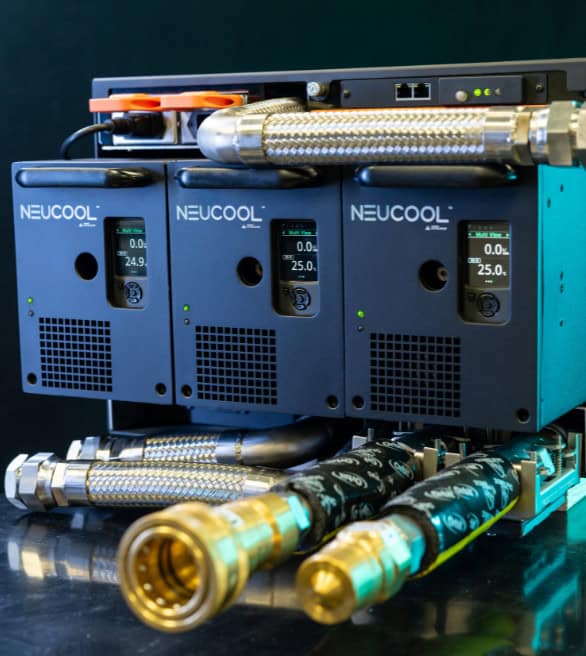
The laboratory needed a pump
The technology came from Nokia Bell Labs. Innventure formed Accelsius in 2022 to develop and commercialize it, arranging patent and know-how rights from Nokia. That gave the new company a scientific starting point. It still had to make a product that could be manufactured, installed and maintained.
One revealing change appears in Innventure’s filings: the original passive two-phase technology became an active, pumped solution suited to volume production. That documented evolution is more interesting than a tidy invention myth. The commercial version had to answer questions about circulation, packaging and repeatability as well as heat transfer.
By 2024, NeuCool was being introduced commercially. The subsequent product range widened the unit of deployment. The MR250, announced in October 2025, supplies 250kW of liquid cooling capacity. The IR150, generally available in April 2026, combines up to 150kW of cooling, 42U of IT space and built-in manifolds in an 800mm-wide enclosure.
The price is in the plumbing
Accelsius sells to enterprises, colocation operators, AI infrastructure providers and other organizations with demanding computing workloads. Its business includes hardware, site assessment, integration, deployment and ongoing service. NeuGuard adds limited warranty options. Cooling buyers are purchasing an operating arrangement whose weakest maintenance procedure may matter as much as its thermal performance.
“Our partners are more than a force multiplier at Accelsius; they are our lifeblood and our route to market.”
Josh Claman · Accelerate partner program announcement
The partner channel brings server integrators and infrastructure providers into that arrangement. Redundant pumps, automatic switchover and hot-swappable components address the practical fear behind liquid cooling: what happens when something needs attention while the computers are still earning their keep? Expertise here includes field service and supply chains, alongside thermal science.
The useful public cost comparison concerns a whole cooling architecture. In a Jacobs 10MW Austin reference design, defined cooling capital costs were approximately $10.38 million for either approach. Modeled annual operating costs were $1,043,799 for single-phase and $678,640 for two-phase. Five-year ownership cost fell from about $15.60 million to $13.77 million, roughly 12%.
35% lower modeled annual OpEx. A Jacobs reference design, not a product quote. Defined cooling CapEx excludes some facility piping, pumps and supporting infrastructure.
Those figures reward attention to scope. They describe a modeled site and specified equipment, rather than a universal discount on running a data center. Climate, electricity prices, existing infrastructure and maintenance assumptions affect the calculation. A purchasing team can copy the method: compare complete designs over years, including the work required to keep them healthy.
A campus is a promise; a technician is a test
In November 2025, DarkNX agreed to use NeuCool across a planned 300MW AI campus in Ontario. Its announced first phase comprised two 65MW facilities, with deployments scheduled for 2026 and 2027. DarkNX cited warmer facility water and efficiency benefits alongside Johnson Controls chillers. The announcement describes a commitment and schedule; it does not establish that 300MW is already running.
Industrial backing followed. Accelsius announced a $65 million Series B in January 2026, led by Johnson Controls with Legrand participating, after a $24 million Series A announced in 2024. The money was earmarked for manufacturing expansion, international growth and product deployment. John Hewitt was named CEO in May 2026; founding CEO Josh Claman became executive chairman.
A smaller August announcement makes the adoption story tangible: an IR150 at EdgeConneX’s Houston Global Training Center. Technicians can practice deployment and service in a working learning environment. Familiar hands are part of the infrastructure. A design that looks persuasive on a specification sheet still needs people who understand its behavior.
Try the heat before buying the computers
Accelsius offers a Thermal Simulation Rack for testing cooling without committing expensive AI servers to the experiment. Its Kickstart trials and newer HyperStart program similarly make evaluation an explicit stage. The practical lesson is to rehearse thermal loads, installation and maintenance before multiplying the deployment.
The comparison remains competitive. Alternatives include ZutaCore’s two-phase approach, single-phase direct-to-chip systems, immersion and air. Accelsius reported third-party B200 testing in July 2026 across roughly 40,000 operating points, with a 9°C junction-temperature advantage under tested warm-water conditions. That finding makes the case for investigating warmer facility water, rather than guaranteeing an identical result for every server.
For modest heat loads, the economics may favor existing cooling. For dense racks, server compatibility, external heat rejection and service arrangements need checking together. Accelsius’s appealing proposition is that these questions can be answered before the processors arrive. The bubbles are the easy part. Making them ordinary is the business.