Thirty minutes after the backup generators started, something went wrong. A Malaysian data center had already lost utility power during extreme weather. Now its emergency generation had developed an abnormality. For an operation built around uninterrupted service, this was an uncomfortable time to discover a second problem.
EPG’s account of the incident, in its 2025 ESG report, describes a cross-functional response team, spare parts mobilized urgently, and technical guidance delivered across borders. The issue was resolved within 2.5 hours. Then came the quieter work: monitoring, a review, training, and better documentation. The repair mattered. So did making the next repair less dependent on improvisation.
- EPG Engineering System is a Malaysian M&E engineering company within the wider EPG group.
- The group packages generators, electrical equipment, cooling, and IT infrastructure into factory-built modules.
- Its proposition is earlier integration and testing, followed by local installation and support.
- The practical lesson: treat the connections between systems as seriously as the systems themselves.
This is a useful place to begin a company profile about AI. The fashionable part of the industry speaks in models and tokens. The infrastructure underneath speaks in transformers, pumps, fire approvals, and the whereabouts of a replacement part. It is considerably harder to charm a generator than a venture capitalist.
A Malaysian company with a much larger family
EPG Engineering System Sdn. Bhd. was incorporated in Malaysia in August 2022. A recruitment notice published through Southern University College the following year placed its office in Iskandar Puteri, Johor. The role was M&E project engineer: plan and supervise construction, read drawings, coordinate customers and subcontractors, manage equipment, observe local regulations, and hand over the work.
That job description supplies a useful antidote to the vagueness of “engineering solutions.” Here, engineering means making a complex construction project happen in the right order, with the right materials and a record of who is responsible. The notice asked for Chinese, English, and Malay language skills. A drawing may be universal; a site meeting usually is not.
The company belongs in the wider EPG story. EPG lists it among its Malaysian businesses, alongside EPG Data Center Module and Vireon Global Services. The group dates its own founding to 2004 and has an overseas headquarters in Singapore. Those two histories should be kept straight: a Malaysian legal entity established in 2022 operates within a business whose experience reaches further back.
The factory becomes part of the construction site
EPG’s history begins with mechanical and electrical trade and develops into backup-power integration. Its corporate timeline records a Rolls-Royce strategic agreement in 2017 and entry into modular data centers in 2021, when it established a prefabrication plant in Shanghai’s Jinshan district. Malaysia’s first plant followed in 2023.
The power relationship has substance beyond a logo on a presentation. Rolls-Royce announced an agreement with an EPG company for around 200 MTU diesel systems in 2019. In 2021, it reported a letter of intent under which EPG planned to procure another 300. An agreement and a letter of intent are different commitments, but both show how deeply power equipment sits in the group’s background.
Modular construction changes where integration happens. Electrical equipment can be wired and tested in a factory before shipment. Pipes, cable trays, controls, and supporting structures can be assembled into repeatable packages. On site, the work moves toward positioning modules, making planned connections, and completing commissioning. The attraction is fewer unfinished decisions arriving with the equipment.
- 01DesignAgree loads and interfaces
- 02Build + testIntegrate in the factory
- 03DeliverMove complete modules
- 04CommissionConnect and verify on site
Conceptual sequence based on EPG’s published delivery approach.
That is the group’s positioning against conventional construction with separately sourced equipment. EPG offers all four principal module families. The commercial argument rests on how well it joins them together, and how consistently it can repeat that work across projects.
Four boxes, a great deal of plumbing
The generator module brings together diesel generation, exhaust, cooling, fuel supply, and auxiliary equipment on a steel base. EPG lists a typical range of 1,000-2,000 kilowatts per unit. The power module handles the electrical backbone: medium- and low-voltage equipment, transformers, switchgear, uninterruptible power supplies, and busbars.
The cooling module is a family of systems rather than a single appliance. Chillers, pumps, heat exchangers, pipelines, and air-conditioning equipment support air cooling, liquid cooling, or a mixture. The IT module brings racks, cabling, monitoring, and associated infrastructure into prefabricated spaces or skids. It supplies the setting in which the customer’s computing equipment operates.
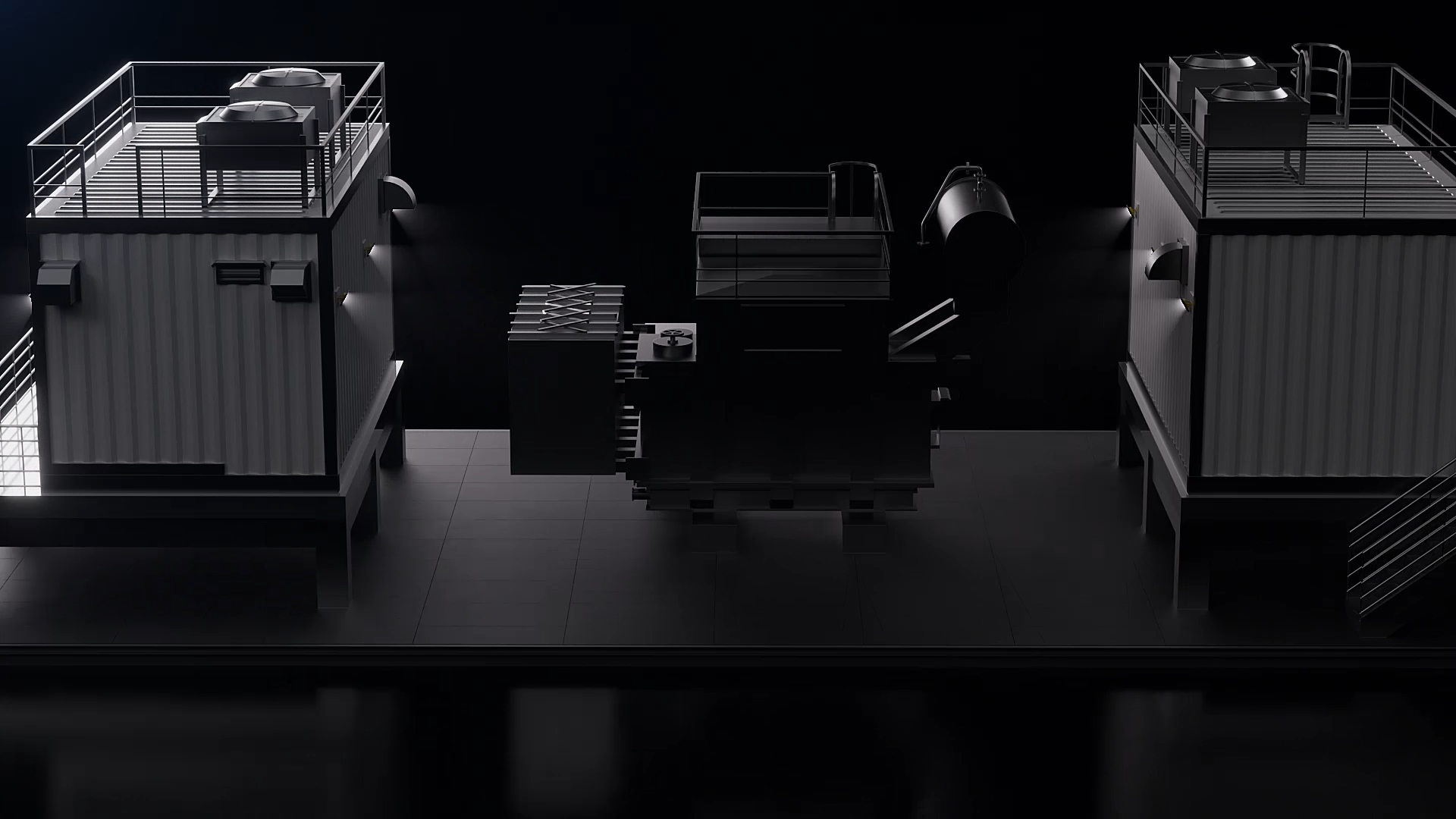
A published AI reference design combines four IT containers, 16 high-power server cabinets, and approximately two megawatts of IT load. That is a configuration, rather than evidence that every customer buys the same thing. EPG offers alternative power and cooling arrangements to suit different requirements.
Its hybrid cooling design is particularly revealing. For GB200 NVL72-class racks, EPG describes cold plates removing about 75-80% of the heat load, with air cooling handling the remaining 20-25%. Liquid cooling does not dismiss air from the premises. Both still have jobs.
EPG reference-design heat split for GB200 NVL72-class racks; actual performance depends on configuration.
The price of making it repeatable
EPG sells to organizations building and operating data centers: cloud and hyperscale providers, AI infrastructure customers, and developers. Its group history names relationships with Alibaba, Tencent, and GDS. Its public case studies describe unnamed Southeast Asian projects ranging from a 20MW-plus power-module assignment to 60MW-plus integrated M&E delivery.
The business is project-based. Customers can procure modules, integrated engineering and delivery, and professional support. A proposal depends on computing load, redundancy, cooling, and site conditions. There is good reason for that specificity: two facilities with identical IT capacity may require quite different electrical architectures and thermal systems.
For the related EPG Data Center Module facility at Senai Airport City, on a 25.54-acre site. Manufacturing investment, rather than a customer’s data-center price.
Scaling this approach requires physical capacity. Senai Airport City’s developer reported the RM360 million investment when the Malaysian facility broke ground in March 2025. At group level, EPG announced nearly US$100 million in Series B financing in January 2026, followed by more than US$100 million in Series B+ in March. The latter named Decarbonization Partners and Alibaba Cloud among its backers.
Those financing announcements belong to the group. So does its report of more than 200MW in prefabricated module deliveries during 2025, including its first full-scope project, a facility exceeding 60MW. For the Malaysian engineering company, the significance is its position inside an expanding delivery system with factories, technical teams, and regional support.
Five cabinets make a useful beginning
In April 2026, EPG’s Malaysian manufacturing center reported delivery of five lithium battery energy-storage cabinets under a contract for 42. Its account divides the work clearly: the Malaysian team handled integration, installation, wiring, and local execution; Shanghai supplied technical and production support.
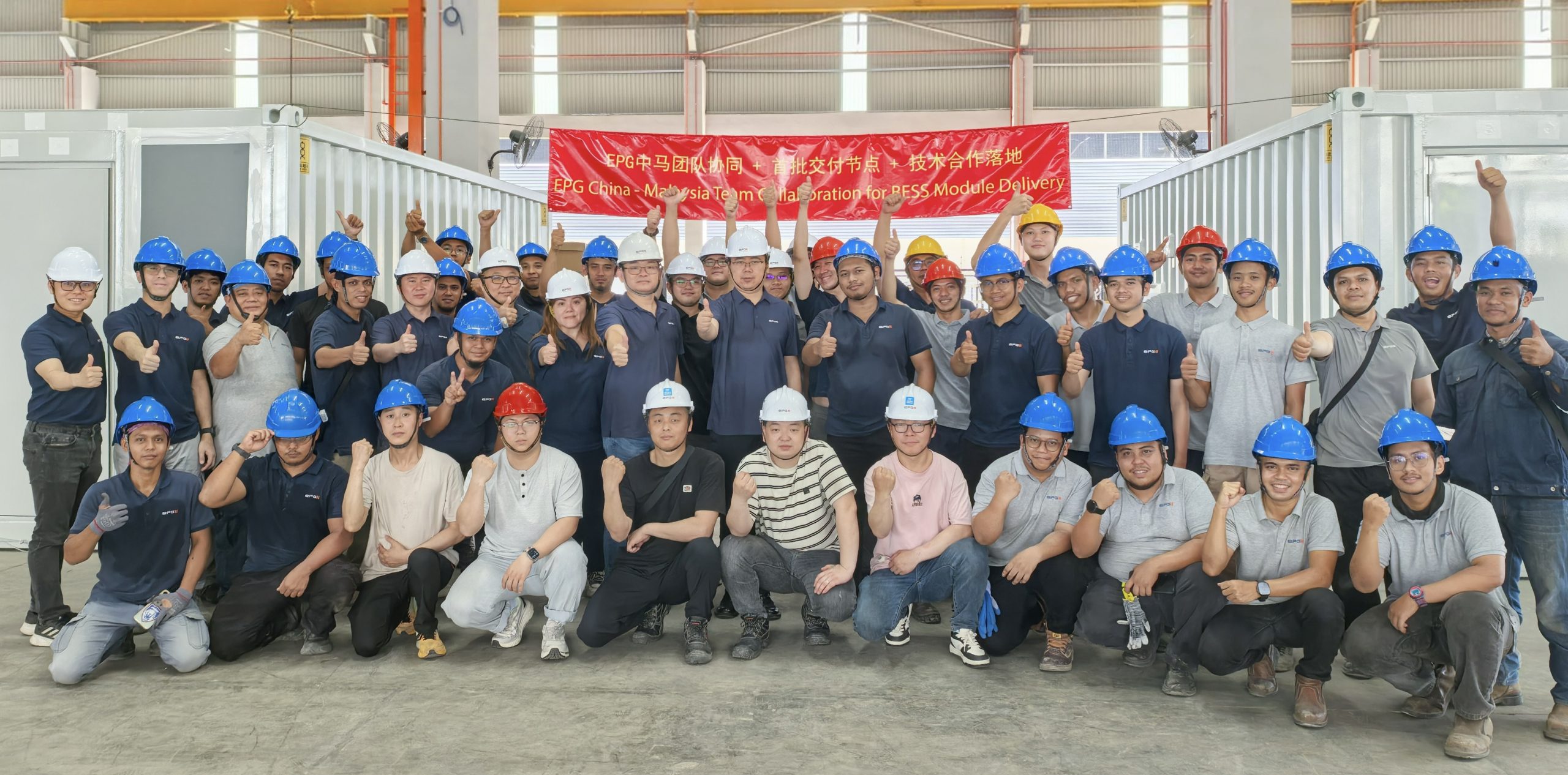
The transferable idea is straightforward. Make the first delivery produce an operating method as well as equipment. Record the interfaces, establish responsibility, test the sequence, and turn what the team learns into instructions another crew can use. EPG describes the cabinet project as a standardized overseas delivery pathway. The ambition is sensible; subsequent batches are where it earns its keep.
Local capability extends beyond production. EPG reported opening a Chonburi service center in May 2026 for technical support, project coordination, supplier collaboration, and customer service. Its reported Malaysian BOMBA approval for containerized products also illustrates that a modular system must pass through a country’s regulatory machinery before it can serve the customer.
The connections are the business
The Malaysian power emergency brings the story back to earth. Utility power failed first. The generator abnormality followed. EPG’s response joined people, technical knowledge, spare parts, and communication across borders. The post-incident work strengthened monitoring and procedures. Buying redundant equipment and organizing a dependable response are related tasks; neither makes the other unnecessary.
“In the AI era, competition goes beyond computing power to delivery speed and energy efficiency.”
Alick Wan · EPG group founder and chairman · March 2026
For a prospective customer, the useful questions concern interfaces and evidence: what has been tested, which connections remain for the site, who handles commissioning, and how support works when equipment misbehaves. Factory prefabrication is most persuasive when requirements are stable enough to engineer early and the site is ready to receive the result.
It cannot supply a missing utility connection, grant a permit, or make an awkward transport route disappear. Changes made late can also erode the value of advance assembly. These are practical boundaries of the method, and they help explain why EPG needs local engineering alongside manufacturing.
EPG Engineering System occupies that meeting point. AI may begin with an ambitious specification. Somewhere in Johor, someone must read the drawing, coordinate the subcontractor, and verify the handover. The cloud owes a surprising amount to people who know which connection to check next.