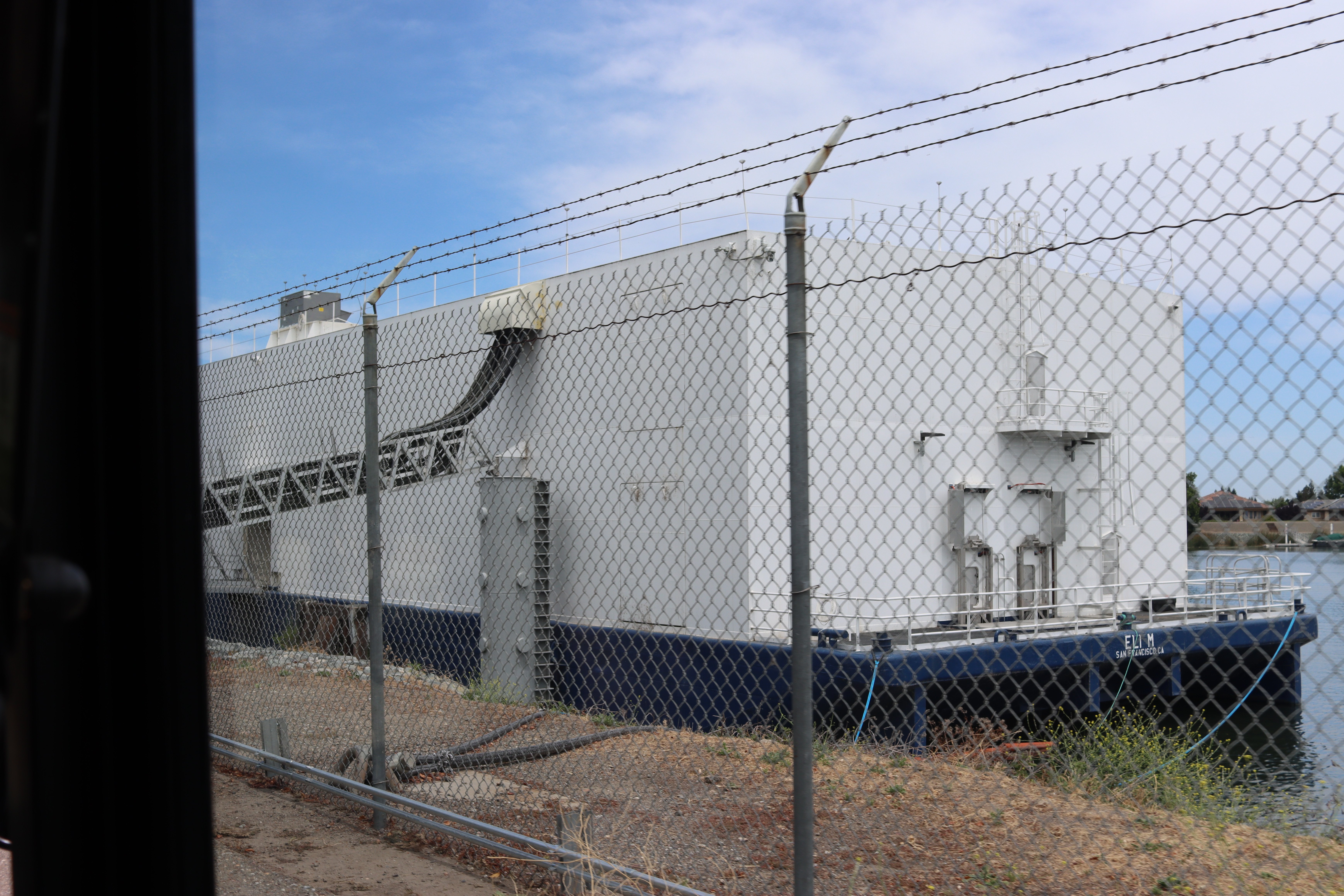
The first Nautilus data center was hard to miss. It arrived in Stockton, California, on a barge: a white, boxy building with server rooms above a steel hull and the San Joaquin River beside it. For a business whose usual buildings prefer to disappear behind fences, the thing was almost theatrical. But the spectacle distracted from the serious experiment below deck. Could a data center move heat through water, avoid evaporative cooling towers and run reliably enough for paying customers?
The story in five points
- Nautilus began with a Navy linked marine prototype and commissioned its Stockton barge in 2020.
- The barge became a working test bed for water-based cooling under real customer loads.
- EcoCore now sells modular cooling infrastructure for AI and other dense data halls, on land as well as near water.
- Start Campus in Portugal is a named deployment; Backblaze and Cerebras have used the Stockton facility.
- Project prices are private. The public $100 million figure was a debt facility for Stockton and other projects, not the barge’s price tag.
Arnold Magcale founded Nautilus in 2013. A Navy veteran with data center experience, he assembled a 2014 proof of concept with collaborators including the U.S. Navy, Applied Materials and Veolia. It was a 100-foot vessel carrying a five-rack data center. The question was practical: a machine room makes heat, and a shipyard already knows how to move heat through water. The idea was to borrow that industrial competence for computing.
A river is not a coolant
The distinction matters. Stockton’s design keeps the water that cools computing equipment in a separate, closed circuit. River water passes through a heat exchanger on the other side, picks up heat, and returns to the river. The loops exchange heat, not water. Nautilus calls this zero water consumption because the system does not evaporate water to cool the building. It still withdraws and discharges water, which brings intake screens, temperature limits, ecological review and permits into the engineering brief.
The site determines the last step. “Zero consumption” is not “zero water movement.”
Nautilus financed its original ambition in stages: a $10 million Series B in 2016, roughly $26 million in Series C funding in 2017, then a $100 million multi-draw debt facility announced in 2020 for Stockton and other projects. That last number is sometimes tempting as a construction-cost headline. It is not one. Nautilus has not published a clean, all-in price for Stockton or a standard price for an EcoCore installation. Anyone copying this work should build a site-specific cost model around power, plumbing, heat rejection, commissioning and permits, rather than borrow a financing headline.
Stockton was commissioned in December 2020 and began serving customers in 2021. Backblaze later took 1 MW there; Cerebras announced a deployment of its AI chip at the site in 2024. The barge had done something a lab bench cannot: it ran the system through ordinary maintenance, awkward customer requirements and long nights when a valve or pressure assumption stopped behaving politely.
“We’ve rewritten startup playbooks multiple times because our assumptions about field behavior didn’t match reality.”Nautilus, reflecting on its operating lessons
The interesting thing came ashore
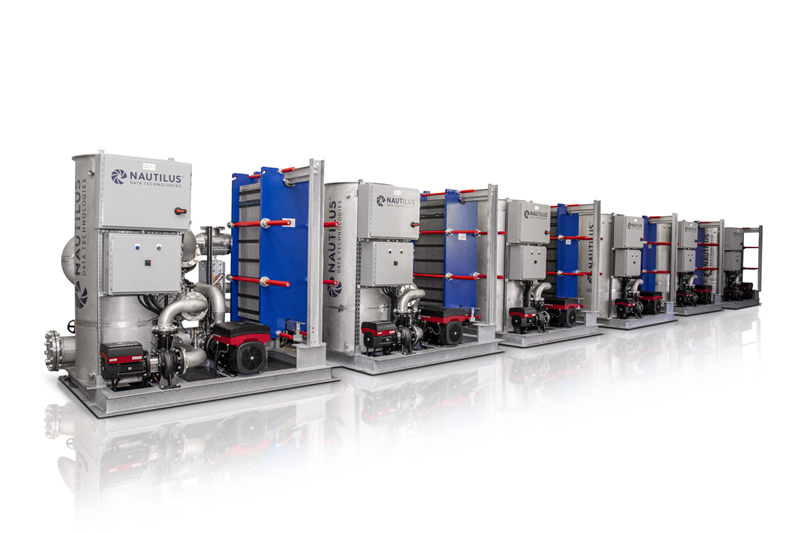
A barge is a memorable sales prop. Most data centers, however, will remain on land. Nautilus’s change of emphasis is visible in its product catalogue. EcoCore Infrastructure packages parts of a data hall in prefabricated modules. EcoCore FCD is a cooling distribution unit designed for a whole hall; EcoCore RCD works closer to the row; EcoCore XCD is aimed at much larger blocks of load. Together they sell the thermal architecture without requiring anyone to buy a boat.
That shift coincided with a change in the machines inside data halls. Dense AI racks can overwhelm cooling layouts designed for more modest servers. A cooling distribution unit manages flow, pressure and heat exchange between the IT side and the facility side. Nautilus says its equipment can work with direct-to-chip, immersion, rear-door and traditional arrangements. This is a useful kind of flexibility: the data hall’s heat rejection equipment need not be married to one server vendor or one cooling method.
The clearest external test came at Start Campus in Sines, Portugal. Nautilus announced a multi-megawatt agreement in 2024 and supplied EcoCore equipment for a data hall designed around demanding AI and high-performance computing loads, including racks above 50 kilowatts. Start Campus chief executive Rob Dunn explained the site’s advantage plainly: “Using partners such as Nautilus, we can fully leverage the cooling power of the Atlantic Ocean.” It is a striking sentence because the ocean is doing a job many operators pay chillers to do.
The numbers deserve careful reading. Nautilus reported more than 650,000 cumulative FCD unit-hours by May 2026; several machines running at once accumulate those hours together. In the same month, it said independent testing measured more than 4.1 MW from an FCD in dual-pump operation, above its 3.2 MW rating. These are equipment claims under stated test conditions, not a promise that every site will achieve the same operating cost or efficiency. For a buyer, the useful question is what happens at its own temperatures, pressure, water quality and load curve.
The first failure is usually an assumption
The company’s own field notes are more revealing than any adjective in its marketing. Nautilus describes installations where a building had no mechanical alley and piping had to go overhead. It says startup procedures were revised when field behavior contradicted design assumptions. The engineers who design the units also handle escalations from live facilities. This is the sort of culture that forms when an equipment maker has spent years operating its own equipment for customers: a drawing meets a technician at 2 a.m., and the drawing may lose.
For operators, that produces a copyable method. Start with a heat balance and the available heat sink. Design both water loops together, including pressure, flow, filtration, degassing, redundancy and maintenance access. Model seasonal source temperatures and verify the discharge rules before calling a project “zero water.” Commission under realistic loads, then write down the failures that appear. Nautilus’s own lesson is that the CDU is a node in a system, not a magic box.
There are boundaries to the model. An open water loop needs a suitable source and an acceptable regulatory path. A site without one may use a closed facility loop, but it still must reject heat somewhere. A retrofit with no room for pipes or service access can turn a neat modular plan into an expensive reconstruction. And while warmer water can reduce mechanical cooling hours, local climate and equipment requirements decide how often. The claim worth buying is narrower and stronger than a miracle: well-matched thermal engineering can save resources while accommodating hotter racks.
Nautilus now sells to AI companies, hyperscalers, enterprises and colocation operators. Its named relationships, including Start Campus, Backblaze and Cerebras, illustrate both sides of the business: operating a cooled facility and selling the cooling apparatus. A January 2026 Series B led by Pangaea Ventures is meant to expand manufacturing, fulfillment and distribution; the amount was not disclosed. A channel deal with LNPG followed in June, and Nautilus announced NVIDIA AI Factory Infrastructure Partner status in August.
The company sits in a crowded contest with traditional chiller designs and other liquid-cooling vendors. Its argument is not that water is novel. It is that a facility-scale system can be designed, deployed and supported by people who first had to keep one alive. The image that sticks is still that improbable white barge. The lesson is less photogenic: a good cooling business may begin by owning the consequences of its plumbing.