Free was supposed to make Raion irresistible. Co-founder Emma Kemp says its first platform went to 40 companies for six months at no charge. The team expected engagement and useful criticism. Instead, it struggled to get either. An investor, she recalled, told them to charge even a token amount.
The figure was a provocation, not a price list. Once Raion introduced a small annual fee, Kemp wrote, customers began telling the team what they needed. The early mistake had cost months of learning as well as the chance to collect revenue. For a business built around getting people to engage, indifference was an especially awkward problem.
Today, the company’s public pitch concerns something considerably heavier than platform access: financing the machines behind artificial intelligence. Its community and events business supplies the relationships. A proposed infrastructure operation would connect those relationships to physical compute. Moving between those businesses means taking on obligations that an introduction alone cannot settle.
A small annual fee followed. Its amount was not the point of Kemp’s lesson: paying customers had something to say.
“I don’t care if you charge £1, charge something!”
An investor’s advice, recalled by Emma Kemp
A network with a finance habit
Raion dates its beginnings to 2021. Its founding account names Laurence Cohen and Jan Dienstl; the company’s founder biographies also identify Kemp as a co-founder. Cohen’s background includes more than seven years at Fisher Investments. Dienstl studied computer science and business at University College London and brought technical leadership experience. Kemp’s career spans financial-services client work and sales on both sides of the Atlantic.
The combination helps explain the company’s direction. This is a team comfortable discussing founders, commercial relationships and capital, with engineering represented at the operating level. An older biography affectionately calls Dienstl the Wizard. The current leadership page is more sober: Cohen is CEO, Dienstl COO, Kemp chief of AI staff and Tarik Kasumovic chief communications officer.

Interviews became one route into that world. Raion’s challenge * the future podcast archive includes fintech founders such as TOQIO’s Eduardo Martinez Garcia. VirtualZ separately features Cohen’s conversation with its CEO, Jeanne Glass, covering sales, partnerships and the difficulties female founders face in securing opportunities. These are useful subjects for an audience that has to sell something before it can afford to scale it.
The public-facing interviews sit beside a more selective community. Raion describes personal screening and curated engagements, with a current emphasis on capital access, commercial partners and compute allocation. Its prospective user is an AI founder or operator facing a specific business constraint. A sprawling contact list would be a poor substitute for reaching the person who can actually approve a project.
Gibraltar supplied the room
The events give that proposition a physical address. Startup Grind’s programme for its March 2024 Gibraltar business expo listed Cohen as a speaker. The following year, Raion’s own Sovereign AI Forum brought technology and finance figures to Gibraltar’s Madison Building. Its programme ranged from banking and model training to the space economy.
Raion’s account names speakers from Microsoft, Lloyds Banking Group, GITAI, NEAR Protocol and Cognizant, among others. GITAI received the Raion Prize. Drainpipe independently reported its founder Dominick Romano’s participation, describing a selected audience drawn from different industries. That matters: the event has a participant’s account as well as an organizer’s programme.
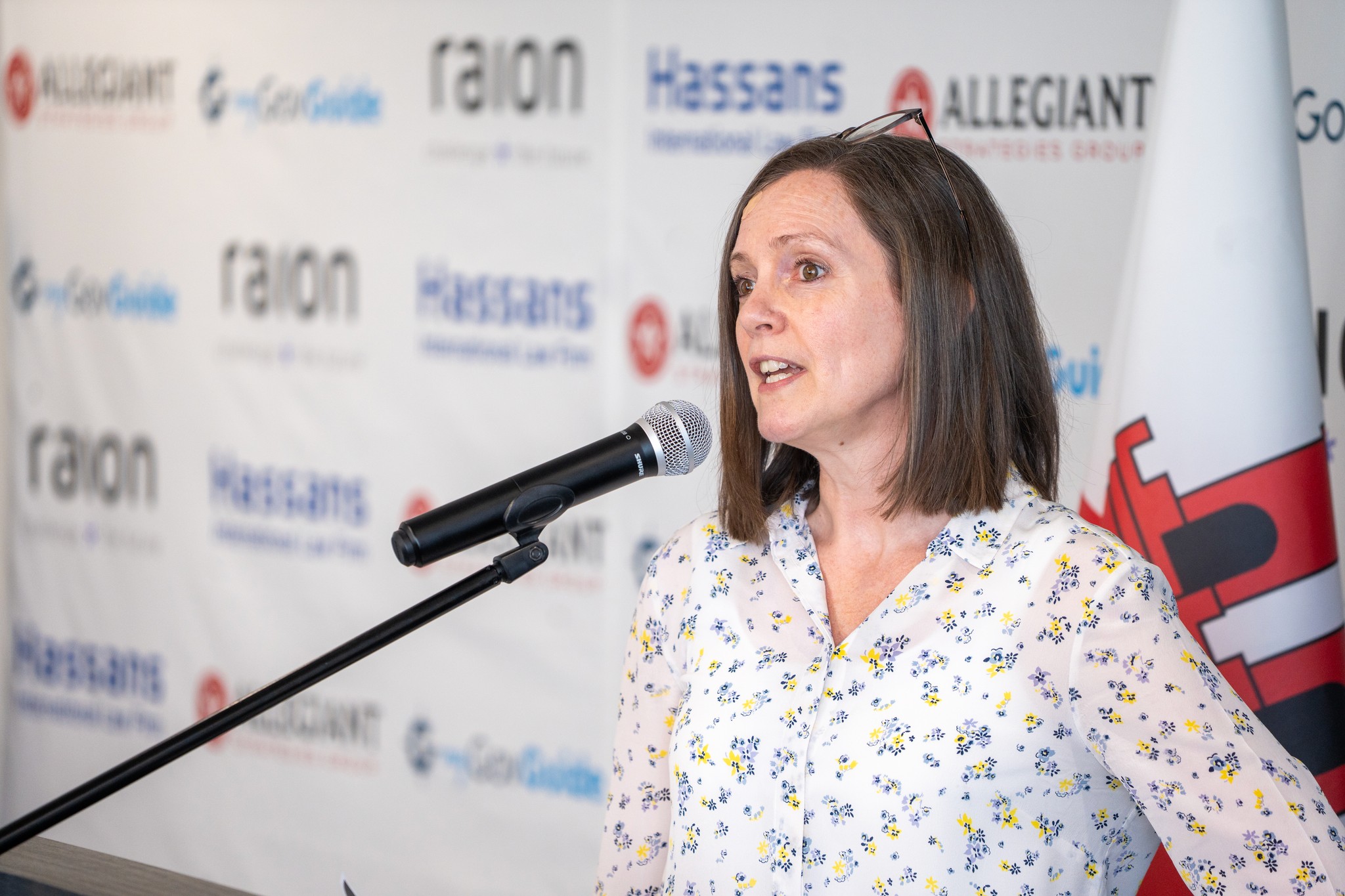
For September 18, 2026, Raion advertises another forum at One Canada Square in London. As of this profile’s publication, that gathering is still ahead. The listing anticipates around 150 delegates; the broader forum description stresses invitation-only attendance and the absence of press or recordings. Those are design choices intended to encourage candid discussion, rather than attendance figures that prove commercial results.
The useful part of a cloud alliance
There is also a more immediate offer for founders. Raion describes a March 2026 technical briefing with the OVHcloud Startup Program, followed by a continuing route into that programme. Members are offered fast-track access, cloud-credit planning and architectural guidance. The advertised sequence is straightforward: join the community, enter the programme through the alliance, then plan infrastructure around actual growth.
The briefing’s central concern was portability. Credits can make an early infrastructure decision easier, but a founder still has to consider what happens when workloads grow or need to move. Raion’s presentation favors open standards and architecture that can travel. The practical value lies in pairing access to resources with a conversation about how those resources will be used.
This is where its community proposition becomes concrete. A founder might seek a cloud-program introduction or an architecture discussion. A technology supplier might seek prospective users. Those are different transactions, and their usefulness depends on fit. A company with settled infrastructure and no need for new partners has a different reason to join than one choosing its first serious production environment.
From introductions to individual assets
Raion’s current website takes the next step into infrastructure finance. It proposes raising capital through its network, organizing it in client-controlled special-purpose vehicles, and financing modular compute deployments. An SPV is a separate legal entity established for a particular purpose. Here, the proposed purpose is to connect a specific project’s assets, obligations and returns to its own vehicle.
The distinction from ordinary cloud buying is consequential. A cloud customer purchases access to computing services. Raion’s proposed counterparty would participate in a structure connected to physical infrastructure. Its intended audience therefore includes professional investors, institutions and qualified family offices, alongside the AI operators that need capacity. A founder looking for credits and an allocator examining a project are entering through different doors.
Raion’s vehicle description also contains an important sequence. Partners retain custody during fabrication and installation. The SPV’s claim takes full effect after commissioning and acceptance. That makes the order of events central to the product: money, hardware, custody and control must arrive at the correct stage.
- 01SecureSite and power confirmed
- 02FabricateProduction tranche released
- 03EnergizeInstallation and power connection
- 04AcceptTests passed; project claim effective
Company-described structure. A process diagram, not a record of completed deployments.
Half a megawatt, with conditions attached
The engineering pitch is modular. Raion’s infrastructure thesis specifies a standard half-megawatt compute shell and a cooling design target of 120 kilowatts per rack. It describes later-generation shells targeting up to two megawatts. Its topology page advertises deployment in fewer than 90 days. These are specifications and targets, not operating results.
The attraction is understandable. Repeating a defined unit could simplify procurement and allow capacity to be added in stages. The thesis is an attempt to reduce the delays and coordination problems Raion associates with large bespoke construction. It puts the repeatable module at the center of the financing story.
But modularity does not supply electricity by itself. The proposal depends on powered sites, suitable hardware, cooling and acceptance testing. A fast fabrication schedule would be of limited use if energization slipped. Likewise, spreading projects among locations only helps when those locations meet the workload’s operational requirements. The useful comparison is between complete, deliverable systems, rather than between attractive assembly times.
The money is still a proposal
Raion’s topology page displays an $80 million minimum unit commitment. Its contact page says final vehicle minimums are to be confirmed in Phase One. Read together, the figure is an illustrative capital requirement in a developing proposal. It should not be mistaken for money already raised, an established customer bill or Raion’s own valuation.
The exploratory roadmap names several intended income sources: management fees, participation in performance, deployment margins and recurring income from powered shells. It argues against competing as another software company or specialist cloud provider, favoring financing instead. That is the stated strategic choice: build around relationships and capital organization, while partners contribute the physical delivery.
The roadmap targets November 2026 for operational launch after a study and formation process. Raion’s disclosures describe the materials as preliminary and the arrangements as private, without the regulatory authorizations associated with a licensed investment offering. For readers, the distinction is part of understanding the business’s stage. Its forum history and its infrastructure ambitions belong on different sides of the ledger.
A lesson small enough to copy
Raion offers a practical early lesson: ask users to make a commitment before treating their interest as evidence of demand. Payment can expose expectations that a free sign-up leaves untouched. The lesson is not universal. Research communities and free products can work for other reasons. In Raion’s account, however, charging helped reveal what its particular customers wanted.
The larger ambition asks whether the company can bring comparable clarity to a much more demanding transaction. A useful introduction can start a project; a working module requires every subsequent obligation to be fulfilled. Raion has put a structure and a target date around that ambition. The next chapter will be written in commissioning tests, customer commitments and power connections.
Open the next conversation
Visit Raion · Explore the OVHcloud alliance · See the next forum · Read the infrastructure roadmap
LinkedIn · X · Instagram · Facebook
▶ Watch: Laurence Cohen with VirtualZ’s Jeanne Glass▶ Watch: Cohen and Drainpipe’s Dominick Romano