A gas flare is a peculiar business problem. The fuel has value, yet somebody is setting it on fire. At an oilfield without an economical route to market, selling the gas can cost more trouble than burning it. Crusoe’s founding proposition was wonderfully literal: if the energy cannot travel to a computer, perhaps the computer should travel to the energy.
- Crusoe builds energy infrastructure, AI data centers and the cloud services running inside them.
- It sold its bitcoin mining business in 2025 to concentrate on AI.
- Customers range from model builders renting GPUs to hyperscalers commissioning campuses.
- The wager: controlling more of the physical supply chain can shorten the wait for useful compute.
Chase Lochmiller and Cully Cavness founded the company in 2018. They were friends and former high-school classmates whose careers supplied complementary equipment. Lochmiller came from computing and quantitative finance. Cavness came from energy. Their early business put computing beside stranded gas, using generators to turn an awkward fuel supply into something a distant customer could buy.

The workload changed. The map stayed.
Bitcoin mining offered an early customer for that arrangement. By March 2025, however, Crusoe had announced an agreement to sell its mining operation, including Digital Flare Mitigation, to NYDIG. The announcement anticipated approximately 135 employees transferring with the business. The sale price was undisclosed. Later company statements confirmed the divestiture.
Crusoe presented the decision as a way to concentrate on AI infrastructure. Its cloud was already taking shape in 2022. The company changed its commercial focus while retaining expertise in finding power, deploying machines and operating difficult physical systems.
Today, Crusoe connects several businesses that buyers often encounter separately. It sources energy, develops data centers, manufactures modular facilities and supplies cloud compute. Its argument is that a construction schedule, a power connection and a GPU order should be coordinated early enough to produce usable capacity together.
That puts Crusoe among specialized AI clouds such as CoreWeave, Lambda and Nebius, while also competing for workloads with AWS, Azure and Google Cloud. The market has a pleasing complication: a hyperscaler can be a cloud competitor and a customer for a building. Crusoe’s announced Microsoft campus in Abilene and Google project in Armstrong County illustrate the overlap.
Three different ways to buy a factory
For an engineering team, the simplest entry is Crusoe Cloud: rent GPU capacity, attach storage and run training or inference. Developers can provision through a console, APIs, command-line tools or Terraform. Managed Kubernetes handles orchestration. Intelligence Foundry adds managed inference and fine-tuning for teams that want to spend less time operating the machinery beneath their models.
These options transfer different jobs to the provider. Renting GPUs leaves more decisions with the customer. Managed inference takes over more of the serving system. Buying physical capacity involves another conversation entirely, about buildings, energy and delivery dates. Crusoe earns money through usage charges, committed capacity and infrastructure agreements across those layers.
8 H100 GPUs × $3.90/hour × 24 hours × 30 days
Illustrative GPU time only, using the published on-demand rate checked October 15, 2026. Storage and other services are additional.That calculation is useful precisely because it is incomplete. The rate card tells you what an hour costs. Your software determines how much useful work fits inside it. An idle GPU and a busy GPU can produce the same rental charge. Reservations and spot capacity change the arithmetic, but spot workloads must tolerate interruption.
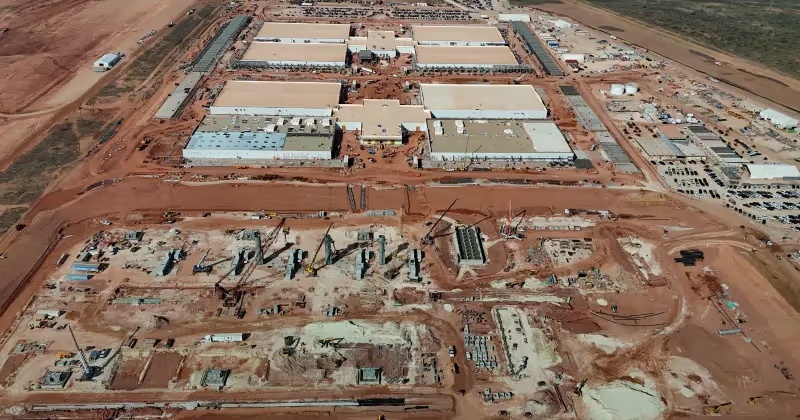
At campus scale, the numbers belong to a different ledger. In May 2025, Crusoe, Blue Owl Capital and Primary Digital Infrastructure announced a $15 billion joint venture for the eight-building, 1.2-gigawatt Abilene campus. Separately, Crusoe announced the initial closing of an anticipated $3.9 billion Series F in September 2026, at a $30.9 billion post-money valuation. Construction financing, corporate equity and customer revenue measure different things.
The machine that holds up the others
Consider the less photogenic problem inside those buildings. In synchronized training, one failed GPU can stop an entire job. The relevant question becomes how quickly the system detects trouble, supplies a replacement and restores useful work.
Crusoe describes testing each node before delivery, monitoring running hardware and keeping validated replacements available. Its AutoClusters documentation says a replacement typically joins within four to five minutes after failure detection. That is not a promise that training resumes in five minutes: initialization and checkpoint restoration take additional time.
The rate card sells an hour. The customer needs useful work inside it.
The system also pauses automatic replacement when failures arrive together. A shared switch or power problem will not be repaired by endlessly exchanging computers. That detail contains a lesson a smaller team can borrow: automate the familiar failure, and recognize when the pattern requires investigation.
Customers buy the resulting economics. Crusoe’s Windsurf case study reports 50% lower GPU costs against traditional providers and 99.98% cluster uptime. Those are reported results from a particular deployment, rather than a forecast for every migrating application. A buyer should benchmark its own workload, region and recovery requirements.
Old batteries. New demands.
Crusoe’s smaller-format Spark facilities make its energy argument tangible. Introduced in June 2025, the prefabricated units combine cooling, power infrastructure and GPU-ready racks. At Redwood Materials’ Nevada campus, modular computing was paired with solar and second-life EV batteries. The announced microgrid had 12 megawatts of power capacity and 63 megawatt-hours of storage. Power and stored energy answer different questions. A module still needs a suitable site, connectivity, permits and a dependable supply of electricity; prefabrication cannot remove those obligations.
Available power still needs scrutiny. Energy-first describes where the search begins; emissions depend on what powers each site. Gas generation, grid electricity and wind have different consequences. Battery storage shifts electricity across time. It does not create the electricity being stored.
By October 2026, Crusoe was reporting NVIDIA Exemplar-level training performance for Spark and expanding its managed offerings. Its stated value, “Think like a mountaineer,” is apt here. Preparation matters because ambition cannot substitute for conditions. The transferable idea is to find the scarce input, build expertise around it, and measure what customers finish. Even a cloud needs somewhere solid to stand.