sovereign-ai
(23)
aiXplain wants your AI agents to know their place
An AI agent can choose a tool, call a model, and get on with the job. aiXplain is building the machinery that decides what it is allowed to do - and where its work is allowed to go.
CodeNinja wants your AI to belong to you
After years of fixing enterprise software, CodeNinja is selling a bigger idea: the intelligence a business creates should stay with that business. Its work with drivers, shopkeepers and a Swedish visualization studio shows where the argument begins.
ibl.ai and the AI You Can Fire
A university bought the code behind its AI. The interesting part was what happened when students started asking questions the catalog could not answer.

Jim Reesing Is Learning to Conduct the Machine
After three decades moving between global giants and entrepreneurial firms, Quantiphi's new CEO has a precise assignment: add scale without sanding away the culture that made the company worth joining.

Arthur Mensch Is Building Europe an Exit from the AI Rental Economy
The Mistral AI co-founder began by making language models portable. Three years later, his larger argument is about who gets to own the intelligence, the machines beneath it and the right to walk away.

Raion learned to charge. Now it wants to finance the machines.
A free startup platform taught Raion a costly lesson about attention. Its next bet pairs a private AI network with a plan to finance modular compute, one project at a time.

BKN301 wants to fix banking without gutting the bank
The fintech that began in San Marino is selling banks a way to connect their old systems, put their data in order and bring AI inside. Its expansion runs through an unusually practical asset: other people’s infrastructure.
Open Innovation AI wants to put your GPUs to work
Buying AI chips is the easy part. The Abu Dhabi company is building the software that lets enterprises share the compute, govern the models and keep the whole operation under their own control.

Ian Tien Lost 26 GB of Company Memory - Then Built Mattermost
A broken chat service trapped his game studio's data. Ian Tien turned that frustration into an open-source collaboration company now built for teams that cannot afford to lose control.

TELUS Spent Billions Escaping the Phone Company Trap - Now It Wants to Be Canada's AI Utility
The Canadian telecom turned a $7-billion fibre build into a launchpad for health, software and sovereign AI. The bet is clever, capital-heavy and newly tested by the one thing every phone company fears: customers losing patience.

Hydra Host Wants to Turn the GPU Gold Rush Into a Boring, Profitable Utility
The Miami-born company is stitching independent data centers into one programmable GPU network. Its wager is that the real bottleneck in AI is no longer buying chips - it is keeping them provisioned, occupied and earning.
CNTXT AI Is Building the Arabic Layer the Global AI Boom Skipped
The Abu Dhabi company is betting that the next enterprise AI advantage will not come from a bigger model. It will come from cleaner local data, Arabic that sounds like people actually speak, and systems that never have to leave the region.

David Stout
David Stout is the co-founder and CEO of webAI, an Austin-based company building private, on-device artificial intelligence that runs on hardware people already own instead of centralized cloud data centers. Raised on a cattle ranch in northern Michigan, he taught himself to compress large AI models onto phones, laptops and edge hardware, and founded webAI in 2019 with Ethan Baird and Tyler Mauer. The company reached a $2.5 billion valuation in January 2026 on the thesis that the most valuable AI of the future will be sovereign, distributed and local rather than rented from Silicon Valley hyperscalers.

webAI
webAI is an Austin-based sovereign AI company that lets enterprises build, train, and run custom AI models on their own local hardware instead of the cloud. Founded in 2019 by David Stout, Ethan Baird, and Tyler Mauer, its end-to-end platform - spanning the Navigator development environment, the Companion assistant, and webFrame clustering software for Apple silicon - keeps sensitive data on-device while delivering cloud-grade intelligence. The company reached a reported $2.5 billion valuation in early 2026 and serves customers across healthcare, retail, logistics, and aviation.

All-In Podcast E280: The Trillion-Dollar IPO Rush, AI Token Wars & Trump Accounts
In episode 280 of the All-In Podcast, hosts Jason Calacanis, Chamath Palihapitiya and David Sacks are joined by 'bestie' Brad Gerstner (David Friedberg is on vacation) to unpack a trillion-dollar rush to the IPO exits led by SpaceX and expected to be followed by Anthropic and OpenAI. The group debates the sustainability of exploding AI token spend, the tug-of-war between frontier labs and cheap open-source models, sovereign AI ambitions, and whether enterprises can actually prove ROI. The emotional centerpiece is the launch of 'Trump Accounts' (the Invest America Act), a $1,000-at-birth investment account for every American child that Gerstner championed for four years, now live as the number-one app in the App Store, with billionaire philanthropists like Michael Dell and Gwynne Shotwell seeding accounts for lower-income kids.

OpenInfer
OpenInfer is a San Mateo-based AI infrastructure startup building an 'Inference OS for the agentic era' - software that runs large AI models and agents directly on the CPUs, GPUs and NPUs enterprises already own, from edge devices to private data centers, without cloud lock-in. Founded by ex-Meta and Roblox systems engineers Behnam Bastani and Reza Nourai, its OpenInfer Engine claims 2-3x faster inference than Llama.cpp and Ollama on distilled DeepSeek models and works as a drop-in replacement for existing endpoints. The company raised an $8M seed round in February 2025 and has since shipped Jean, a private email-native agentic AI system, and orchestration layers for heterogeneous compute.

Misha Laskin
Misha Laskin is the co-founder and CEO of Reflection AI, a New York lab building open-weight frontier models and autonomous coding agents. A theoretical physicist by training (Yale, University of Chicago), he led reward modeling for Google DeepMind's Gemini and worked in reinforcement learning at Berkeley and DeepMind before launching Reflection in 2024 with AlphaGo co-creator Ioannis Antonoglou. In 2025 the company raised roughly $2 billion at an $8 billion valuation, positioning itself as America's open-source answer to DeepSeek.
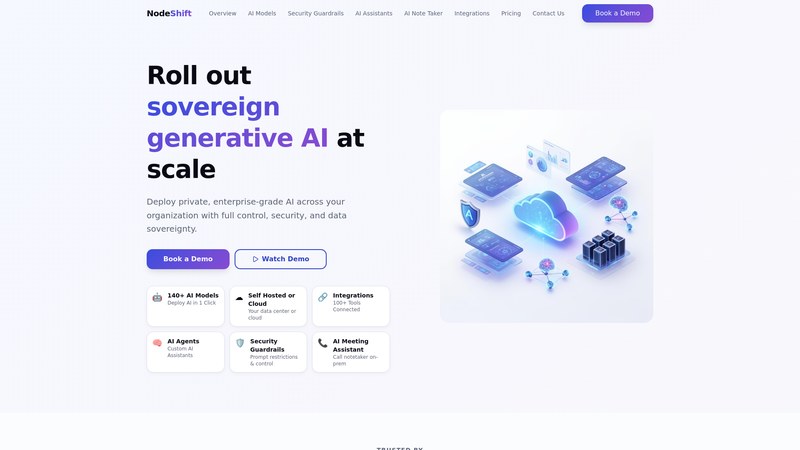
NodeShift
NodeShift is a decentralized cloud platform that aggregates spare compute, GPU and storage capacity from independent data centers and web3 networks, then resells it through one simplified UI and a single API. By tapping underused infrastructure instead of building hyperscale data centers, NodeShift offers developers and enterprises GPUs, virtual machines and storage at prices it claims are up to 70-80% cheaper than traditional cloud providers - positioning itself as a 'sovereign AI cloud' for teams that want affordable, distributed, compliance-friendly compute.

Uniphore
Uniphore is a Business AI company that helps large enterprises put their own data to work without moving or copying it. What began in 2008 as a speech-recognition startup incubated at IIT Madras has become a full-stack, multimodal AI platform - the Business AI Cloud - that powers AI agents across customer service, sales, and back-office workflows for more than 1,600 enterprises in 20+ countries.

H2O.ai
H2O.ai is a Mountain View-based AI cloud company founded in 2012, on a mission to democratize artificial intelligence for everyone. The company offers a converged platform spanning predictive and generative AI - from its open-source H2O-3 machine learning framework to enterprise products like Driverless AI, h2oGPTe, and the H2O AI Cloud. Trusted by over 20,000 organizations including more than half the Fortune 500, H2O.ai is known for employing the world's largest team of Kaggle Grandmasters and for pioneering automated machine learning. With $246 million in total funding at a $1.7 billion valuation, the company serves industries from financial services and healthcare to government and telecommunications, delivering AI that organizations can deploy on their own terms - on-premises, in the cloud, or in air-gapped environments.

Alex Yeh
Alex Yeh is the Founder and CEO of GMI Cloud, a GPU-native AI cloud infrastructure company he built from Bitcoin mining data centers into a global AI infrastructure leader in just 30 days. GMI Cloud — one of only 6 NVIDIA Reference Platform Partners worldwide — raised $82M in Series A funding in 2024 and is behind a $12 billion sovereign AI infrastructure initiative in Japan. Yeh's mission: make building AI applications as simple as building a website on Shopify.

Sung Kim
Sung Kim (김성훈), known professionally as Hun Kim, is the Co-Founder and CEO of Upstage AI, South Korea's first generative AI unicorn. A former HKUST professor and founding head of Naver Clova AI, he co-founded Upstage in October 2020 to solve the gap between enterprise data and practical AI deployment. Under his leadership, Upstage developed Solar - a compact 10.7B parameter language model - and Solar Pro 2, which outperforms GPT-4.1 at half the compute cost. With $326M in total funding and a Series C close in early 2026, Upstage is positioning itself as a global AI frontier company focused on enterprise document intelligence and AI agents.

Rodrigo Liang
Rodrigo Liang is the co-founder and CEO of SambaNova Systems, an AI infrastructure company he built from the ground up in 2017 alongside Stanford professors Kunle Olukotun and Chris Ré. Born in Taipei, raised in Brazil, and trained in electrical engineering at Stanford, Liang spent two decades designing high-performance processors at Hewlett-Packard, Sun Microsystems, and Oracle before betting that the entire computing paradigm for AI needed to be reimagined. SambaNova's Reconfigurable Dataflow Unit (RDU) is the architectural expression of that conviction - chips designed around data movement rather than instructions - and in February 2026 the company announced the SN50, claiming it runs agentic AI 5x faster than competing chips at 3x lower cost, backed by $350M in Series E funding and a strategic partnership with Intel.