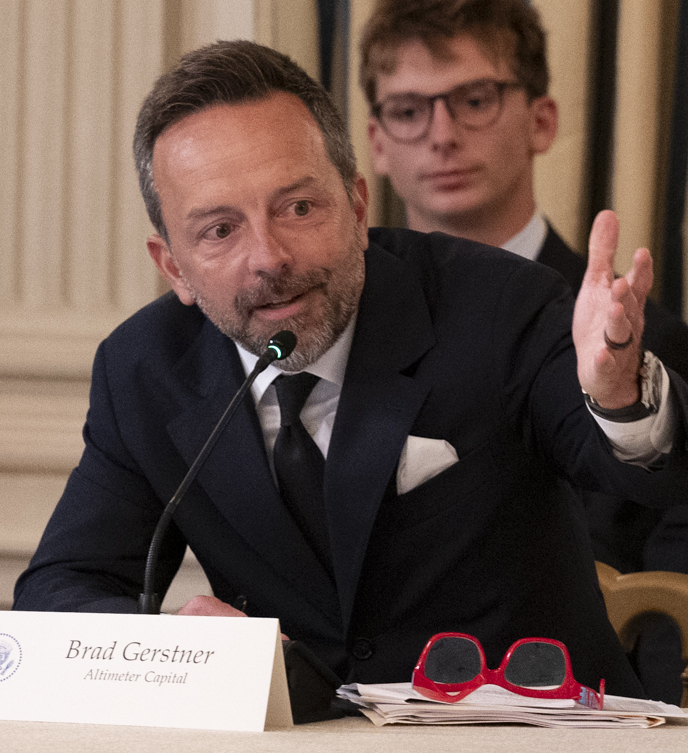
There is a particular kind of American optimism that only surfaces when three billionaires and a hedge-fund founder sit in front of microphones and argue, cheerfully, about the fate of the country. Episode 280 of the All-In Podcast — recorded across a Paris hotel, a very patriotic "flag room" on the East Coast, and a software factory somewhere in between — is exactly that kind of conversation. With David Friedberg away on what host Jason Calacanis coyly called a "little vacay," the seat beside Chamath Palihapitiya and David Sacks was filled by "bestie" Brad Gerstner, the founder and CEO of Altimeter Capital. What followed was a sprawling, two-hour meditation on money, machines, and the American dream that swung from the coldly analytical to the openly emotional.
The through-line was simple and enormous: the biggest companies in the world are heading for the public markets, the technology powering them is burning cash at a terrifying clip, and — in the middle of it all — a program is quietly turning tens of millions of American children into shareholders. It is a lot to hold in one hand. The besties tried anyway.
The Trillion-Dollar Rush to the Exits
The episode opened on what Calacanis dubbed "a trillion-dollar IPO rush to the exits." SpaceX had already crossed the line, going public at roughly $1.75 trillion and raising in the neighborhood of $75 billion — a listing Gerstner repeatedly called "textbook." The stock had run to $200 a share, cooled to $150, and was trading "right at the IPO price," making SpaceX, by the show's accounting, the seventh-largest company on Earth at a two-trillion-dollar market cap on roughly $35 billion of forward revenue.
Next in line: Anthropic and OpenAI. Anthropic, the group noted, confidentially filed on June 1st, and prediction markets put the odds of an IPO this year around 65%. Fellow bestie Gavin Baker had guessed on a prior episode that Anthropic could exit 2026 with over $100 billion in revenue — "and very profitable" — and might trade at three trillion dollars if it went public today. Gerstner, an investor in all three companies, was blunt about the demand: "As I sit here today, Altimeter would be a buyer at scale and at size in both of those IPOs."
Chamath, ever the skeptic, reframed the question as one of price discovery. "These are all great businesses," he allowed. "The question is what is the market clearing price?" His advice echoed a call he'd made earlier about Elon Musk getting out first: if you can get out now, do it — before the harder questions about AI economics "seep into the water table."
The numbers strained comprehension by design. Gerstner floated the possibility that a lab ending the year above $100 billion in revenue could "3 to 5x again next year." Where once a startup thrilled investors by going from $100 million to $300 million, the frontier labs are contemplating the same multiple with a "B" — from $100 billion to $300 billion. "We've never seen anything like this," he said. "Never." His explanation was a single phrase he returned to again and again: "Intelligence is the largest TAM we've ever seen in the history of the world."
The Token Reckoning
If the IPO talk was euphoric, Chamath's contribution was a cold shower. He recounted a conversation with his own CTO that has become the episode's most-quoted moment. "Right now, our token costs are doubling every 45 days," the CTO told him. And the downstream productivity gain? "Maybe 5% max." The models, in the CTO's telling, had "effectively already asymptoted" — squeezing out the next increment of improvement now requires vastly more compute.
The implication, Chamath argued, is a reckoning that every company will face within three or four years: "At some point, you'd have to be an idiot not to ask, well, who is paying you this? And can they sustain paying it to you?" He walked the anthropic-new-model through an exercise in AI ROI, pressing it on how much of the S&P 500's earnings growth actually traced to artificial intelligence. Once he stripped out Nvidia's chip sales, pricing power riding on inflation, and buybacks, the honest answer for real ROI landed "somewhere between zero and 2%."
Gerstner did not entirely disagree — he simply disagreed on the timeline. "There's no doubt there's a lot of money being spent today that is in the experimental bucket," he conceded. "But I think we're so early nobody cares." His counter was that the total addressable market is "every single small, medium, large company on the planet," with revenue distributed across millions of customers making rational decisions daily — not four or five whales who might churn. He cited Jensen Huang's claim that Nvidia now designs its next-generation chips using AI: "The machine is building the machine. So you can't get rid of that even if you wanted to."
Calacanis offered the on-the-ground texture. Because these tools hit every department at once — unlike Excel, which "the accounting department" adopted alone — a thousand-person company sees everyone "token-maxing" simultaneously. At $200 or even $400 a month per employee against a six-figure salary, the incremental cost is "only 3, 4%," and the question becomes whether it made that worker "three, four, five times more effective." He described his own conversion: after slashing his token costs by 95% using open models routed through a Bittensor subnet serving GLM 5.2, he shifted his agents from daily to hourly runs and woke up to "14 jobs" already done, including an hourly "trend-spotting agent" trained on every episode of All-In and This Week in Startups.
Frontier vs. Open Source: The Data Surprises Everyone
The most counterintuitive thread of the episode concerned who is actually winning. Since the "DeepSeek moment" 18 months ago — when markets fell 40% on fears that open source would kill the frontier labs — the conventional wisdom held that cheap, "good enough" tokens would erode premium pricing. The data, Gerstner insisted, says the opposite: the frontier labs' share of wallet is increasing even as commodity token volume rises elsewhere.
David Sacks, joining mid-episode from his flag room after a week in Washington, supplied the sharpest diagnosis. Enterprises would love to diversify off closed models — for cost, and for the "AI sovereignty" fear of handing their alpha to a lab that might one day compete with them. But most can't. "The spirit is willing but the flesh is weak," he said. Coinbase and DoorDash built the token-routing middleware to send frontier tasks to frontier models and mundane tasks to cheaper ones; the average enterprise cannot. By his numbers, open source fell from roughly 19% to 11% of enterprise spending — even as usage skyrockets in both camps.
The nuance, drawn from a Decagon blog post Sacks cited, is maturity. For well-defined, mature use cases — customer support that "doesn't need to know physics" — you post-train a small open model and route 90% of traffic to it. But for the immature, still-being-discovered workflows, "you're just going to want to use the most powerful general model that you can." Chamath added the harness dimension, pointing to Databricks founder Ali Ghodsi's finding that the same model on a better harness can cut costs by "about 2x." The frontier, Chamath warned, may not be converging at all: as super-intelligence becomes recursive, "the smarter your model gets, the more revenue you get, the more compute you can buy" — potentially extending the lead rather than closing it.
Sovereign AI, China, and the Energy Wall
Fresh off a UN Commission on AI co-chaired by Marc Benioff — "the empresario of empresarios," he marveled — and populated by Jensen Huang, Microsoft's Brad Smith, Grab's Anthony Tan, and Anthropic co-founder Tom Brown, Chamath reported that "there is not a single country in the world that is not trying to figure out its own sovereign AI strategy." Many, he said, have "no desire to subjugate themselves to any technical risk" and will stand up their own open-source stacks, pointing to the UAE's Falcon, Saudi Arabia's Humain, and a fresh $6 billion Japanese consortium.
On China, the group parsed Reuters reports that the CCP might restrict overseas access to top Chinese models — making AI research theft a national-security offense. Sacks read it as chess: labs stay open "until you catch the frontier," then go closed to capture the value, "exactly what Sam Altman did famously at OpenAI." His week in Washington convinced him that staying ahead of China is "a unifying force," with interest running "all the way up to the president." Then came the episode's most quotable geopolitical wish, from Chamath: "The absolute best thing that could happen for America… is if China somehow sprouted their own doomer community." The besties want, in Calacanis's phrase, to "get their doom up."
And beneath the software and the chips sat the real constraint. "We have an enormous problem in the United States with respect to electrons," Chamath said, citing an analysis that projects the US to be "about three entire Californias worth of energy short" by 2050. Calacanis extended the point to Taiwan, which runs on LNG and holds only "two or three weeks of it" — a chokepoint should China ever blockade the island.
Trump Accounts: A Kitchen Table to the Oval Office
Then the register changed. For the back half of the episode, Gerstner set aside the coldly analytical investor and became something closer to a proud father. The subject was Trump Accounts — born of the Invest America Act, which he championed for four years and first sketched with his two sons "at our kitchen table in the fall of 2020."
The mechanics are elegantly simple: every American child gets a privately owned investment account at birth, seeded with $1,000 invested in the S&P 500, no fees. Family, friends, and employers can contribute up to $5,000 a year; an employer can add up to $2,500 tax-free. The money compounds until 18, then rolls into an IRA or Roth IRA. "You're born, you get a social security number, and you get an investment account," Gerstner explained. Save ten dollars a week on top of a matched $1,000, and it becomes "$50,000 at age 18." Sacks, channeling the CPAs celebrating on Twitter, called it possibly the greatest middle-class family-planning tool ever created — a vehicle where "you're getting both" the free money and the tax advantage. Maxed out at historical returns, he noted, a child "will be a millionaire" by 28.
The launch numbers were, by any measure, a consumer-tech triumph. The app went live July 4th and hit #1 in the App Store, with "over a million and a half accounts created in the first 24 hours" and "over a billion dollars of deposits." A joint bell-ringing between the NYSE and NASDAQ was staged from the Oval Office. The philanthropy was staggering in scale and personal for the panel: Michael and Susan Dell anchored with over $6 billion ($250 each for 25 million lower- and middle-income kids); SpaceX president Gwynne Shotwell contributed $350 million in SpaceX shares; Micron matched up to $1,000 per employee. And Gerstner — whom Calacanis ribbed as "the guy who complains when we make him buy in for 10K" at poker — quietly put in $100 million, funding every child in Indiana.
Gerstner framed it as a philanthropic platform he believes could raise "$100 billion in the first 12 months" — "the largest direct philanthropic platform in the history of the country," with no "charitable middleman" and no "NGO industrial complex" taking a cut. He positioned it explicitly against the politics of the moment: "The antidote to more socialism is more capitalism. And as I told the president, this is more capitalism." Where Bernie Sanders and Zohran Mamdani would "tax all these corporations… and decide who gets it," this model makes kids "independent of the government to build wealth on their own."
Calacanis delivered the episode's emotional coda, pleading with critics to "put your TDS on the side." Comparing the program to Australia's superannuation funds and the happiness that comes from financial security, he argued it could reconnect a disillusioned generation to the American dream: "That's all people want. That's the only thing a parent wants — to make sure their kids have a better future." He heaped praise on Gerstner ("this is your legacy") and on Airbnb co-founder Joe Gebbia, now in government, for building software the American public sector could be proud of. Even Sacks, ever cautious about the bureaucracy, called it "a really important antidote" to populist anger. Whatever one makes of the name on the tin, the besties agreed on one thing: the easiest compounding on Earth is, as Calacanis put it, "between zero and 5" — and for the first time, every American newborn is in the game.
Chamath, having to leave early "to go sell some enterprise software," floated a final provocation before signing off: convince OpenAI and Anthropic to donate their equity into every child's account. Gerstner didn't rule it out — noting that Intel shares, a TikTok fee, or AI-company stock could all "go directly to all the citizens." Whether that happens or not, Episode 280 landed on a rare note of consensus from a show built on friendly combat: the machines are getting expensive, the markets are getting frothy, and — improbably — a generation of children just became owners.