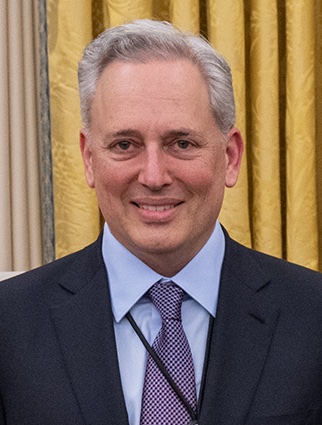
In December 2024 a venture capitalist with a law degree he never used, a movie producer credit nobody expected, and a podcast he records in shorts took a title that had never existed: White House AI and Crypto Czar. David Sacks did not lobby for a department or a budget. He took a 130-day clock - the legal ceiling for a special government employee - and went to rewrite how the United States treats two industries at once. Fifteen months earlier he was telling startup founders, on a podcast called All-In, that distribution beats product almost every time. Then he went and proved his own point on the largest stage available.
That is the through-line. Sacks shows up early, runs the playbook, and leaves before the credits. He has done it with payments, with enterprise software, with a turnaround nobody wanted, with a venture fund, and finally with policy. The companies change. The method does not.
The operator who reads the spreadsheet first
Today Sacks is a general partner at Craft Ventures, the early-stage fund he co-founded in late 2017. It opened with $350 million. It now runs somewhere near $3.3 billion in assets across multiple funds, and it is built on a thesis that sounds dull until you watch it work: back operators, not dreamers. People who have actually carried a P&L. People who know that a great demo and a great company are separated by a thousand unglamorous decisions about onboarding, pricing, and the single core action that makes a user come back.
Sacks talks about that core action the way a watchmaker talks about an escapement. For PayPal it was sending money. For Yammer it was posting to your colleagues. Find the action, remove every gram of friction around it, and the rest of the company has a spine. He has repeated this lesson so many times on All-In that his co-hosts - Chamath Palihapitiya, Jason Calacanis, and David Friedberg - nicknamed him "Rain Man" for the way he recalls the numbers behind it.
Distribution is the difference between a good product and a great company.
- A Sacks refrain, repeated to a generation of foundersCape Town, Memphis, and a resignation letter
He was born David Oliver Sacks in Cape Town, South Africa, on May 25, 1972. The family moved to Tennessee; he grew up in Memphis, attended Memphis University School, and became a U.S. citizen in 1982. Stanford gave him an economics degree in 1994 and something more combustible: a collaboration with a fellow student named Peter Thiel. Before he turned 24, the two co-authored The Diversity Myth, a polemic against campus political correctness that would read, decades later, like a rough draft of arguments he would carry into national politics.
A law degree from the University of Chicago followed in 1998, then a job at McKinsey. The consulting career lasted about a year. In 1999 Sacks quit to join a startup of a few dozen people called Confinity, run by Thiel and Max Levchin. Confinity became PayPal. Sacks became its first product leader and then its chief operating officer, running product, design, marketing, international, fraud, and human resources - a portfolio wide enough that he effectively learned to run a company while building one.
PayPal went public in February 2002. eBay bought it that October for $1.5 billion. The people who built it scattered into legend as the "PayPal Mafia," and Sacks was unmistakably in the original cast alongside Thiel, Elon Musk, and Reid Hoffman.
An intermission at the movies
Then he did something a spreadsheet would never recommend. He financed and produced a film. Thank You for Smoking, a sharp satire about a tobacco lobbyist, premiered at the 2005 Toronto International Film Festival, was picked up by 20th Century Fox, and earned two Golden Globe nominations. Years later he produced a second film, Daliland, a 2023 biopic of Salvador Dali. The man who preaches focus keeps a side door open to the absurd.
Yammer, and the art of the spin-out
In 2006 Sacks founded Geni.com, a genealogy site. The more interesting thing was buried inside it: an internal communication tool the team built for themselves. In 2008 he spun that tool out as Yammer, an enterprise social network - Facebook for the office, before that phrase was a cliche. Yammer won the grand prize at TechCrunch50, crossed eight million users in four years, and in July 2012 sold to Microsoft for $1.2 billion. The side project had outgrown the company it was born inside.
The reluctant firefighter
In early 2016 Zenefits, an HR software company Sacks had backed, was on fire - regulators circling, growth stalling, a founder departing. Sacks took the interim CEO chair himself. He negotiated with insurance regulators across the country, rebuilt the product line under an initiative he called Z2, and steadied the ship enough that a permanent CEO could take over after ten months. It was not the kind of job a billionaire investor has to take. He took it anyway, which tells you something about how he sees his own usefulness: he is an operator first, and operators run toward the fire.
The besties build an empire
Around 2020 Sacks and three friends started recording their group-chat arguments. All-In became one of the most listened-to business and technology podcasts in the world, its live shows filling theaters, its annual summit drawing the people it talks about. Sacks is the table's resident contrarian and its most reliably political voice. Along the way he launched a podcasting platform of his own, Callin, in 2021 - it was acquired by Rumble in 2023 - and co-founded Glue, an AI workplace chat tool.
The war on crypto is over.
- Sacks, at the Crypto Ball following the 2025 inaugurationOne hundred and thirty days in Washington
On December 5, 2024, President-elect Donald Trump named Sacks the White House AI and Crypto Czar, a role invented for him. He was sworn in as a special government employee in January 2025, which capped his service at 130 days a year and spared him Senate confirmation and full financial disclosure - a structure that drew both efficiency and criticism. He divested direct crypto holdings, kept investments in startups, and got to work building a legal framework for digital assets and loosening the regulatory grip on artificial intelligence.
In his first week the administration revoked a Biden-era executive order that had taken a more cautious line on AI. Through 2025, reporting from NPR and The New York Times raised pointed questions about whether his private AI investments and his public role were too close for comfort. Supporters, including OpenAI's Sam Altman, vouched for his intentions; critics in the AI-safety camp never warmed to a deregulator running deregulation. In March 2026 Sacks announced he had used up his days and would step aside, moving onto the President's Council of Advisors on Science and Technology. The czardom, like everything else he builds, had a clock on it from the start.
The contradictions, kept on purpose
He is a lawyer who never practiced, a movie producer who preaches focus, a South African immigrant who became a tribune of American economic nationalism. His political checks have gone to Mitt Romney, then Hillary Clinton, then Donald Trump - a trajectory that confuses anyone trying to file him under a single label. He threw a Marie Antoinette-themed party for his 40th birthday and then spent his 50s arguing about monetary policy on a microphone. The cleanest read is that Sacks is less an ideologue than an optimizer who keeps finding new systems to optimize. Right now the system is American technology policy. Next year it will probably be something else, and he will probably be early to it.
Career Timeline