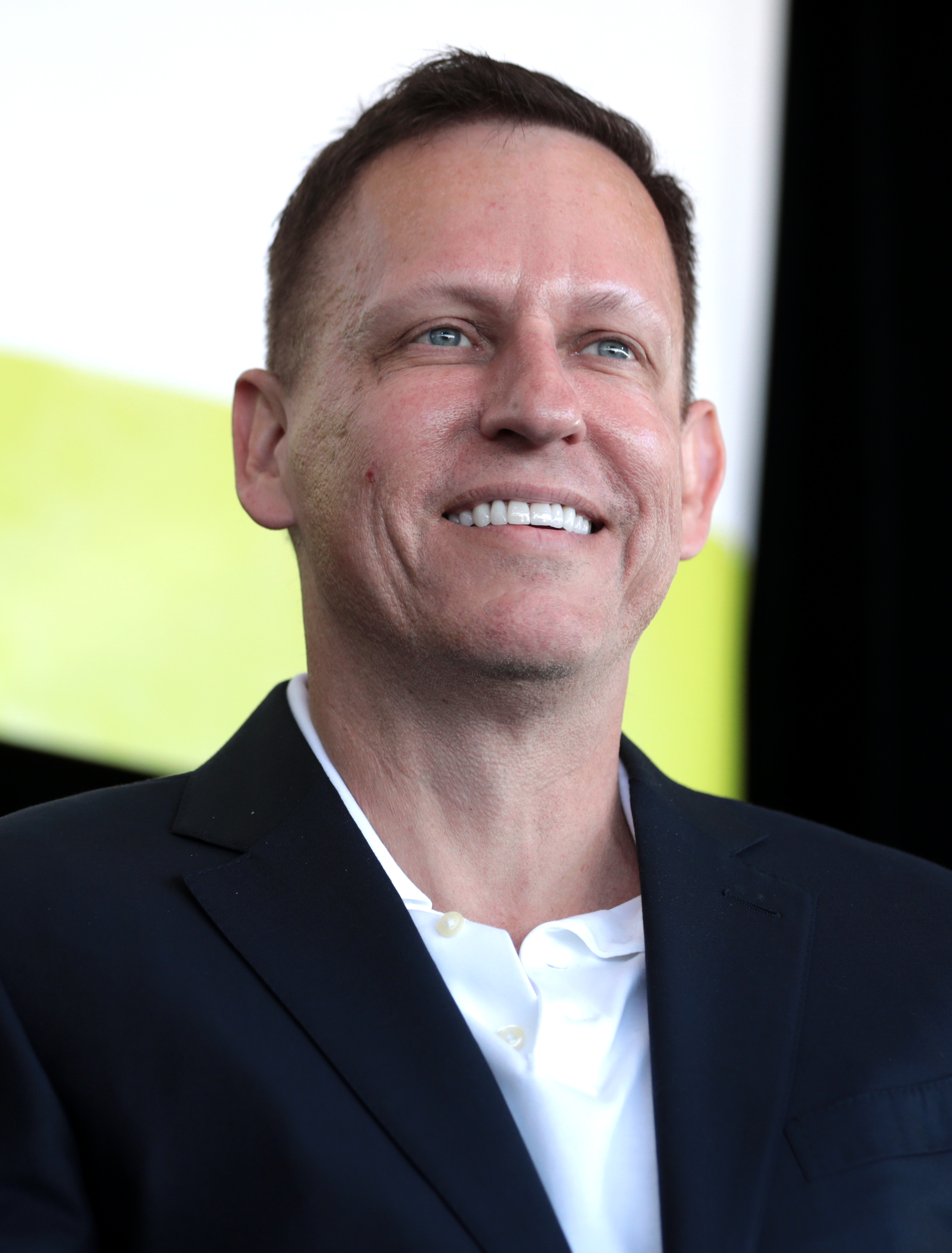
The Man Who Bets Against the Room
He turned $500,000 into a billion dollars by handing a check to a 19-year-old college sophomore in 2004. He named his data intelligence company after magical stones in a fantasy novel he has read more than ten times. He spent a decade quietly funding a professional wrestler's lawsuit to destroy a media company that had written about him. These are not flukes. They are a pattern.
Peter Andreas Thiel was born in Frankfurt on October 11, 1967, and grew up bouncing between continents - South Africa, Namibia, and finally California, where the Thiel family settled when Peter was a teenager. The years in Namibia, where corporal punishment was routine at the German-language school he attended, left a mark. Not trauma, exactly. More like an allergy to conformity that never cleared up.
He was valedictorian of San Mateo High School in 1985. He studied philosophy at Stanford - not the obvious choice for someone who would become one of the wealthiest people in technology - and graduated in 1989. Then he stayed for law school, finished his J.D. in 1992, and did what Stanford Law graduates are expected to do: clerked for a federal judge, got hired at Sullivan & Cromwell, lasted seven months. Silicon Valley's foundational disruptor didn't like being told what to do.
The next few years are the quiet part of the story. He traded derivatives at Credit Suisse. He wrote speeches for a cabinet secretary. He ran currency futures at a small fund. He was circling something without knowing what it was yet. In 1998, he found it: a small payment encryption company called Confinity, which he co-founded with Max Levchin and Luke Nosek. The product they built together was called PayPal.
What PayPal became, and what it cost to get there, is the founding myth of modern Silicon Valley. The company burned $10 million a month at its peak, merged with Elon Musk's X.com in a near-death move, and went public in 2002, two months after 9/11, in a market that wanted nothing to do with internet companies. eBay bought it for $1.5 billion. Thiel netted roughly $55 million. It was not the last time he would make a contrarian bet pay off.
"We wanted flying cars, instead we got 140 characters."- Founders Fund Manifesto
In 2003, while most of his peers were declaring the internet bubble officially over, Thiel co-founded Palantir Technologies. The name came from Tolkien - the palantiri are the seeing-stones in The Lord of the Rings, magical orbs that let their users observe events across great distances. Thiel thought data analytics for governments and corporations could work the same way: see what others cannot see. He was right, and patient about it. Palantir did not go public until 2020. By 2024, its market cap had crossed $400 billion.
The Facebook bet is the one people still talk about. In the summer of 2004, Thiel wrote a check for $500,000 to a 19-year-old Harvard sophomore named Mark Zuckerberg. He received 10.2% of the company. He eventually sold those shares for well over $1 billion. The investment was not complicated. The insight was simple: Zuckerberg understood something about social networks that other people were treating as a feature rather than a foundation. Thiel saw it first.
In 2005, he co-founded Founders Fund with Ken Howery and Luke Nosek, the same people who had been in the room at PayPal. The fund's manifesto - and Founders Fund does not so much issue documents as it issues manifestos - declared that technology had stagnated. Too many smart people were building apps instead of rocket ships. Founders Fund became one of the first institutional investors in SpaceX. It backed Palantir, Stripe, Airbnb, Spotify, Lyft, and Anduril before any of them were household names.
The Thiel Fellowship launched in 2011 on a deliberately provocative premise: college is overrated, and the most important thing a 20-year-old can do is skip it. The program offers $250,000 - recently doubled - to young people willing to defer or leave college to build companies instead. Larry Summers, the former Harvard president, called it "the single most misdirected bit of philanthropy in the last decade." The fellowship has since produced Vitalik Buterin, who built Ethereum; Dylan Field, who built Figma; Austin Russell, who built Luminar. All billionaires. All college dropouts.
"What important truth do very few people agree with you on?"- Zero to One, Peter Thiel
Zero to One, published in 2014 with Blake Masters, is the book that made Thiel's philosophy accessible to people who had not spent years in his orbit. The core argument: genuine innovation is going from zero to one - creating something that does not exist yet. Copying what already exists is going from one to n - marginally useful, competitively brutal, and ultimately cheap. Monopolies are not villains. They are the proof that someone built something genuinely new. Competition is the sign of a commodity market, not a special one. "Competition," he wrote, "is for losers."
The politics are where Thiel gets complicated. In 2016, he became one of the first prominent Silicon Valley figures to openly back Donald Trump, delivering a primetime speech at the Republican National Convention. In that same speech, he declared "I am proud to be gay" - the first time he had said this publicly, a decade after Gawker Media had outed him without his consent. He had spent roughly $10 million funding Hulk Hogan's privacy lawsuit against Gawker, a campaign so meticulously patient that nobody knew he was behind it until it was over. A $140 million jury verdict forced Gawker into bankruptcy in 2016. Thiel compared the effort to philanthropy.
He married his partner Matt Danzeisen in Vienna in 2017. He quietly obtained New Zealand citizenship in 2011, visiting the country twice before the paperwork was approved - a fact that was not publicly known for six years. He has purchased substantial land there. Whether this represents sincere attachment to New Zealand or a sophisticated exit strategy depends on your theory of Peter Thiel, of which there are many.
What remains consistent across four decades is the posture: see what the consensus cannot see, act before the consensus catches up, and never be found competing in a market you can escape. As of 2026, Founders Fund is closing a $6 billion growth fund. Thiel Fellowship fellows are building the next generation of companies. Palantir is embedded in the architecture of governments and large corporations worldwide. The man who said competition is for losers is still, conspicuously, not competing.
How a Philosophy Major Rewired Silicon Valley
The Five Biggest Bets
Thiel Fellows: Where Are They Now
271+ fellows since 2011. 11+ unicorn companies. Notable alumni:
The Book That Changed Startup Theory
Betting on Things Before They Existed
Quotes That Startups Still Argue About
"Competition is for losers."
"What important truth do very few people agree with you on?"
"We wanted flying cars, instead we got 140 characters."
"Brilliant thinking is rare, but courage is in even shorter supply than genius."
"Monopoly is the condition of every successful business."
"The most contrarian thing of all is not to oppose the crowd but to think for yourself."
"A startup is the largest endeavor over which you can have definite mastery."
"Every moment in business happens only once. The next Mark Zuckerberg won't create a social network."
Eight Moments That Define the Man
$500K on a Harvard Sophomore
In the summer of 2004, Peter Thiel wrote a check for half a million dollars to a 19-year-old Mark Zuckerberg. He received 10.2% of a company called TheFacebook. When Facebook went public in 2012, Thiel's stake was worth over $1 billion. No spreadsheet would have predicted it. He saw something in Zuckerberg that no one else had seen yet.
Nine Years to Take Down Gawker
In 2007, Gawker Media outed Thiel as gay without his consent. He said nothing publicly. For the next nine years, he quietly funded lawsuits against Gawker. His most decisive move financed Hulk Hogan's privacy suit, which resulted in a $140 million jury verdict in 2016. Gawker filed for bankruptcy that same year. Thiel called it philanthropy.
New Zealand Citizenship, Quietly Obtained
In 2011, Thiel obtained New Zealand citizenship after visiting the country just twice. Nobody knew for six years. He purchased substantial land there. When it was revealed in 2017, journalists speculated about billionaire bunkers and apocalypse insurance. Thiel declined to explain.
Palantir's Rejection Tour
When pitching Palantir, Thiel and co-founders were turned away by virtually every major venture capital firm. Sequoia Capital's chairman reportedly doodled through an entire meeting. Kleiner Perkins predicted failure. Thiel self-funded the first $30 million. By 2024, the market cap exceeded $400 billion.
Tolkien's Seeing-Stones
Thiel named Palantir after the magical palantiri in The Lord of the Rings - orbs that allowed their bearers to see across vast distances. He has read Tolkien's trilogy more than ten times as an adult. The metaphor was deliberate: a company that lets governments and corporations see what others cannot.
Clarium's 90% Collapse
After correctly anticipating some dynamics of the 2008 financial crisis, Clarium Capital peaked at $8 billion AUM. Then Thiel made a series of wrong macro calls on oil and the dollar. The fund shrank by 90% between 2008 and 2011 - one of the largest and most public implosions of a billionaire's investment vehicle in Silicon Valley history.
Fellowship Produces Its Own Billionaires
When Thiel announced the Thiel Fellowship in 2010, Harvard's Larry Summers called it "the single most misdirected bit of philanthropy in the last decade." The fellows who have since built Ethereum, Figma, and Luminar - all billionaires, all without college degrees - have made Summers' quote the most expensive wrong prediction in education commentary.
"I Am Proud to Be Gay"
At the 2016 Republican National Convention, in a primetime speech endorsing Donald Trump, Thiel said publicly for the first time: "I am proud to be gay, I am proud to be a Republican, and I am proud to be an American." He had been outed nine years earlier by the company he had just destroyed. The sentence landed differently knowing that.
Things You Did Not Know Until Now
What Peter Thiel Is Doing Now
Ten Traits That Explain the Man
Contrarian by Design
Thiel's contrarianism is not posturing. It is methodology. He looks for the thing everyone has agreed not to do and asks why. The question "what important truth do very few people agree with you on?" is how he filters ideas and people.
Long Memory, Patient Action
He waited nine years to act on Gawker. He held Palantir private for 17. He backed Trump before it was fashionable in tech and before it was punished. He plays timescales that most investors cannot stomach.
Philosophical Framework First
Most investors look at markets. Thiel looks at mimetic theory - the idea, from his mentor Rene Girard, that humans are driven by imitation and rivalry. He uses it to explain bubbles, competition, and why great companies are not built by copying.
Loyal to the Network
The PayPal Mafia is not accidental. Thiel deliberately maintained and invested in relationships forged during the PayPal years. Elon Musk, Reid Hoffman, Max Levchin, Keith Rabois - the network is his infrastructure.
Anti-Conformist at Root
Corporal punishment in a German school in Namibia. Moving countries multiple times as a child. Starting a contrarian newspaper as a college freshman. The pattern was set early: he does not conform to the expected environment.
Obsessed with Death
Thiel funds longevity research, backs anti-aging biotech, and has spoken extensively about the taboo around death and aging. He considers accepting mortality a form of learned helplessness. He funds the people trying to fix it.