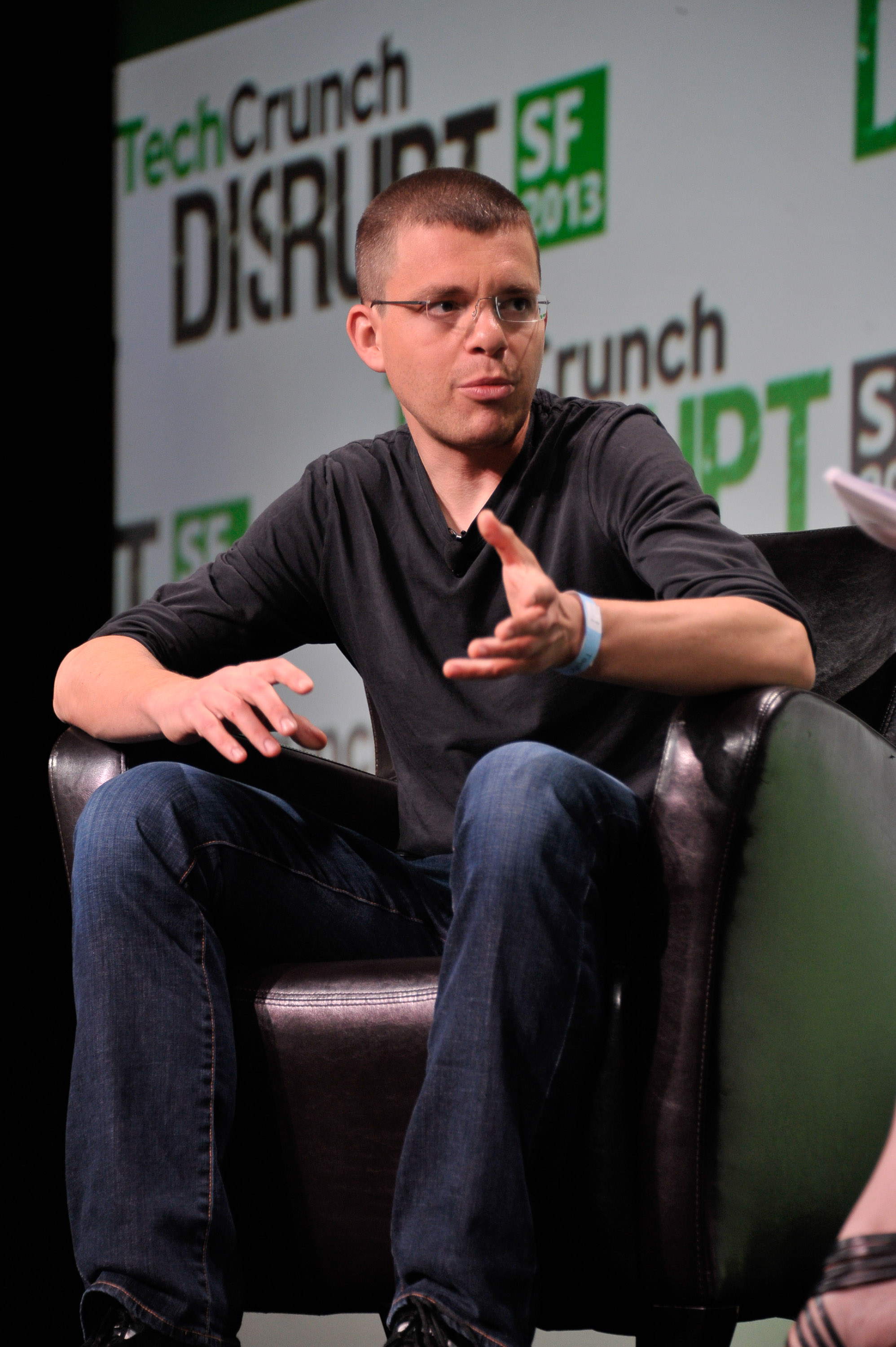
Max Levchin, Affirm CEO and PayPal co-founder
Profile - Founder & Engineer

Max
Levchin

Kyiv → Chicago → PayPal → Affirm - $3B and counting

The kid who fled Soviet Ukraine now runs a $3B revenue fintech company and still thinks in cryptographic proofs.

PayPal Mafia Affirm CEO Cryptography BNPL Pioneer HVF Labs SciFi VC
$3.2B Affirm FY25 Rev
$36.7B GMV
~$3B Net Worth Est.
1998 Co-founded PayPal
25M Glow app users
478K Affirm Merchants
$182M Slide - Google exit
2016 Levchin Prize est.

The Man Who Built Trust Into Money

He was 16 when his family packed what they could carry and left Soviet Ukraine. The year was 1991. Anti-Semitic harassment had made staying untenable, and Chicago - cold, enormous, indifferent - was the other option. Max Levchin arrived without English and without money. He left the Soviet Union with something harder to carry: a deep, personal education in what systems of power do to people when those people have no financial protection.

Twenty-five years later, he runs a publicly traded lending company that has made never charging a late fee into a structural policy. That is not marketing. That is autobiography written in contract law.

Levchin's full name is Maksymilian Rafailovych Levchin. He studied computer science at the University of Illinois Urbana-Champaign, where he met Luke Nosek and, later, connected with Peter Thiel through a Stanford lecture. In December 1998, the three co-founded Confinity - a company that started with encrypted payments on Palm Pilots and ended up, after merging with Elon Musk's X.com in 2000, becoming PayPal.

As CTO, Levchin built the fraud detection systems that kept PayPal alive when automated bots were draining accounts faster than the company could grow. The solution he helped devise - a visual challenge that humans could pass and machines could not - became the Gausebeck-Levchin Test, one of the first commercial CAPTCHAs. Its descendants now protect billions of logins worldwide. He invented critical internet infrastructure while in his mid-twenties, largely out of necessity.

Being an entrepreneur is not about being in love with an idea. It's about being in love with running a company.

- Max Levchin

When eBay bought PayPal for $1.3 billion in 2002, Levchin walked away with enough to do essentially anything. He chose to start more companies. Slide.com - a social media platform for sharing photos and widgets - became one of Facebook's largest third-party developers before Google acquired it for $182 million in 2010. He briefly joined Google as VP of Engineering, lasted about a year, and left. He later said it plainly: once you know you can't work for anyone else, you can't unknow it.

In 2011 he founded HVF Labs - the initials stand for Hard, Valuable, Fun, his personal criteria for what problems are worth solving. HVF is a company creation studio: a small team generates hypotheses, tests them, and if the data holds, spins out a real company. Affirm came out of HVF in 2012. Glow, the women's health app, followed in 2013. Divvy Homes, Resolve, HM Bradley, PathPoint - all HVF incubations.

Glow is worth pausing on. Levchin grew up in Kyiv during the Chernobyl era. His family had thyroid checkups as children, monitoring for radiation damage from the 1986 disaster. The experience left him with a lasting conviction that health data - when collected properly and given back to the person it belongs to - can change outcomes. Glow applies that conviction to reproductive health. Twenty-five million women use the app family. He is the Chairman.

Affirm is the flagship. The thesis is simple and the execution is not: extend credit with complete transparency. Show the total cost upfront. Charge no late fees. Use machine learning to assess creditworthiness beyond the FICO score. Levchin became CEO in 2014, took the company public on Nasdaq in January 2021, and watched the IPO raise $1.2 billion with shares doubling on day one. His stake was valued at roughly $2.5 billion that day.

The years since have been a more complicated story. Affirm laid off 19% of its workforce in February 2023, shut down its crypto unit, and reset toward profitability. Walmart replaced Affirm with Klarna as its BNPL partner in March 2025 - a public setback. But Affirm also closed partnerships with Apple Pay, Costco, JPMorgan Chase, and Worldpay. FY2025 results, reported in February 2026, showed $3.22 billion in revenue, $36.7 billion in gross merchandise volume, and - for the first time - a $52.2 million annual profit. Levchin also filed an application for an industrial loan company charter in Nevada: Affirm is applying to become a bank.

In October 2025 he was elected to the Board of Directors of The Coca-Cola Company. It is a peculiar combination. He responded to the announcement on X with characteristic economy of words.

A classic engineering mistake - and one I've made - is confusing what is hard and what is valuable.

- Max Levchin

He runs SciFi VC with his wife Nellie, whom he married in 2008 and who is his co-founder at the fund. The portfolio includes Stripe, Brex, Uber, and Anduril - a list that reads less like a VC firm's holdings and more like a map of where Silicon Valley's most serious engineering bets have landed.

In 2015 he founded the Levchin Prize for Real-World Cryptography, awarded annually to researchers whose cryptographic work has proven itself in practice - not theory. Winners include Joan Daemen and Vincent Rijmen, who designed AES; Moxie Marlinspike and Trevor Perrin, who built the Signal Protocol; Ralph Merkle; and Adi Shamir. Two $10,000 prizes per year, administered through the International Association for Cryptologic Research. The prize is small. The signal it sends about what Levchin considers important is not.

He was also the first Silicon Valley technology executive appointed to the Consumer Financial Protection Bureau's Advisory Board, in 2015. He has written and spoken publicly about immigration reform - his own history makes it personal, not theoretical. He executive produced Thank You for Smoking in 2005, because why not.

His Medium bio reads: "Entrepreneur (PayPal, Slide, HVF, Affirm, Glow), investor (Yelp, etc), coder, cyclist, coffee snob." The order is deliberate. The self-description is accurate. He is, by most accounts, still writing code.

Kyiv to Nasdaq - The Timeline

1975
Born in Kyiv, Ukrainian SSR. Family name: Levchin.
1991
Family emigrates to Chicago, fleeing anti-Semitism and Soviet collapse. Arrives without English.
1993-1997
BS Computer Science, University of Illinois Urbana-Champaign. Recruits earliest network of technical co-founders.
1995
Co-founds SponsorNet New Media with Luke Nosek and Scott Banister while still a student. It fails.
1998
Meets Peter Thiel at a Stanford lecture. Co-founds Confinity in Palo Alto. The mission: encrypted payments on Palm Pilots.
1999-2000
Confinity launches PayPal. Merges with Elon Musk's X.com. Levchin builds anti-fraud systems; co-invents Gausebeck-Levchin CAPTCHA test.
2002
PayPal IPOs on Nasdaq. eBay acquires for $1.3B. Named MIT Technology Review Innovator of the Year.
2004
Founds Slide.com. Becomes first investor and chairman of Yelp.
2005
Executive produces Thank You for Smoking. Yes, that one. Directed by Jason Reitman.
2010
Google acquires Slide for $182M. Levchin joins Google as VP Engineering. Leaves within a year.
2011
Founds HVF Labs - Hard, Valuable, Fun. A studio for building companies from first principles.
2012-2014
Co-founds Affirm through HVF. Becomes CEO in 2014. Core rule: no late fees, ever.
2013
Co-founds Glow Inc., women's health app. Now 25 million users across the app family.
2015-2016
Founds Levchin Prize for Real-World Cryptography. First Silicon Valley exec on CFPB Advisory Board.
2021
Affirm IPOs on Nasdaq. Raises $1.2B. Stock doubles on day one. Personal stake: ~$2.5B.
2025-2026
Elected to Coca-Cola Board. Affirm posts first annual profit. Applies for banking charter ("Affirm Bank").

What He Actually Says

The very first company I started failed with a great bang. The second one failed a little bit less...

Ignore your mistakes. The number one thing to worry about is: Am I doing what I'm good at?

You can have successful teams where people hate but deeply respect each other. The opposite is a recipe for disaster.

I think the hallmark of a really good entrepreneur is that you realize one day that you can't really work for anyone else.

The world is now awash in data and we can see consumers in a lot clearer ways.

Honest financing is a path to economic mobility and social justice - not just a product feature.

Roles and Affiliations

Chair & CEO
Affirm Holdings
2014 - Present
Co-founder & Chairman
Glow Inc.
2013 - Present
Founder
HVF Labs
2011 - Present
Co-founder
SciFi VC
2017 - Present
Board Director
Coca-Cola Company
2025 - Present
Co-founder & CTO
PayPal / Confinity
1998 - 2002
Founder & CEO
Slide.com
2004 - 2010
First Investor & Chairman
Yelp
2004 - 2015
Board Member
Unity Technologies
Active
Prize Founder
Levchin Prize / IACR
2016 - Present

SciFi VC Portfolio Highlights

Stripe Brex Uber Anduril

Ten Things Worth Knowing

01

His full legal name is Maksymilian Rafailovych Levchin. He goes by Max.

02

As a child in Kyiv, he had thyroid checkups because of the Chernobyl disaster. That experience shaped his belief in personal health data.

03

The Gausebeck-Levchin Test (2001) was one of the world's first commercial CAPTCHAs. Google's reCAPTCHA descends from it. He invented it to stop fraud, not to prove a point.

04

He executive produced Thank You for Smoking (2005), the satirical film about a tobacco lobbyist. It won at Sundance.

05

He was Yelp's very first investor. He found Jeremy Stoppelman and backed the idea before anyone else did.

06

Affirm has never charged a late fee. The policy is not aspirational. It's in the product architecture.

07

He runs SciFi VC with his wife Nellie. They have invested together since 2017. Work and life, same portfolio.

08

He was the first Silicon Valley tech executive ever appointed to the CFPB Advisory Board (2015).

09

His Medium bio ends with "coder, cyclist, coffee snob." In that order. After listing the companies.

10

The Levchin Prize pays $10,000 per year to the most practically impactful cryptographers on the planet. Winners include the designers of AES, SHA-3, and the Signal Protocol.

The PayPal Mafia - And Why He's Different

The phrase "PayPal Mafia" gets used to describe the alumni network of PayPal founders and early executives who went on to reshape technology: Elon Musk (Tesla, SpaceX, X), Peter Thiel (Palantir, Founders Fund), Reid Hoffman (LinkedIn), David Sacks (Yammer, now AI & Crypto Czar), Keith Rabois (OpenDoor), Jeremy Stoppelman (Yelp).

What distinguishes Levchin within that group is a continuous focus on building operating companies rather than primarily investing in or advising them. Thiel became a legendary investor. Musk became a force of nature in manufacturing. Levchin - twenty-three years after PayPal's IPO - is still running the company he founded. He codes. He manages. He does not appear to have shifted into pure capital allocation.

His immigrant experience also sets a different tone. Levchin has written publicly about immigration reform, contributed to FWD.us, and spoken about opportunity as something fragile and earned. The no-late-fee policy at Affirm has an ideological root: he watched what predatory credit does to people who can't absorb a financial shock. He was, at one point, one of those people.

Levchin on immigration

In the land of opportunity, why hinder our own success?

TechCrunch essay, March 2015

Levchin on honest financing

Honest financing is a path to economic mobility and social justice - not just a product feature.

TechCrunch essay, July 2017

The Cryptography Thread

2001

The CAPTCHA

To stop automated bots from draining PayPal accounts, Levchin and David Gausebeck built a visual challenge that humans could solve and machines could not. The Gausebeck-Levchin Test was one of the earliest commercial CAPTCHAs - a direct ancestor of Google's reCAPTCHA, now used billions of times daily.

2015 - Present

The Levchin Prize

Two $10,000 awards per year, given by the IACR Real World Crypto committee, to cryptographers whose work has proven its value in practice. Winners include designers of AES, SHA-3, the Signal Protocol, and foundational asymmetric cryptography pioneers.

Philosophy

Practice Over Theory

The prize specifically rewards real-world impact - not theoretical elegance. This mirrors how Levchin approaches all his work: systems matter only when they operate under real conditions, with real adversaries, at real scale.

Latest Dispatches

Feb 2026

First Annual Profit

Affirm posts $52.2M net income in FY2025 - the company's first annual profit. Revenue $3.22B. GMV $36.7B. 25.8M active users. Files for Nevada bank charter.

Oct 2025

Coca-Cola Board

Elected to the Board of Directors of The Coca-Cola Company. A Ukrainian immigrant who fled the Soviet Union is now helping govern one of the most recognizable brands on earth.

Apr 2026

Forbes Self-Made 250

Named to Forbes' Self-Made 250 list of America's wealthiest self-made individuals. Net worth estimated at approximately $3 billion, fluctuating with AFRM stock.

2024-2025

Apple Pay + Costco

Affirm integrates with Apple Pay, bringing BNPL to millions of iPhone users at checkout. Costco partnership expands. JPMorgan Chase and Worldpay deals deepen institutional reach.

Mar 2025

Walmart Switches to Klarna

Walmart replaces Affirm with Klarna as its primary BNPL partner - a setback that Levchin acknowledged publicly. Affirm's response: double down on partnerships with Apple and financial institutions.

Jan 2023

Profitability Drive

Affirm cuts 19% of workforce and exits crypto. The reset was painful and public. The outcome two years later: first annual profit in company history.

Find Max Levchin Online

Share this profile