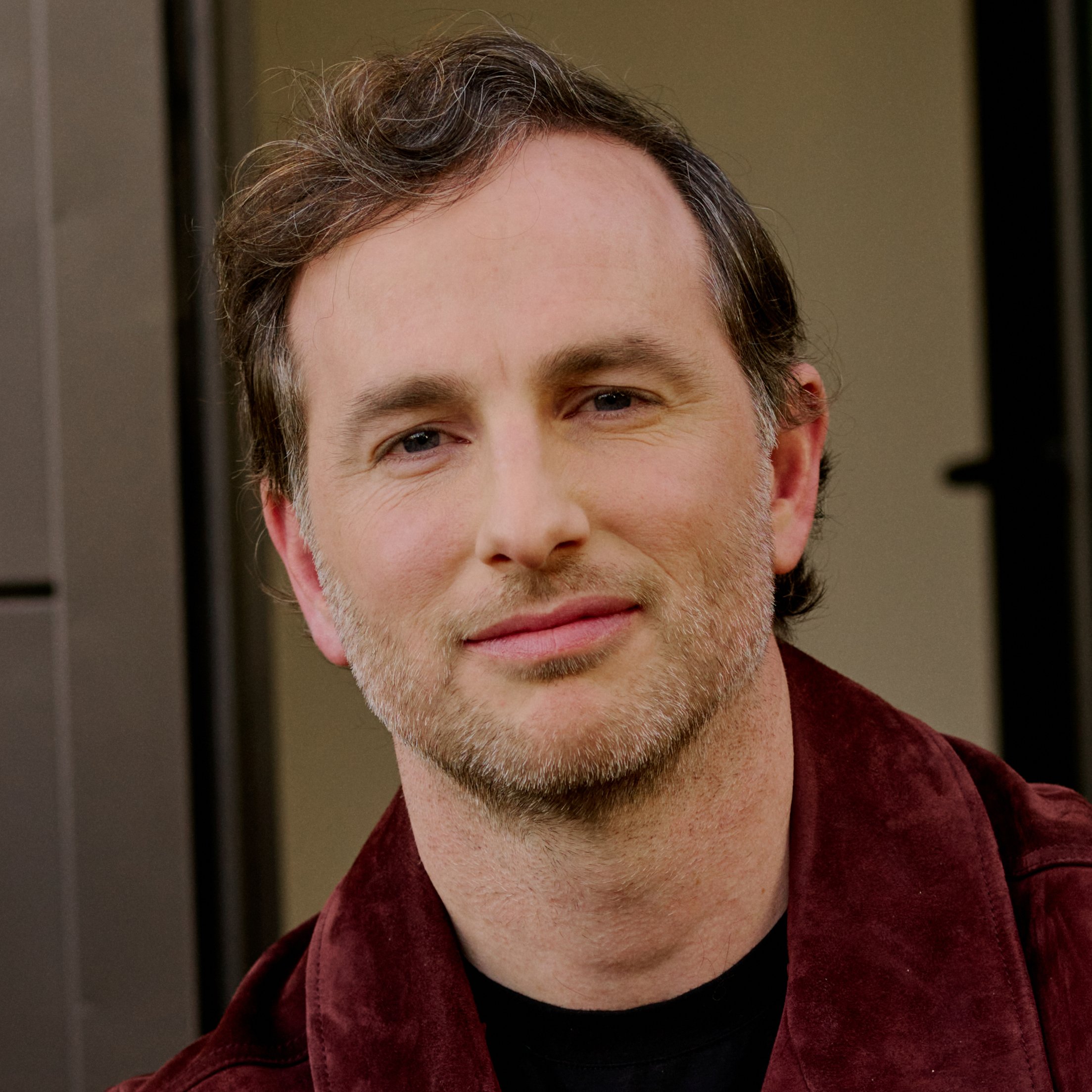
The Designer Who Redesigned Trust
On August 21, 2025 - his 44th birthday - Joe Gebbia received a phone call from the White House. By end of day, he was America's first Chief Design Officer, handed the keys to 27,000 federal websites and told to make them feel like an iPhone app. The man who once made air mattresses feel aspirational was now tasked with making the DMV feel delightful.
This is not an origin story. Gebbia has been running at full speed since at least 2005, when his RISD graduation project - a foam seat cushion shaped like a butt - landed on the shelves of the MoMA Design Store. He named it CritBuns. Art students sat on it. Critics appreciated the joke. The MoMA bought it anyway.
That is the essential Gebbia move: take the uncomfortable thing - the hard chair, the empty apartment, the dilapidated government portal - and redesign it until it feels obvious in hindsight. He has done this three times now at civilizational scale. He is attempting it a fourth.
Five Years, Two Degrees, One Insight
Gebbia grew up in Lawrenceville, Georgia - a suburb of Atlanta where, as a kid, he sold hand-drawn Teenage Mutant Ninja Turtle illustrations to classmates. He was a ball boy for the Atlanta Hawks. Neither of these things are surprising in retrospect.
He enrolled at the Rhode Island School of Design in 2000, initially to study painting, then pivoted to pursue dual degrees in graphic design and industrial design simultaneously. While at RISD, he snuck into business courses at Brown and MIT. He absorbed Bauhaus principles. He devoured the work of Charles and Ray Eames.
The Eames philosophy - "create the best design for the most people for the least price" - became something close to doctrine. Decades later, Gebbia would fund the Eames Institute of Infinite Curiosity, a nonprofit dedicated to preserving and spreading their legacy. He named his rescue dog Belo, after the Airbnb logo symbol. The man commits to his references.
"Through the curriculum and through the five years I spent on campus, at each turn RISD has this profound way of challenging you in ways you never anticipated or expected."
- Joe Gebbia on RISDHis graduating class of 2005 held a product competition. Gebbia won with CritBuns - conceived freshman year during an eight-hour drawing critique when he realized that art school's only design flaw was its chairs. He spent four years thinking about it, then found a local machinist and a foam pool-float company to produce 800 units in time for the competition. RISD funded the run. MoMA stocked the shelves. Amazon listed it as a bestseller.
He was 23. The lesson he drew: "It was just looking at a problem and turning it into an opportunity. That is like the basis of our company." He would say the same sentence again in 2007, 2016, and 2025 - each time meaning something different, each time being correct.
The Cereal Boxes That Built a Billion-Dollar Company
In 2007, Gebbia's landlord raised rent by 25%. His RISD classmate Brian Chesky needed a place to sleep. Neither had a job. They inflated three air mattresses, cooked breakfast, and rented out their San Francisco living room to strangers attending an industrial design conference. The first three guests paid $80 per night each. One of them later invited Gebbia and Chesky to his wedding.
The idea had a name - AirBed & Breakfast - and a third co-founder, Nate Blecharczyk. What it did not have, for the better part of two years, was money. Investors passed. Savings dwindled. The company entered what Gebbia calls "the Trough of Sorrows" - a phrase that has since become startup shorthand for the phase after early excitement and before real traction, when nobody believes in you and the evidence supports their skepticism.
Then came the 2008 presidential election. Two designers. A political moment. And an idea that sounds insane unless you understand how RISD works.
$30,000 "Airbnb was funded by breakfast cereal."
Gebbia and Chesky designed two limited-edition breakfast cereal boxes by hand: Obama O's ("The Breakfast of Change") and Cap'n McCains ("A Maverick in Every Bite"). Each contained actual cereal. Each sold for $40. They printed 500 of each. Katy Perry bought one. Perez Hilton bought one. They raised $30,000 from cardboard and corn.
More importantly: the boxes got them into Y Combinator. When Paul Graham interviewed them, he was skeptical until they put the Obama O's box on the table. "If you can convince people to pay $40 for $4 boxes of cereal," Graham told them, "maybe, just maybe, you can convince strangers to live with each other." He accepted them. Sequoia Capital followed with $600,000.
"If you can convince people to pay $40 for $4 boxes of cereal, maybe, just maybe, you can convince strangers to live with each other."
- Paul Graham, Y Combinator, to Joe Gebbia and Brian Chesky, 2009Graham also delivered a second lesson that proved equally valuable: "Your users are in New York and you're in Mountain View. What are you still doing here?" Gebbia and Chesky flew to New York, knocked on the doors of their hosts, and personally photographed their apartments. Revenue doubled weekly. The "do things that don't scale" philosophy entered startup canon. Airbnb entered something larger.
Building the Trust Machine
As Airbnb's Chief Product Officer, Gebbia owned the design layer - the interface between strangers and their anxiety about each other. His thesis was simple and radical: a well-designed reputation system could override the "stranger danger" reflex that evolution spent millennia installing in human brains.
He built the review system. He built the photography program - hiring 3,000 photographers across the globe to shoot over a million listings, transforming how hosts presented their homes and, more importantly, how guests trusted what they were booking. He oversaw the 2014 rebrand, including the Belo symbol - a logo so distinctive that he named his dog after it.
In his 2016 TED Talk - "How Airbnb Designs for Trust" - Gebbia described the experience of a guest who suffered a heart attack and was saved by the host who took him in. The talk's central exercise: he had the audience unlock their phones and hand them to a stranger. The point was visceral. Trust is designed, not found.
"Maybe the people that my childhood taught me to label as strangers were actually friends waiting to be discovered."
- Joe Gebbia, TED Talk: How Airbnb Designs for TrustWhen Airbnb went public on December 10, 2020 - raising $3.5 billion in one of the most watched IPOs of the pandemic era - the company was worth over $100 billion. Two billion guest nights would follow. 220 countries. The original $80/night air mattress had become the largest hospitality company on Earth, without owning a single room.
Gebbia stepped back from full-time operations in July 2022. He remained on the board. He had other problems to design.
Samara: The Housing Problem Is a Design Problem
Samara began in 2016 as Airbnb's internal R&D studio - the place where Gebbia quietly prototyped ideas about the future of living. In 2022, he spun it out as an independent company. The mission: address the U.S. housing crisis with beautifully designed, factory-built prefab homes that fit in residential backyards.
The product is called Backyard. It is a fully turnkey accessory dwelling unit (ADU) - net-zero ready, solar-compatible, fire-resistant steel frame. Samara handles everything: design, permitting, manufacturing, delivery, installation, and financing. The studio (430 sq ft) starts at $289,000 installed. It arrives in roughly eight months. The on-site build takes six weeks.
In February 2024, Samara acquired its own manufacturing factory in Mexicali, Mexico to control quality and scale. By November 2024, TIME magazine named Backyard one of the Best Inventions of the year. The company had raised $41 million. Gebbia donated Backyard homes to victims of the Los Angeles wildfires.
Prefab ADUs designed to solve the U.S. housing crisis, one backyard at a time.
The name Samara comes from the winged seed pods that spin away from their source trees and travel far. The metaphor is intentional. So is the factory acquisition. So is everything Gebbia touches - the design is never incidental.
America's First Chief Design Officer
National Design Studio, White House
On his 44th birthday - August 21, 2025 - Gebbia was appointed the first-ever U.S. Chief Design Officer, heading the newly created National Design Studio within the White House. He reports to Chief of Staff Susie Wiles and works from the Eisenhower Executive Office Building.
The directive: redesign the federal government's 27,000+ websites so they feel like the Apple Store - "beautifully designed, great user experience, run on modern software." His first DOGE assignment, completed in May 2025 at the Office of Personnel Management, was a fully online retirement application system for federal employees. The man who made it easy to book a stranger's apartment was now making it easier to collect a pension.
By February 2026, the National Design Studio had launched TrumpRx.gov (drug discount pricing), realfood.gov (nutrition information), and the Genesis AI research site. The countdown to July 4, 2026 - America's 250th birthday, the target deadline for government-wide design revamps - was running.
His political evolution has been contentious. Previously a Democrat, Gebbia voted Republican in 2024 and joined DOGE - drawing backlash from the Airbnb community and forcing his resignation from the Airbnb.org board in April 2025. Airbnb publicly stated his personal views do not reflect the company's. He continued building websites for the government. The cereal boxes were a collector's item. The controversy was not.
Giving It Away
In May 2016, Gebbia signed the Giving Pledge alongside Brian Chesky and Nate Blecharczyk - committing to give away the majority of his wealth. The pledge letter describes his goal: funding "the moment of instantiation," when an idea becomes real for the first time. He wants that moment to reach as many people as possible.
He has been specific about where: $25 million to The Ocean Cleanup - the largest single private donation the organization had ever received. $25 million to the Malala Fund over five years. $25 million to San Francisco homelessness organizations at the Airbnb IPO. $2.1 million in Airbnb stock distributed to 890 graduating seniors at his Georgia high school. $300,000 to RISD for student scholarships. $5 million personally to found Airbnb.org, which has housed 75,000 people in crises and conflicts.
From CritBuns to Constitution Avenue
What He Actually Says
"Turning fear into fun is the gift of creativity."
- Joe Gebbia"Design can overcome our most deeply rooted stranger-danger bias."
- Joe Gebbia, on what Airbnb proved"I want to devote my resources to bring the moment of instantiation, when someone who has an idea sees it become real, to as many people as I can."
- Joe Gebbia, Giving Pledge letter