TELUS has the friendliest-looking balance sheet in Canadian infrastructure. The logo is a looping purple flourish. The advertisements prefer lizards, bunnies and tropical fish. Behind the petting zoo sits a company that digs streets, buys spectrum, installs fibre, manages health records and now racks thousands of power-hungry graphics processors in Canadian data centres.
That contrast explains TELUS better than the usual label, “telecom.” The Vancouver company still makes its living connecting phones and homes. At the end of 2025, it counted 21.2 million telecom connections. But the strategic ambition is larger: turn a regulated, capital-intensive network into the base layer for health, customer experience, food systems and artificial intelligence.
The idea is not to escape infrastructure. It is to make the same infrastructure pay rent several times.
01 / The old utility learns new tricks
A phone company without a garage myth
TELUS has no photogenic founder story. It began in 1990 when Alberta created a holding company to privatize Alberta Government Telephones. The modern business took shape after a 1999 combination with BC Telecom, a deal worth roughly C$8 billion. This was pipes, policy and provincial history, not two friends with a prototype.
Darren Entwistle became chief executive in 2000 and spent 26 years stretching that regional wireline inheritance into a national technology group. Customer connections rose from 4.3 million in 2000 to more than 21 million. Wireless went national. Optik TV, home security and business technology widened the bundle. Health and digital services pushed the company into other countries and other budgets.
Victor Dodig, the former CIBC chief executive, took over in July 2026. His mandate arrived with a useful phrase: “discipline and focus.” TELUS has already proved it can add businesses. The new question is whether it can make the collection simpler, more profitable and easier for customers to navigate.
02 / The expensive foundation
What TELUS actually did - and what it cost
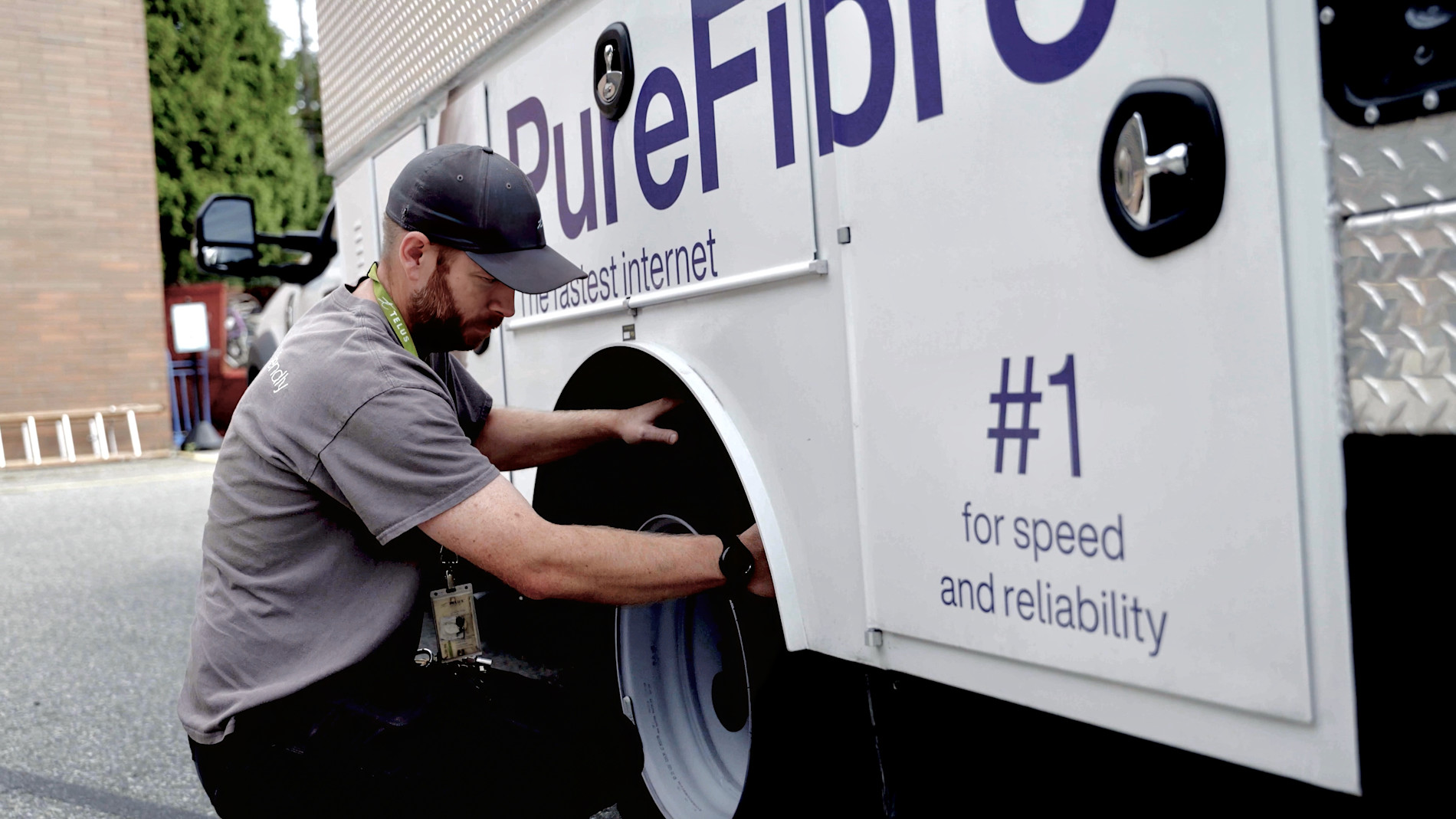
In 2013, TELUS began replacing its aging copper access network with PureFibre. A decade later it said the program had absorbed more than C$7 billion. By 2025, fibre reached 3.7 million homes and businesses, and 99 percent of legacy copper TV and internet customers had migrated. Residential customers generally moved at no charge, but TELUS carried the construction burden.
The payoff is partly familiar: faster internet, lower latency, higher reliability and more capacity. The better strategic answer is reuse. Fibre supports television, security cameras, business networks, virtual care, cloud workloads and the backhaul beneath 5G. Once the trench is dug, each additional service can travel over an asset already in the ground.
This is the company’s practical difference from a narrower carrier. Bell and Rogers also bundle connectivity and media, and both possess formidable networks. TELUS has leaned harder into health technology, global customer-experience work and now sovereign compute. The pitch is not merely “we carry your data.” It is “we can help operate the sensitive system around it.”
The idea is not to escape infrastructure. It is to make the same infrastructure pay rent several times.YesPress analysis
03 / The adjacency machine
From a phone bill to a benefits portal
TELUS Health is the boldest extension. It sells electronic medical records, pharmacy systems, virtual care, benefits administration, employee assistance and mental-health services to providers, employers, insurers and governments. The 2022 purchase of LifeWorks cost C$2.3 billion, plus roughly C$600 million of assumed net debt. That transaction took TELUS deep into employer wellbeing and pushed the unit beyond Canada.
By the first quarter of 2026, TELUS Health said it covered approximately 170 million lives globally. Revenue had grown from C$245 million in its earlier form to more than C$2 billion, according to the company’s 2025 review. TELUS also reported C$400 million in annualized LifeWorks-related cost and cross-selling synergies by mid-2025. The play is legible: buy workflow software and care access, connect it to enterprise distribution, then remove duplicated systems.
TELUS Digital follows similar logic. It handles customer service, software engineering, trust and safety, and AI data work for outside clients while supplying capabilities back to the parent. TELUS listed the unit publicly, watched its market value and operating outlook deteriorate, then bought the remaining shares in October 2025 for about US$539 million. The first proposal was US$3.40 a share; the final deal was US$4.50. TELUS expected roughly C$150 million in annual efficiencies from closer integration.
Agriculture & Consumer Goods is the strangest-looking cousin until one notices the same ingredients: regulated information, fragmented supply chains and customers who pay to reduce mistakes. A 10-year partnership with Welch’s automates compliance for more than 700 growers and helps trace products across 40 countries. Still, TELUS acknowledged lower agriculture revenue in early 2026 as it prepared to divest non-core assets. Adjacency has limits; not every workflow belongs forever.
04 / The AI utility bet
The cloud, but with a Canadian passport
TELUS opened a sovereign AI factory in Rimouski, Quebec, in September 2025. NVIDIA supplies accelerated computing technology; HPE designed the infrastructure. The facility lets organizations train, tune and run models while keeping data under Canadian control. League, Accenture and OpenText were early collaborators. By May 2026, Rimouski was sold out.
That demand changed the size of the plan. TELUS proposed expanding Kamloops and developing two Vancouver sites with Westbank, scaling the British Columbia cluster beyond 60,000 GPUs and 150 megawatts by 2032. The company framed this within C$66 billion of planned Canadian investment through 2030. It also designed the new facilities around clean power, liquid cooling and heat recovery.
This is where a telecom’s old assets become newly fashionable. Data residency matters to governments, hospitals, financial institutions and companies guarding intellectual property. TELUS already owns Canadian fibre, data centres, security operations and public-sector relationships. It can offer local compute without asking buyers to assemble the chain themselves.
The competition is awkwardly large: AWS, Microsoft and Google can spend at planetary scale. TELUS cannot win by being a smaller hyperscaler. It has to win where Canadian control, regulated workloads, local support and network proximity matter enough to outweigh a narrower global ecosystem.
05 / What failed first
The customer promise sprang a leak
For years, TELUS pointed to postpaid wireless churn below one percent as proof of customer loyalty. It achieved that for a twelfth consecutive year in 2025. Yet its own annual filing disclosed a bruising counterpoint: TELUS accounted for 19.7 percent of complaints accepted by Canada’s telecom complaint body that year, the highest share among providers and the end of a 13-year run of industry leadership on customer-satisfaction measures.
Billing errors, unexpected charges and missing credits are mundane compared with an AI factory. They are also where trust is experienced. TELUS responded with digitization, simplified support, AI-assisted service and cost reductions. Those tools can shorten resolution time, but automation is useful only if the underlying account data and policies are clean. A polite chatbot that cannot fix a bill is a queue with punctuation.
A broad platform earns the right to expand only while the basic service remains boringly reliable.
The same tension appears on the financial side. Fibre, spectrum, acquisitions and data centres consume cash before they produce it. TELUS generated C$2.2 billion in free cash flow in 2025 and planned lower capital spending in 2026, while management made deleveraging an explicit priority. The strategy works best when recurring subscriptions fund the next layer. It works poorly when price competition compresses mobile revenue, integrations slip and debt becomes impatient.
06 / The copyable playbook
Steal the architecture, not the shopping spree
Most companies cannot copy TELUS by buying a health platform or ordering thousands of GPUs. They can copy the sequence. Identify the hardest asset you already paid for. Find adjacent problems where that asset removes a meaningful cost or risk. Add one recurring service. Measure whether it improves retention, distribution or unit economics. Only then stack the next one.
TELUS’s durable advantage is fibre, spectrum, data operations and distribution - not a particular phone plan.
Health and sovereign AI fit when buyers care about privacy, uptime and Canadian control.
More services per relationship can lower churn, provided the bill and support experience stay intelligible.
If a new business cannot share customers, infrastructure or capability, it may be a collection, not a platform.
The model does not travel well to businesses with weak balance sheets, short customer lifetimes or no reason to be trusted with sensitive work. It also fails when the core is unstable. Cross-selling five products to an unhappy customer does not create a moat; it creates five reasons to call support.
TELUS is now a useful live experiment. It has the network, scale and patient history required to make adjacency compound. It also has a new chief executive, a customer-service repair job and an AI build whose power demand is measured like a small city. The next chapter will decide whether the purple phone company built a coherent utility for the digital economy - or simply found more expensive ways to remain a phone company.