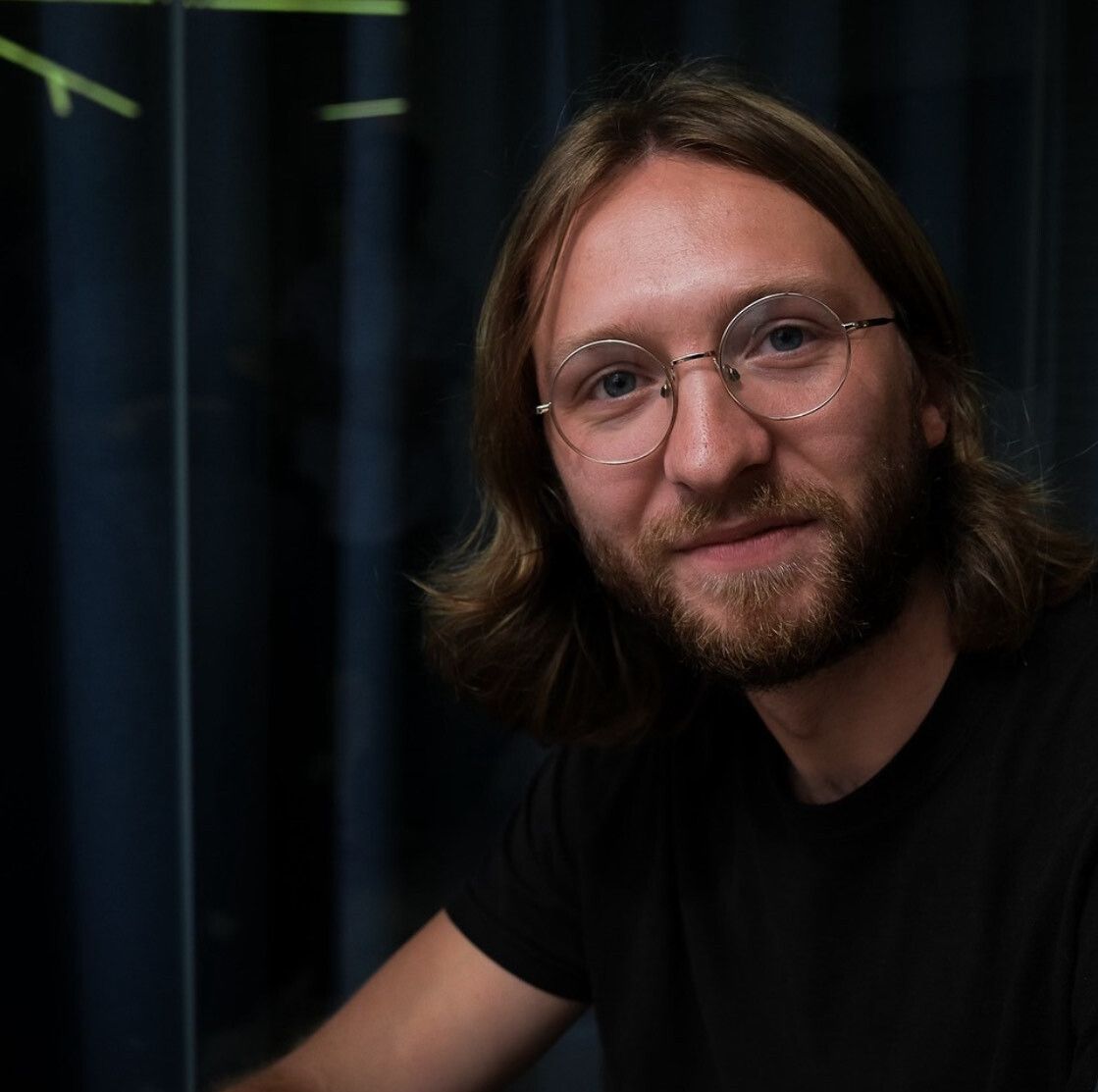
$2.5B - webAI valuation reached January 2026David Stout co-founded webAI in 2019Raised on a Michigan cattle ranchTerm Member, Council on Foreign Relations (2025)Thesis: AI belongs on your device, not the cloudHQ: Austin, Texas
Founder / CEO / webAI
David Stout
He runs a company betting that the most valuable artificial intelligence of the next decade will not live in a distant data center. It will live on the devices you already own - private, sovereign, and yours.
Edge AISovereign AIOn-DeviceAustin, TX
Most of the artificial intelligence industry is racing in one direction: bigger models, bigger clusters, bigger data centers. David Stout is quietly walking the other way.
As co-founder and chief executive of webAI, Stout leads an Austin company built on an idea that sounded stubborn in 2019 and looks prescient now. The most important AI, he argues, should not be rented from a handful of cloud providers. It should run locally, on hardware people and organizations already have - a phone, a laptop, a machine on a factory floor. Private by architecture. Owned by the user. In January 2026, investors valued that idea at $2.5 billion.
webAI describes itself as the first end-to-end private AI platform. Enterprises use it to bring AI to their own data rather than shipping their data off to someone else's servers, producing specialized models that are trained on their own knowledge and grow more valuable with every use. The pitch lands hardest in places where sending sensitive information to the cloud is a non-starter - manufacturing, defense, and other high-stakes settings where control is not a feature but a requirement.
Stout's framing is blunt. "I don't want a future where we're renting intelligence from someone from Silicon Valley," he has said. It is a sentence that doubles as a business plan. Where the dominant model of the AI era concentrates capability in a few enormous systems, webAI wants to scatter it - billions of small, specialized models running in the systems that already surround us.
That contrarian streak did not come from a boardroom. It came from a ranch.
Stout grew up on a cattle ranch in northern Michigan, an environment that taught a specific kind of engineering discipline long before he wrote a line of production code. On a ranch, you fix what you have. You do not order a replacement and wait. Working under constraint - limited money, limited tools, limited slack - became a habit of mind, and it maps almost cleanly onto the technical problem he would later spend years solving: how to make a large AI model small enough, and efficient enough, to run where the data actually lives.
His path into the field was unconventional. He attended Davenport University and later enrolled in online AI coursework through Stanford, which he left before finishing to build the company full time. In 2016, before webAI existed, he started a first venture, Ghost House Technology, working on neural networks. The formal credentials never quite completed; the conviction did.
In late 2019, Stout joined two other engineers from Michigan - Ethan Baird and Tyler Mauer - and moved the effort to Austin. The founding thesis was set from the start: the cloud was the wrong place for the most valuable AI. At the time, that was close to heresy. The entire industry was organizing itself around centralized compute. webAI was organizing itself around the opposite.
“I don't want a future where we're renting intelligence from someone from Silicon Valley.”
David Stout
$2.5B
Valuation, Jan 2026
2019
webAI founded
3
Co-founders
2030
Billions of models, his forecast
The Work
What webAI actually builds
Compression
Models that fit
Stout's core technical work has centered on shrinking large AI models so they run on consumer and edge hardware - phones, laptops, even equipment in the field - without a round trip to the cloud.
Platform
Navigator & webFrame
Products include Navigator, a drag-and-drop way to train models, a device-native assistant, and webFrame for distributing models across Apple devices.
Research
Guided Attention & LIM
His named innovations include Guided Attention, Attention Steering, and the Large Infrastructure Model - approaches aimed at efficiency rather than raw scale.
The Philosophy
Four words webAI keeps coming back to
01
Specialized
Models built for a specific problem, not one giant system trying to do everything.
02
Sovereign
Intelligence you own and control, running on your own data and hardware.
03
Efficient
Do more with less compute - the ranch lesson, turned into architecture.
04
Sustainable
Success measured by impact - risks prevented, time saved - not model size or traffic.
“The ability to deploy locally and economically at scale is the core value of edge AI - and why we believe it will ultimately win out over purely centralized approaches.”
David Stout
The Arc
From Ghost House to a $2.5 billion bet
2016
Founds Ghost House Technology in Michigan, working on neural networks and frequency technology - his first venture.
2019
Co-founds webAI in Austin with Ethan Baird and Tyler Mauer, betting the most valuable AI will run on devices, not in the cloud.
2024
Closes a $43M Series A in September, reaching roughly a $700M valuation, with backers including Forerunner Ventures.
2025
Named a Term Member of the Council on Foreign Relations; webAI announces a partnership with Divergent.
2026
webAI reaches a $2.5 billion valuation after a high double-digit million raise with TIME Ventures, Atreides, Forerunner and OXCART.
The Stakes
A different scoreboard
The scale of the industry Stout is arguing against is hard to overstate. The prevailing wisdom holds that progress in AI is a function of compute: more chips, more electricity, more concrete poured for data centers. webAI's counter-argument is that this approach overbuilds - that you can bring intelligence down to the level of a single household, business, building, or personal device, and get something both cheaper and more private in the bargain.
It is also a policy argument, which is part of why Stout's role has widened beyond product. In June 2025 he became a Term Member of the Council on Foreign Relations, joining the conversation about how nations think about AI. His language there sharpens the thesis: he advocates for "AI infrastructure that is sovereign by design - distributed, on-device, architecturally private." For governments wary of routing sensitive workloads through commercial clouds, that framing is not abstract.
webAI's own forecast puts a date on the vision. By 2030, the company says, billions of specialized models will operate as seamlessly as software does today - embedded in the systems that keep businesses, communities, and nations moving. The measure of success, in Stout's telling, will not be how large a model is or how much traffic it draws. It will be impact: risks prevented, time conserved, lives improved.
Whether the industry bends his way is still an open question. The hyperscalers are not slowing down, and centralized frontier models remain formidable. But the fact that a company founded on the opposite premise now carries a multibillion-dollar valuation suggests the argument has moved from the fringe to the table. For a founder who learned to build under constraint on a Michigan ranch, that may be the most fitting outcome of all - proof that scarcity, handled right, is a strategy.
Questions
The basics, answered
Who is David Stout?
David Stout is the co-founder and CEO of webAI, an Austin-based company building private, on-device artificial intelligence. He founded the company in 2019 with Ethan Baird and Tyler Mauer.
What is webAI?
webAI describes itself as the first end-to-end private AI platform. It lets enterprises run specialized AI models locally on their own data and hardware instead of in centralized cloud data centers.
How much is webAI worth?
webAI reached a $2.5 billion valuation in January 2026 after a high double-digit million funding round, up from roughly $700 million following its 2024 Series A.
Where did David Stout grow up?
He was raised on a cattle ranch in northern Michigan, an experience he credits for his resourceful, do-more-with-less approach to building technology.
What is his vision for AI?
He advocates for sovereign, distributed, on-device AI, arguing that by 2030 billions of specialized models will run as seamlessly as software does today, without depending on data centers.