On his way out of Accenture, Jim Reesing spent his last full day doing the sort of work that had kept him there for nearly nine years. He sat with a client leadership team and helped them think through how to reinvent the business. Then he wrote a farewell that barely bothered with the vocabulary of corporate triumph. The point, he said, had been the people: working hard, making sacrifices, celebrating, laughing together and occasionally laughing at one another. It was a warm ending to a large job. It was also a clue.
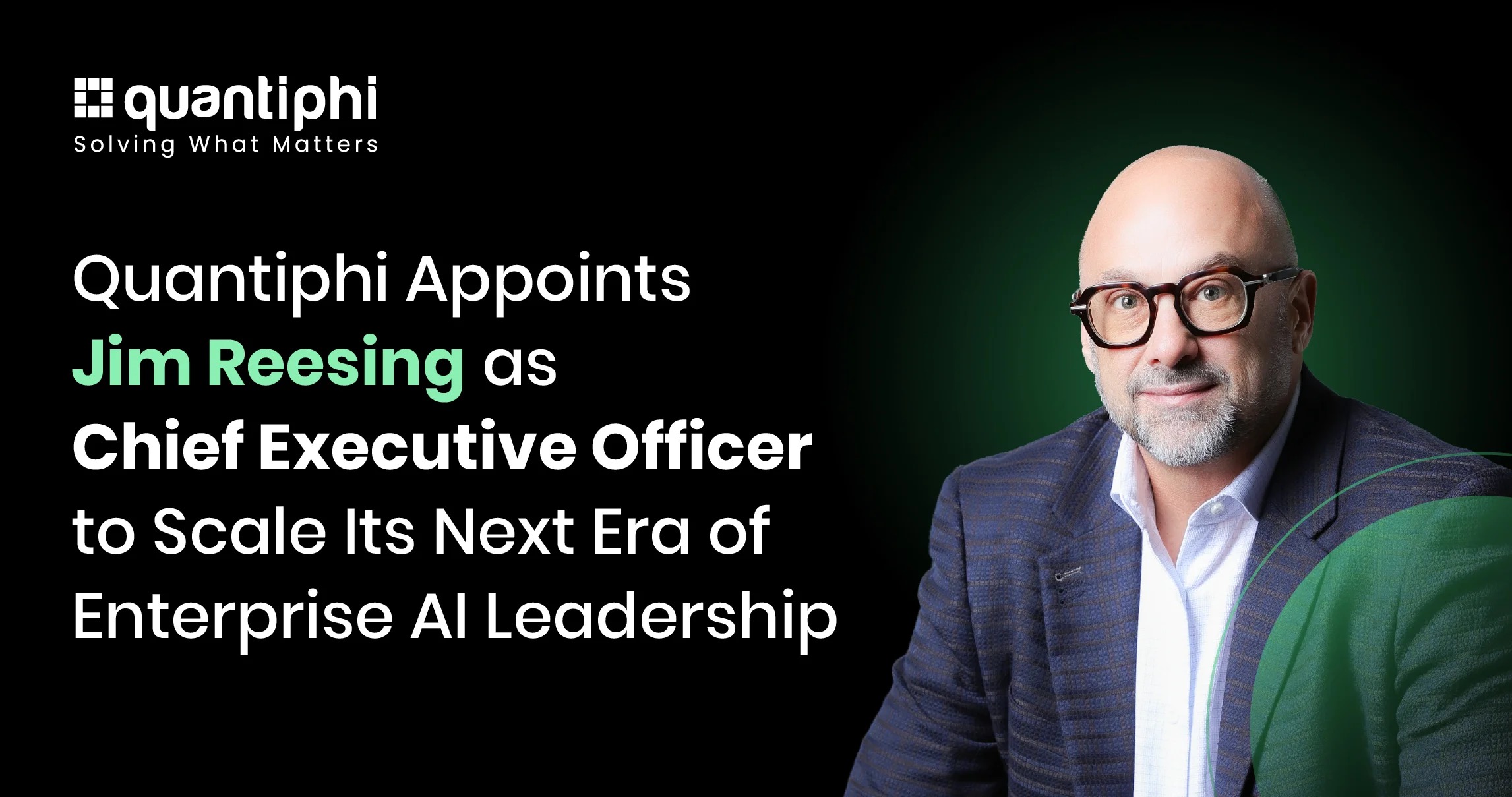
A few weeks later, in May 2026, Quantiphi named Reesing its chief executive. The appointment placed an enterprise-transformation veteran atop a company built around artificial intelligence long before AI became a compulsory item in every board presentation. Quantiphi's founders would stay involved in innovation, customers and long-term strategy. Reesing would bring the institutional experience for the next stretch. The arrangement sounded tidy. The work ahead was anything but.
Scale has a habit of arriving with luggage. It brings systems, governance, reporting lines and meetings about meetings. Some of that luggage is useful. Some of it can flatten the very instinct that made a growing company interesting. Reesing's assignment is to know the difference. He has spent more than three decades studying it from both directions, inside giants including IBM and Accenture and inside smaller, more entrepreneurial technology-services firms. His language on taking the job was revealingly careful. He wanted to combine Quantiphi's engineering ability with mature enterprise transformation. He also wanted to protect its energy.
The education of a pattern spotter
Reesing's route into technology did not begin with a computer-science degree or a garage startup. He completed a bachelor's degree in psychology at UCLA in 1989, followed by work as a high-school teacher. He later served as a technology director at Laurel School. By the middle of the 1990s, he was at IBM in network services. The progression has the appealing untidiness of a career assembled before personal brands were expected to arrive fully typeset.
Sales and growth roles followed. He worked at Kanbay, later part of Capgemini, and then spent years at Freeborders overseeing global accounts and operations. At Xchanging, he served as chief executive for North America and president of business development before becoming the executive responsible for global sales and marketing. His brief was straightforward: use sales across the business to strengthen the value proposition and produce growth.
Two sides of scale / selected stops
At Accenture, the problems grew larger. Reesing held senior roles spanning financial-services sales, insurance and banking operations, and global enterprise-transformation sales. He says that work put him across the table from boards making complicated bets. Some deals looked immaculate on paper and broke during execution. Other bets, questioned at the beginning, accumulated value. The resulting judgment, he has said, was earned slowly and sometimes painfully. It is an honest description of experience: useful precisely because the tuition was expensive.
A CEO enters by listening
New chiefs are often tempted to advertise motion before they understand the floor plan. Reesing's first public gestures at Quantiphi were quieter. He thanked the founders for the culture and momentum they had built. He promised customers “total operational continuity.” Then he toured company offices around the world and returned to Cleveland writing about hospitality, talent and the value of listening. “Let's roll,” he added, because restraint need not mean sitting still.
The company he joined had already spent 13 years working in machine learning, cloud, data engineering and applied AI. It had founders with durable influence and an engineering identity worth defending. Reesing's role was therefore closer to stewardship than rescue. Co-founder Asif Hasan described the leadership change as a way to amplify momentum while the founding team remained focused on innovation, deep customer engagement and long-term strategy. The orchestra was already playing. The incoming conductor first needed to hear it.
Reesing sees an opening between two capabilities that technology providers often keep in separate buildings. On one side sits deep AI engineering. On the other sits the unglamorous craft of changing how a large enterprise operates: process, governance, incentives, adoption and accountability. A model can produce a clever answer in seconds. A multinational company can spend years arguing over who owns the question. Quantiphi's proposed advantage is to connect those worlds, moving AI programs from impressive experiments into systems that alter measurable business outcomes.
His August 2026 essay on sovereign AI made the position more specific. Reesing argued that companies risk agent sprawl, runaway usage costs and dependence when they build on foundations they do not govern. His answer was an enterprise-owned core that keeps sensitive data and intellectual property under the organization's control while remaining portable across cloud providers and models. He paired that architecture with a distinctly operational prescription: design for human adoption, reuse disciplined pipelines and expand from proven value rather than demanding wholesale reinvention on day one.
The argument is commercially convenient for an AI services company, of course. It is also continuous with Reesing's older thinking. In 2014, he published an article declaring the traditional offshore services sales model dead, contending that labor-cost arbitrage had lost its old force. More than a decade later, he is again describing a services market in which access to technical capacity is insufficient. The value lies in shaping that capacity around a client's own advantage.
The Cleveland backbeat
Executive biographies are efficient machines. They accept a life and output titles, dates and board seats. Reesing's public record contains a better detail. In Cleveland, he has sung and played guitar with Faith & Whiskey, a large cover band that has appeared at benefit events around the city. He sang with the group at the 2013 Jam for Justice performance at the House of Blues. The ten-member lineup played a repertoire built for audience reaction, and Reesing also played guitar. The band returned to Jam for Justice in 2019.
There is no need to stretch the metaphor until it complains. Still, ten musicians on a benefit stage offer a tidy lesson about organizations. Volume is not coordination. Talent is not arrangement. The person at the microphone must know when to lead and when to make room. Faith & Whiskey's public purpose added another dimension. Its gigs supported local causes, and Reesing has also written about serving on the board of FrontLine Service, a Cleveland organization working with vulnerable residents.
This local life makes the corporate one easier to see. Reesing is based in Cleveland while leading a company with teams across countries and clients across industries. The distance between those facts is bridged by routine: travel, calls, office visits, repeated listening. His farewell to Accenture emphasized friendships built through difficult work. His early Quantiphi notes emphasized the warmth of colleagues he had just met. He describes himself as a builder of teams, culture and strategy. People can decorate a résumé with the word culture; repetition across years and settings begins to look like a preference.
The difficult promise
Quantiphi's challenge is familiar to any firm that becomes valuable because it is unusual. Customers arrive. Expectations rise. More controls become necessary. The business grows capable of taking on bigger programs, but each layer of maturity risks turning its original curiosity into a procedure. Reesing is betting that enterprise discipline and entrepreneurial energy can share the same room.
His advantage is that he has lived in both rooms. He knows what large organizations require before they entrust a partner with consequential change. He also knows why smaller firms can move with an urgency that institutions struggle to imitate. The useful version of scale is not a choice between those qualities. It is a system that lets each correct the excesses of the other: engineering ambition checked by operational reality, governance kept awake by curiosity.
That balance will be tested in results rather than prose. Reesing's own standard is measurable business transformation. The immediate signs are more modest: a global listening tour, a promise of continuity, a thesis about owned intelligence and an effort to define the white space between AI engineering and operating change. It is a beginning written in pencil.
The final clue may still be his last day at Accenture. After decades of promotions and vast programs, Reesing chose to remember a room of colleagues and clients trying to solve something together. The machinery mattered. The people gave it purpose. At Quantiphi, he now has a larger machine and a faster tempo. His job is to help it grow louder without losing the tune.