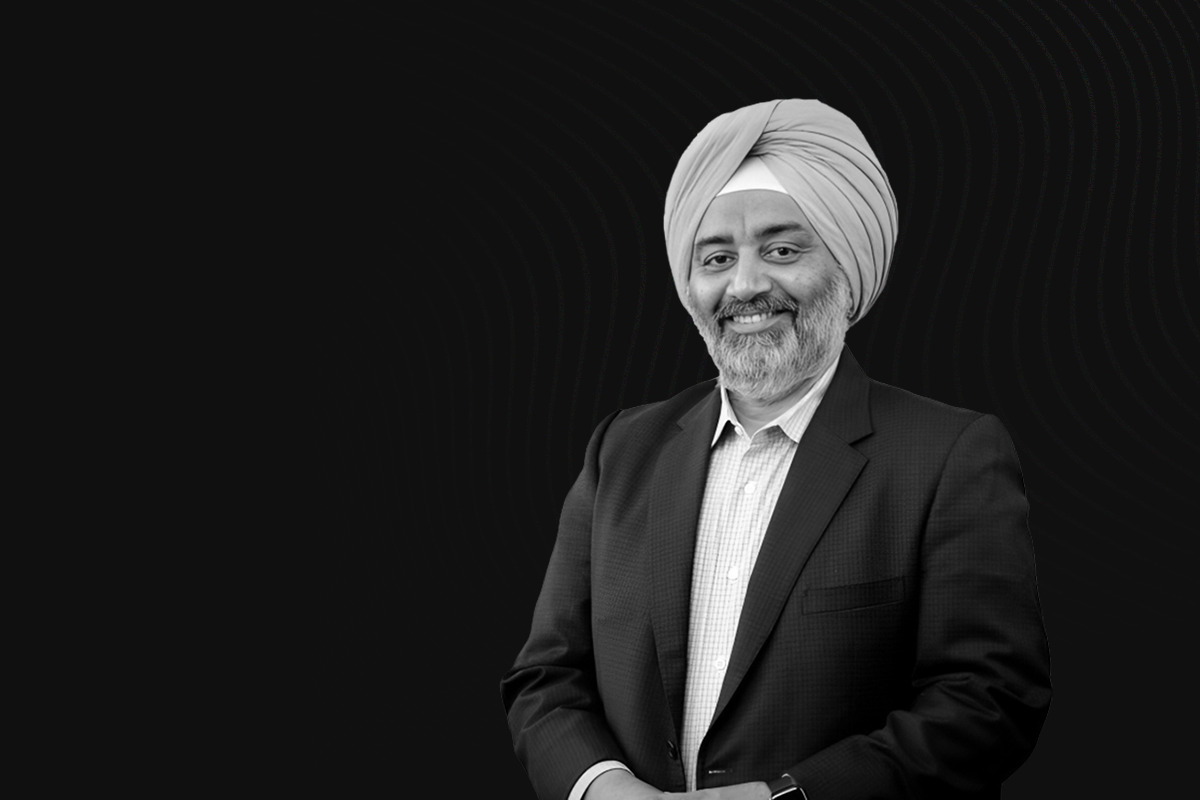
The least interesting thing a chief executive can say in 2026 is that artificial intelligence matters. Harmeet Chauhan, the CEO and board member of Neurealm, has chosen a more awkward test: prove where it changes the work. In his account of the company's AI playbook, employees follow tiered certification paths, internal hackathons surface ideas, and outside tools sit beside homegrown platforms. The ambition reaches finance, legal, sales, marketing, and delivery. Even the executive team carries a measure of how AI agents create value for the people they lead.
It is management by visible homework. The mandate turns a fashionable adjective - AI-first - into a collection of obligations. Learn it. Try it. Show the proof. Explain the result. The approach suits a leader whose career has moved repeatedly between technology as product and technology as service, and between the clean geometry of a strategy and the untidy work of making one survive an organization.
Chauhan trained as a computer engineer at Pune University and later studied business at FORE School of Management in New Delhi. His professional path crossed Microsoft, Sun Microsystems, and HCL in roles spanning sales, product management, and business development. He then became chief strategy officer and president of service lines at Aricent. After Altran acquired Aricent, he led Altran's software and internet business in North America. Products taught him leverage; services taught him context. A client rarely buys one without eventually demanding the other.
Six years at engineering's edge
At Wipro, Chauhan's remit grew around engineering and research and development. He led businesses covering 5G, Industry 4.0, cloud, data, embedded systems, and AI. When Wipro made Engineering Edge a standalone global business line in 2023, he became its global head and joined the company's executive board. It was an expansive portfolio, reaching from chip design to connected products and the systems that keep them useful.
He wrote about engineering as the “connective tissue” of a connected world. The phrase is more revealing than it first appears. Connective tissue is rarely the glamorous part of an organism, but everything complains when it fails. Modern engineering works in the same way: a clever device needs cloud infrastructure, data pipelines, security, interfaces, maintenance, and someone willing to answer a call when the demonstration becomes a deployment.
Recognition followed the operating work. His public profile lists Wipro's Best Unit Award for fiscal 2022 and a CEO Award for Best Business Unit for fiscal 2023. Wipro's engineering organization also earned industry recognition across areas including AI and machine learning. Chauhan's language around those moments consistently returned to teams, customers, and partners. When he closed his Wipro chapter in October 2024, he credited engineers who were passionate about creating an impact every day.
“Engineering provides the connective tissue for our connected world.”Harmeet Chauhan, writing at Wipro
Wipro announced that his six-year tenure would end at close of business on October 4, 2024. On October 7, he started as chief executive of GS Lab | GAVS. Three days is a short bridge between chapters, especially when the next chapter arrives with thousands of colleagues, hundreds of customers, and an industry relearning its vocabulary in real time.
A new realm, with deadlines
In May 2025, GS Lab | GAVS became Neurealm. The name joined “neuro,” for intelligence and connection, with “realm,” for an open field of possibility. Corporate names are often asked to perform feats of optimism beyond the natural abilities of nouns. Chauhan gave this one a useful constraint: exploration must lead to progress for customers, partners, and colleagues.
His stated attraction to the company began with four values - Respect, Integrity, Trust, and Empathy, shortened to RITE - and a promise of purpose-led growth. Values can become office wallpaper with alarming efficiency. The practical question is whether they shape the operating system: who learns, who decides, who benefits, and who is accountable when a promising idea refuses to become a useful one.
Neurealm's portfolio supplies the terrain. It spans platform engineering, modernization, data, cybersecurity, and technology operations. The 2026 integration of Ignitarium added silicon design, embedded systems, and perception AI. The acquisition of Veersa added another specialist engineering group. Chauhan described the combined ambition as operating across a spectrum “from Silicon to Agentic AI.” It is a neat phrase for a decidedly un-neat stack.
The risk in a portfolio this broad is the buffet problem: everything looks strategic, so nothing receives an appetite. Chauhan's answer is an engineering mindset. In a conversation shared by Neurealm, he defined it through problem solving and learning. As systems and roles blur, he argued, people need multidimensional knowledge rather than a single narrow lane. The point is not to turn every accountant into a model engineer. It is to give each function enough fluency to redesign its own work intelligently.
“That problem solving and learning mindset is super critical.”Harmeet Chauhan, on engineering in the age of AI
Curiosity with an owner
The most portable idea in Chauhan's playbook is that curiosity needs infrastructure. Neurealm offers learning paths according to role, interest, present skill, and industry. It provides external platforms. It holds internal hackathons where employees can demonstrate skills and propose ideas. It has recruited specialist talent to accelerate the work. Each move answers a different failure mode: ignorance, lack of access, fear of experimentation, and shortage of expertise.
Then comes the uncommon part: accountability. Chauhan has said every executive who reports to him has an AI-related key performance indicator, including a measure connected to agents working with their teams. The wording may evolve as the technology does, but the managerial principle is durable. A transformation stops being an innovation-department hobby when the people running the business have to discuss it in the same room as revenue, hiring, and delivery.
This does not guarantee good judgment. Metrics can be gamed; agent counts can become the digital equivalent of counting meetings. The value lies in forcing a better conversation. What task changed? What became faster or clearer? Where did quality improve? What still needs a human decision? A sensible scorecard rewards consequences, not merely activity. Chauhan's emphasis on proof points with customers and employees suggests that evidence, rather than inventory, is the intended destination.
The explorer and the operator
Neurealm calls its people “neuronauts,” a coinage with the cheerful audacity of a Saturday cartoon. Beneath it sits a serious organizational proposition: exploration is a job, not a personality type. Chauhan's public remarks balance the explorer's appetite with the operator's ledger. He speaks about possibility, then attaches certification. He invokes imagination, then asks for proof. He praises learning, then puts a number beside leadership responsibility.
The duality extends beyond work. His official biography notes a passion for golf and philanthropy. Golf is, among other things, a long argument between intention and execution conducted outdoors. It feels almost too apt for a leader managing technology transformation: the landscape is visible, the variables are not, and yesterday's excellent swing has no contractual obligation to return.
His Bay Area base also places him near the industry's loudest promises. Chauhan's career, however, was built in the quieter machinery that makes promises deployable: business development, product management, engineering services, operating models, and client outcomes. That may be why his AI story is less about the magic of a model and more about the habits of a company.
The next test for Neurealm is integration. New capabilities in silicon, embedded engineering, and enterprise AI have to behave like one useful system rather than a collection of acquired nouns. Chauhan has called the company a growth platform. Platforms earn that description only when other people can build on them. The work is architectural, cultural, and commercial at once.
For leaders watching from outside, there is something to steal. Start with the job, not the tool. Give people a route to learn. Create a safe place to test. Demand proof from internal functions as well as client teams. Put accountability high enough in the organization that enthusiasm cannot evaporate on its way to the calendar. Curiosity is charming. Curiosity with an owner can change a company.
Chauhan's project remains in motion, as any honest AI strategy must. Models will change, fashionable terms will expire, and some experiments will earn a discreet burial. The durable advantage is not knowing every answer first. It is building an institution that learns quickly enough to ask a better question, and disciplined enough to do something with the reply.