The most revealing thing about Levio may be its name. It comes from a Latin verb meaning “to make lighter,” which is a neat promise to sell a bank replacing core systems, an insurer untangling a merger or a government department whose workflow has acquired the geology of an ancient city. The work is rarely photogenic. It involves architecture, code, procurement, security, policy, training and the diplomatic arts required to get all six to agree. Levio has turned that difficult middle into a company of roughly 2,000 people serving about 300 clients.
Founded in Québec in 2014 by François Dion, the firm is neither a strategy boutique that leaves after the slides nor simply a body shop billing developer hours. Its offer runs from business strategy and program governance through software engineering, cloud migration, data platforms, cybersecurity, enterprise systems and change management. The customer buys one accountable bench for the whole transformation - or a selected piece of it - and Levio earns project fees and continuing managed-service revenue. There is no public menu price. The cost follows the size of the team, the duration, the risk and the service level, which is how enterprise consulting usually works.
01 / THE JOBBetween the diagram and the deploy
The clients explain the shape of the company. Levio works in financial services, insurance, government, health and life sciences, retail, telecommunications, manufacturing, aerospace and defence. These buyers have legacy systems that cannot simply be unplugged, regulators who expect receipts and users who still need service while the rebuild is happening. A mobile app may be the visible output. Underneath are identity, data, mainframes, cloud controls, contact centres, new employee routines and a small parliament of stakeholders.
Levio's pitch is that business context and technical execution belong in the same room. A program can begin with an operating model or customer journey, proceed through architecture and custom software, plug into Salesforce, SAP, ServiceNow or Guidewire, and end with training, adoption metrics and operational support. That breadth places Levio between global integrators such as Accenture, CGI and Deloitte and smaller specialists that may be deeper in one platform but too narrow for the whole mandate.
This is also why the company is difficult to describe with the fashionable shorthand “AI consultancy.” AI is one line in a much larger wiring diagram. Levio's engineers work across AWS, Azure and Google Cloud; its data teams build warehouses, lakes and real-time pipelines; its security practice covers identity, incident response, privacy and compliance. Project and program managers then keep budgets, vendors and milestones from drifting apart. Customers are not buying a chatbot. They are buying the ability to place a new capability inside an organization that already has thousands of employees, years of data and no appetite for an outage.
The economics follow that reality. A strategy workshop may open the door, engineering expands the mandate, and managed services extend the relationship after launch. Platform partnerships reduce reinvention: Salesforce for customer systems, major cloud providers for infrastructure, Snowflake and Databricks for data, ServiceNow and SAP for enterprise operations. Levio can remain an adviser while also supplying the people who configure and connect those products. That makes the model more durable than a one-off report, although it also asks the client to watch for the familiar consulting hazard of dependency. Good delivery should leave stronger internal teams, not permanent training wheels.
The product is not advice. It is fewer seams between the people who promised the outcome and the people expected to ship it.
The difference is meaningful only when the pieces behave as one team. A broad catalogue can otherwise become an expensive directory. Levio's public case is built on delivery accountability, senior industry expertise and Canadian ownership, a useful combination in government procurement and in discussions about data sovereignty. Its scale is large enough for multi-year programs but still smaller than the multinational firms whose internal handoffs can resemble client handoffs.
02 / THE MOONSHOTAn enterprise consultant, 400,000 kilometres away
Then there is the robotic arm near the Moon. Levio's AI division grew from Menya, a specialist founded by computer scientist Froduald Kabanza in 2007. In 2018, Menya began work with MDA Space on behalf of the Canadian Space Agency to support autonomous operations for Canadarm3, the next-generation robotic system planned for the lunar Gateway. Its HybridLogic technology helps machines reason through goals and plan sequences of actions.

Distance changes the product requirement. At roughly 400,000 kilometres from Earth, communication delays make constant human control impractical. A robot must plan, react and recover with limited intervention, while the margin for improvisational chaos is close to zero. That makes the project a compact advertisement for Levio's broader claim: technology matters when it can make decisions inside a real operating environment, not when it merely performs well in a demo.
The space work is unusual, but its commercial value is terrestrial. Levio also offers AI roadmaps, governance, data readiness, custom models, enterprise agents and automation. Its CORALS platform work addresses military command-and-control tasks such as threat assessment, tactical planning and execution monitoring. In banks, insurers and health organizations, the vocabulary changes to fraud, service, compliance and productivity. The shared problem is putting automated decisions into consequential workflows without surrendering accountability.
03 / THE ENGINEBuy the missing muscle
Levio did not pretend to grow every capability from a seed. It acquired it. More than ten deals helped the firm enter new geographies and add specialist teams. Indellient brought cloud, DevOps and real-time-payments experience. SOLJIT brought Salesforce implementation depth and a Summit-level partner relationship. Systemscope added 35 years of federal-government service design, user experience and change-management knowledge. Menya supplied the AI lineage.
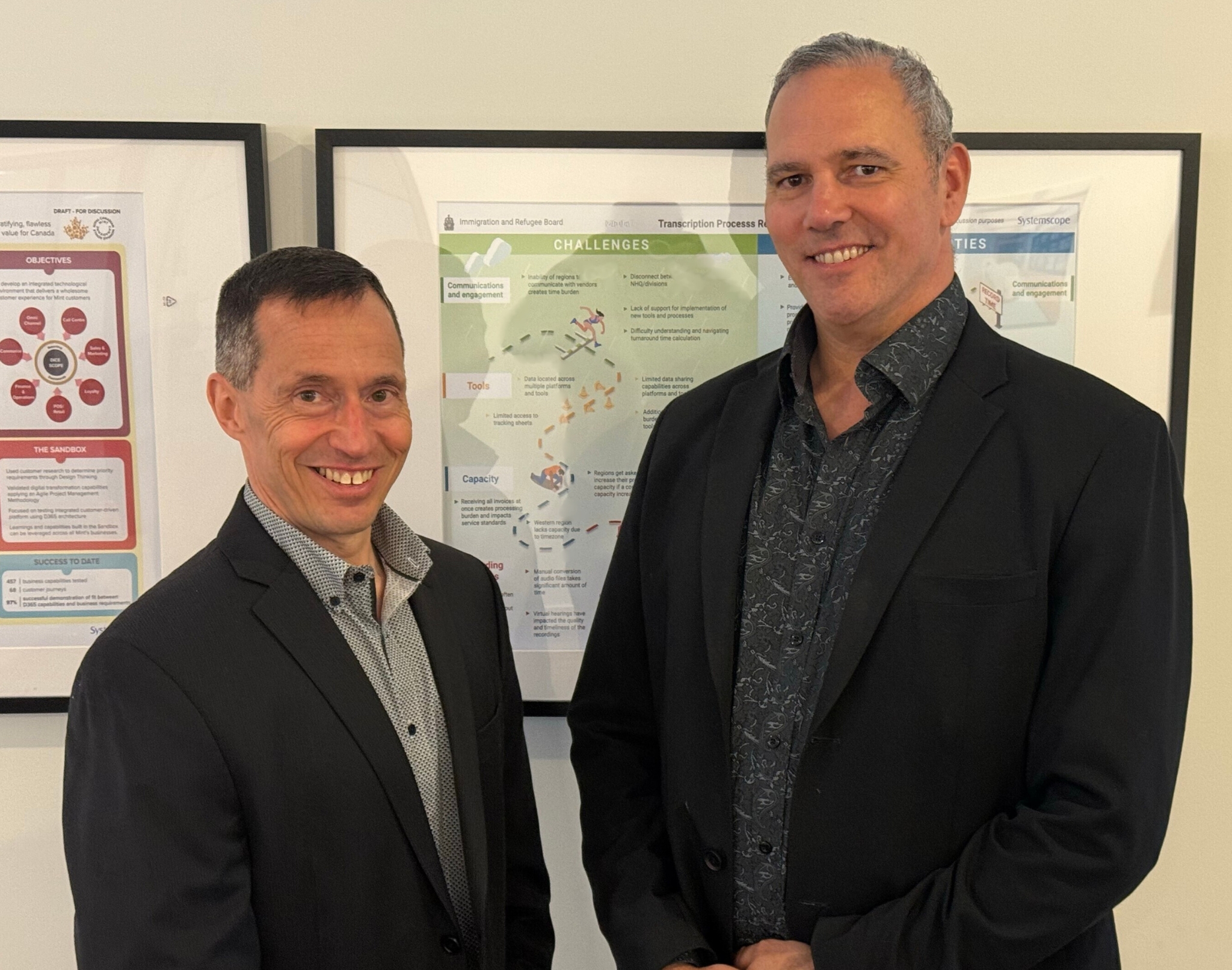
In February 2024, CDPQ invested C$125 million to accelerate that acquisition strategy. The money did not fund a single app or model. It funded the ability to assemble expertise and client relationships faster than hiring alone would allow. For a services firm, people, trust and proven methods are productive assets. The trick is integration: acquired specialists must keep the credibility that made them valuable while joining a larger sales and delivery machine.
Systemscope is the revealing deal. Federal modernization is not just software installation. It is policy, accessibility, service design, stakeholder consent and institutional memory. Buying that fluency gives Levio a better chance of understanding the problem before assigning technology to it. It also deepens relationships with a customer group whose transformations are large, durable and difficult to transfer once underway.
04 / THE NETWORKPartners make the broad promise believable
A consultancy that claims expertise in everything quickly sounds expert in nothing. Levio answers with named ecosystems and specific credentials. The SOLJIT acquisition gave it Salesforce Summit status; a later Outsourcing Services Provider designation added managed delivery, while Agentforce membership connected the practice to Salesforce's agent push. An AWS DevOps competency signals tested cloud delivery. Relationships with Microsoft, Google, SAP, ServiceNow, Snowflake, Databricks and security vendor Cyera form the less glamorous but commercially important substrate under the custom work.
Two newer partnerships sharpen the Canadian angle. PINQ² gives Levio a route to IBM's quantum computer in Bromont, so clients can test quantum use cases and plan post-quantum protection without building a physics lab. Mantle Technologies supplies distributed data infrastructure for Levio's emerging sovereignty stack. The point is not that every company needs a quantum algorithm tomorrow. It is that regulated organizations hold data for decades, while cryptography and foreign-jurisdiction risk are architectural decisions made today. Levio can sell readiness before it sells implementation.
The partnership with Kids Help Phone shows a different route to proof. Levio committed C$1 million in expertise and support to help the national youth mental-health service apply AI, beginning with social listening that can better interpret how young people describe their experiences. It is both community investment and a live test of responsible AI in a sensitive setting. If the work succeeds, the technology is useful because it improves decisions about content and services, not because anyone can admire the model.
05 / THE FIRST FAILURECuriosity met the security desk
Levio's early experience with generative AI offers the useful blemish. When ChatGPT arrived in late 2022, interest inside the firm reportedly surged through individual experimentation. Levio stopped that first rush long enough to establish a secure framework. The pause was brief, but the sequence matters. The first thing to fail was not the model. It was the assumption that scattered use could safely become enterprise practice without rules for data, access and accountability.
What changed the approach was exposure to the risk. Levio moved from individual novelty toward governed adoption and later signed Canada's voluntary code for advanced generative AI. Its current AI offer starts with governance, a roadmap and data readiness before deployment. “No data, no AI. Bad data, bad AI,” is the blunt version. The company also packages a 100-day framework intended to prove a use case, measure value and create a decision point before a pilot becomes permanent theatre.
Copy this
Pick one painful workflow, appoint an accountable owner, define the metric, install data and security rules, and force a scale-or-stop decision within 100 days.
Skip it when
No executive owns the outcome, the data is unusable, staff have no time to change their work, or the project exists mainly to signal that the company “does AI.”
That is the part other operators can steal. Start narrow, but include the conditions that make scale possible. A clever prototype without identity controls, clean data, process ownership or employee adoption is not a small production system. It is a different species. Conversely, months of governance without a live use case become policy cosplay. The bounded sprint connects the two.
06 / THE LIMITWhen the Levio model does not fit
Levio is best suited to expensive complexity: regulated operations, many stakeholders, legacy integration and meaningful consequences if delivery fails. It is a poor fit for a small company that needs one simple SaaS tool, a founder who can replace the whole stack in a weekend, or a buyer whose main requirement is the lowest hourly rate. An end-to-end consultancy carries coordination overhead of its own. If the problem is narrow and the interfaces are obvious, a specialist can be faster and cheaper.
The acquisition playbook also has a failure condition. Buying expertise works only if the parent preserves talent, methods and client trust. Standardize too aggressively and the specialist edge disappears; integrate too lightly and the customer receives a collection of logos. Levio's continuing test is whether a 2,000-person firm can remain as accountable as the handful of experts Dion began with.
For now, the company occupies an interesting Canadian middle: big enough to orchestrate enterprise programs, locally owned enough to make sovereignty part of the discussion, and technically eclectic enough to move from a citizen-service workflow to an autonomous space robot without changing the basic promise. Make the system lighter. Keep the important parts running. Leave behind something that works after the consultants go home - even when home is 400,000 kilometres away.