data-sovereignty
(20)
Galaxy Backbone wants Nigeria’s government to stop buying the same IT twice
Built to connect a fragmented public sector, Nigeria’s state-owned technology company now sells cloud, connectivity and a place to keep the country’s data. Its hardest job is turning shared infrastructure into services people actually use.

Prevalent AI spent nine years fixing the data. Then came $22 million.
The London company built its business untangling enterprise security data. Now it is betting that the same knowledge graph can give AI agents a more reliable picture of the world they work in.
The 37-Year-Old Telecom Engineer Teaching AI to Watch Every Packet
Telesoft spent decades learning how carrier networks behave. Now it is turning that hard-won packet craft into an on-premise security stack for organisations that cannot afford blind spots - or send their most sensitive traffic to somebody else’s cloud.

Jon Toor Has Spent Four Decades Making Storage Sound Urgent
Before AI needed data lakes, Jon Toor was already translating hard drives, virtualized I/O and object storage into reasons to care. His career is a lesson in staying with one difficult industry long enough to watch its quiet machinery become the main event.
Scality Bet Against the Storage Tax - Now AI Is Making the Bet Look Timely
For 17 years, Scality has sold a stubborn idea: the valuable part of storage should be software, while the hardware underneath stays replaceable. Ransomware, sovereignty rules and GPU-hungry AI have made that once-technical argument a boardroom concern.
Cloudian Survived a Telco Crash. Now It Wants to Feed AI Without Shipping Your Data Away
Cloudian turned the wreckage of a mobile-messaging company into an enterprise storage business. Its newest wager is that the AI race will be won as much in the data room as in the GPU rack.

Brad Murdoch Is Betting the Help Desk’s Future Lives Behind Your Firewall
After two decades around B2B software and a string of acquired companies, Deskpro CEO Brad Murdoch is making a quieter AI pitch: useful automation, human judgment and infrastructure the security team can actually approve.
Levio Built a 2,000-Person Consultancy by Making Big Tech Projects Feel Lighter - Now Its AI Is Headed for the Moon
The Québec consultancy found a lucrative job between strategy decks and working software: making complex change survivable. Its playbook mixes acquisitions, industry specialists and tightly governed AI - including software intended to help Canadarm3 think for itself in deep space.

Airbyte Killed Its First Product - Then Turned Boring Plumbing Into a $1.5 Billion Company
A paid marketing tool died when COVID froze its buyers. What survived was the expensive, brittle connector code underneath - and a repeatable playbook for turning customers' least-loved engineering work into a platform.

Adot
Adot wants to search the parts of the internet that conventional engines flatten or miss - then let users and developers share in the value of the index. The idea sits somewhere between an AI answer engine, a Web3 data layer, and a public experiment in who gets paid when the internet organizes itself.

Open Social
Discover the world's only sovereign Community Collaboration Platform

Deskpro
Deskpro is a helpdesk and customer support platform that unifies email, live chat, voice, social media, SMS and WhatsApp into a single ticketing system. Founded in 2001 and bootstrapped for over two decades, it stands out by offering both cloud and on-premise deployment, making it a fit for regulated and privacy-sensitive organizations that need to keep support data in their own environments. In June 2024 it raised a $25M Series A from Elsewhere Partners, appointed Brad Murdoch as CEO, and opened a global headquarters in Austin, Texas.
webAI
webAI is an Austin-based sovereign AI company that lets enterprises build, train, and run custom AI models on their own local hardware instead of the cloud. Founded in 2019 by David Stout, Ethan Baird, and Tyler Mauer, its end-to-end platform - spanning the Navigator development environment, the Companion assistant, and webFrame clustering software for Apple silicon - keeps sensitive data on-device while delivering cloud-grade intelligence. The company reached a reported $2.5 billion valuation in early 2026 and serves customers across healthcare, retail, logistics, and aviation.

Atolio
Atolio is a private, AI-powered enterprise search platform that runs inside a company's own cloud (AWS, Azure, or GCP) or on-premises. It connects to workplace systems like Slack, Google Workspace, Office 365, Salesforce, and ServiceNow, then indexes them with document-level permissions so employees only see what they are already authorized to view. Founded in 2019 by Splunk and PagerDuty veterans, Atolio pairs hybrid semantic-plus-keyword search with permission-aware retrieval-augmented generation, giving enterprises secure question answering across siloed knowledge without their data ever leaving their environment.
ONES.com
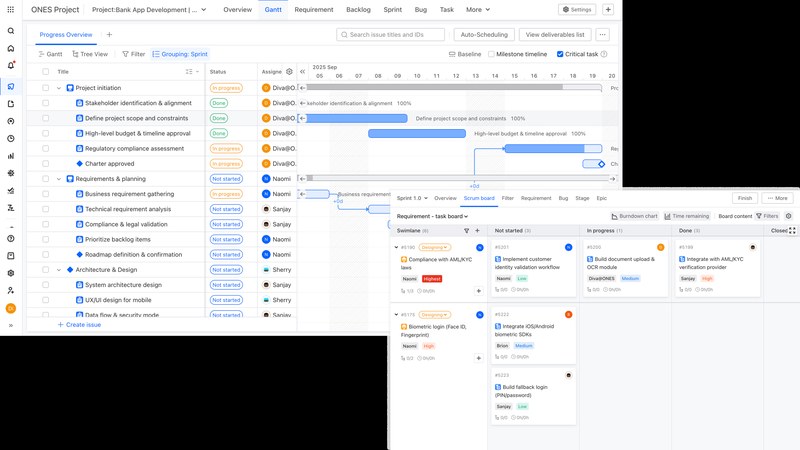
ONES.com is an all-in-one project and knowledge management platform built for software teams. It bundles project tracking, a Confluence-style wiki, test management, and CI/CD pipeline integration into one workspace, with AI woven into every plan and a strong emphasis on on-premises and air-gapped deployment. Founded in 2015 and backed by investors including GIC and Source Code Capital, ONES positions itself as a unified, self-hostable replacement for Atlassian's Jira and Confluence for enterprise teams that need data sovereignty.

Expanso
Expanso is a Seattle-based distributed data processing company built on its open-source Bacalhau project. Instead of shipping raw data to a central cloud, Expanso runs lightweight agents that filter, transform, and govern data at its source - across edge devices, on-prem systems, and multiple clouds. The 'Compute Over Data' approach cuts egress and storage costs, keeps sensitive data in place for compliance, and speeds up pipelines feeding analytics and AI. Founded in 2022 by former Google, AWS, and Microsoft engineers, it raised a $7.5M seed round in 2023.

David Aronchick
David Aronchick is the co-founder and CEO of Expanso, the Seattle company commercializing Bacalhau, an open-source platform that moves computation to where data already lives instead of hauling data to the cloud. A 4x founder, he helped launch Google Kubernetes Engine, co-founded the Kubeflow machine learning project, led open source ML strategy at Microsoft Azure, and ran Compute over Data at Protocol Labs. His through-line is a stubborn belief that technology is not neutral and that distributed systems should make computing cheaper, more private, and more useful at the edge.

Tuan Cao
Tuan Cao is the co-founder and CEO of Genetica and LIFE AI, biotech companies building AI-driven precision health for Asian populations. A Cornell-trained computer scientist who once redesigned Google's Ads reporting engine, he left a comfortable Silicon Valley career to decode genomes built for the nearly one billion people of East Asian descent that Western genetic tools serve poorly. His current venture, LIFE AI, is a Singapore-based foundational AI platform he calls the Intelligence Layer of Human Health, securing 15+ petabytes of genomic data on-chain and aiming to let people own and benefit from their own genetic data.
Pienso
Pienso is a no-code AI platform that lets domain experts - not just engineers - train, fine-tune, and deploy their own machine learning and large language models without writing a single line of code. Founded by MIT Media Lab alumni Birago Jones and Karthik Dinakar, Pienso keeps humans in the loop and data in the customer's control, with cloud or on-premise deployment for governments, media companies, and regulated enterprises.

Uniphore
Uniphore is a Business AI company that helps large enterprises put their own data to work without moving or copying it. What began in 2008 as a speech-recognition startup incubated at IIT Madras has become a full-stack, multimodal AI platform - the Business AI Cloud - that powers AI agents across customer service, sales, and back-office workflows for more than 1,600 enterprises in 20+ countries.