Company Profile · Enterprise SaaS
ONES.com
The Jira you can actually host yourself.
One workspace for projects, documents, test cases and pipelines - with AI in every plan, in the cloud or behind your own firewall.
The Jira you can actually host yourself.
One workspace for projects, documents, test cases and pipelines - with AI in every plan, in the cloud or behind your own firewall.
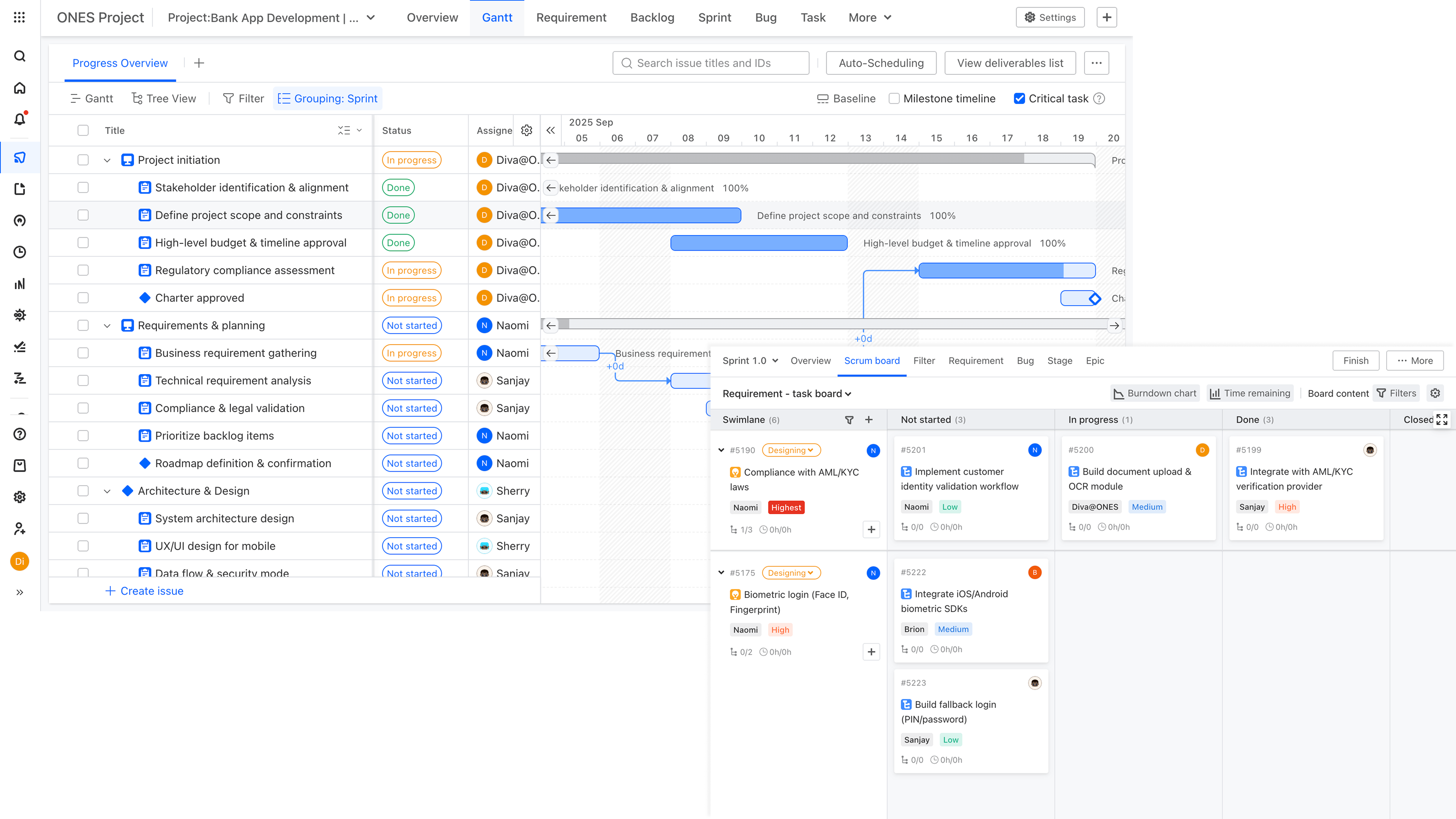
Here is a mildly heretical idea in enterprise software: maybe the problem isn't that your project tracker is bad, but that you have five of them. ONES.com, founded in Shenzhen in 2015 and now selling into San Jose boardrooms, is built entirely around that suspicion. It puts project tracking, a Confluence-style wiki, test management and CI/CD integration in one place, then adds an AI assistant, and then - the part that actually matters to a bank or a defense contractor - lets you run the whole thing on your own servers, fully air-gapped, with no cloud in sight.
That combination is rarer than it sounds. Plenty of tools do projects. Plenty do wikis. A shrinking number will let you self-host, and almost none will let you self-host an AI copilot. ONES has decided that the intersection of "all-in-one" and "runs where you tell it to" is a defensible place to stand, and it has convinced more than a thousand enterprise teams - the kind that used to pay Atlassian for Jira and Confluence and a fistful of marketplace add-ons - to test the theory.
The pieces are sold as one platform, but they map neatly onto the tools a software team would otherwise stitch together. Here's the inventory.
Gantt charts, Kanban boards, backlogs, sprints, epics and releases, with bug tracking and workflows you can bend to your process. The flagship, and the thing most Jira refugees come for.
A collaborative knowledge base with real-time co-editing and hierarchical spaces. It renders Mermaid and PlantUML natively - a small tell that it was built for developers, not just managers.
The AI layer: meeting transcription, knowledge-base Q&A with citations, defect investigation and auto-drafted release notes. Included in every plan rather than gated behind a premium tier.
Test management and quality analytics wired directly into the same project data, so QA isn't living in a separate spreadsheet universe.
No-code automation plus a scripting layer, code and pipeline integration, and MCP support - the connective tissue for teams that want to customize without rebuilding.
Managed SaaS, private cloud, or fully self-hosted and air-gapped - with feature parity across modes. This is the line item that wins regulated-industry deals.
A note on precision: user counts and funding figures for ONES come from a mix of company statements and third-party trackers, which don't always agree. Treat the round numbers as directional. The compliance credentials are more concrete - SOC 2, ISO 27001, GDPR and CMMI Level 5 - because those are the sort of thing enterprise buyers audit before they sign.
ONES's whole sales motion is a reaction to a specific frustration: the moment a team realizes "extensible" meant "buy six add-ons to get a working wiki." This is a stylized illustration of that pitch - the count of separate tools or paid extensions a team typically juggles, versus the ONES answer.
The founding metaphor is unusual, and it's worth sitting with. Most startups romanticize the garage and the lone hacker. ONES went the other way. Its origin story frames software development as an industry that had outgrown its "mysterious" early era and needed the management discipline of a factory floor - standardized processes, collective intelligence, large teams shipping reliably. The company projected a world of tens of millions of developers who would need exactly that.
You can read the entire product roadmap out of that one idea. Bundling instead of fragmentation, because assembly lines don't hand off between five vendors. Native AI, because automation is what industrialization looks like in 2026. On-premises deployment, because a factory owns its floor. It is a coherent thesis, and coherence is underrated in enterprise software, where products more often accrete features than express a worldview.
The company organizes itself around three stated values - Teams & Collaboration, Human Intelligence, and what it calls the Magic of Software - the middle one being a bet that people, not process, produce great products. That's a slightly softer note than the assembly-line framing, and the tension between the two is arguably the interesting thing about the culture.
ONES launches with a mission to industrialize software development management.
Knowledge and wiki products push ONES beyond pure project tracking.
Raises a growth round with investors including GIC and Source Code Capital.
Buys the developer community to deepen its reach among software engineers.
Launches the ONES Assistant with transcription, Q&A and automated release notes.
Positions itself as the leading self-hostable replacement for Jira and Confluence.
The named customers - KPMG, Teledyne, Fast Retailing, Beebole, Openlogi - sketch the target buyer: large organizations, often in regulated or process-heavy industries, where a spreadsheet of compliance requirements arrives before anyone talks about Kanban boards. These are also, not coincidentally, the buyers for whom "we can run this behind our own firewall" is the deciding sentence.
The competitor is obvious and enormous. ONES is fighting Atlassian's Jira and Confluence directly, and secondarily the modern wave - Monday.com, Asana, ClickUp, Linear, Azure DevOps. Against that field, ONES's differentiators aren't speed or design polish; they're bundling and deployment control. It built seamless Jira and Confluence migration precisely because the switching cost, not the feature gap, is the real thing standing between it and the incumbent's install base.
ONES has raised across multiple rounds up to Series C, with a backer list that reads like a who's-who of cross-border growth capital: GIC (Singapore's sovereign wealth fund) and Source Code Capital leading the later stage, alongside earlier participation from XVC, Vision Knight Capital and SB China Venture Capital. Reported totals vary by source - some cite roughly $50M, others higher - so the precise figure is best treated as approximate. What's clear is that patient, institutional money is underwriting a long enterprise game rather than a consumer land-grab.
ONES pitches an AI copilot that can run with no internet at all - a genuine rarity for anything with "AI" in the name.
Its founding metaphor is an industrial assembly line, not a startup garage. The romance is efficiency.
The wiki renders Mermaid and PlantUML out of the box - built for the people who file tickets, not just read them.
Its sharpest weapon is unfashionable: bundling, in an era when everyone else sells you a marketplace.
Product walkthroughs and talks live on the company's official channel.
An all-in-one project and knowledge management platform for software teams - project tracking, a wiki, test management and CI/CD integration with built-in AI, available in the cloud or on-premises.
Yes. It markets itself as a unified replacement for Jira and Confluence, with native reporting and migration tooling to move projects and docs across.
Yes - on-premises and air-gapped deployment with feature parity to the cloud version, aimed at enterprises and regulated industries needing data sovereignty.
Over 200,000 users and 1,000+ enterprise teams, including named customers like KPMG, Teledyne and Fast Retailing.
Founded in 2015 (originally in Shenzhen, China), led by co-founder and CEO Yingqi Wang, with a team of roughly 160 people.