BREAKING — BANNER MANAGES $10B+ IN REAL ESTATE CAPEX
SERIES A: $10M FROM BLACKSTONE & FIFTH WALL
CUSTOMERS AUTOMATE 80%+ OF ADMIN WORK
UP TO 10% SAVED ON PROJECT COSTS
A TRILLION DOLLARS A MONTH STILL LIVES IN EXCEL
Y COMBINATOR S19 · HEADQUARTERED IN MANHATTAN
BREAKING — BANNER MANAGES $10B+ IN REAL ESTATE CAPEX
SERIES A: $10M FROM BLACKSTONE & FIFTH WALL
CUSTOMERS AUTOMATE 80%+ OF ADMIN WORK
UP TO 10% SAVED ON PROJECT COSTS
A TRILLION DOLLARS A MONTH STILL LIVES IN EXCEL
Y COMBINATOR S19 · HEADQUARTERED IN MANHATTAN
Who they are now
The company that wants real estate to close the spreadsheet
Somewhere right now, an asset manager is reconciling a multimillion-dollar roof replacement across a budget tab, a contractor's emailed PDF, and a thread of forty replies. Banner exists to make that scene obsolete. It is an enterprise CapEx management platform built for the people who own and operate buildings - and it has quietly become the place where more than $10 billion in capital spend is tracked.
Banner is not a flashy consumer app. It is plumbing. The kind of software that owners of millions of units come to depend on without ever posting about it. Its promise is unglamorous and exact: take the entire capital process - planning, bidding, contracting, invoicing, lender draws - and put it in one system instead of forty.
Most software wants your attention. Banner wants your spreadsheet - and the trillion-dollar mess inside it.The Banner thesis, paraphrased
The problem they saw
A trillion dollars a month, tracked in Excel
Commercial real estate runs on capital projects: renovations, replacements, ground-up development, the constant churn of keeping buildings standing and rentable. The money involved is enormous. The tools were not.
Mark Murphy had seen it up close. Asset managers were responsible for billions in capital projects and managing them with the same toolkit a freelancer uses to invoice for a logo - spreadsheets, email threads, and a patchwork of disconnected apps that did not talk to one another.
The result was predictable. Budgets drifted. Approvals stalled in inboxes. Nobody had a single, current view of where a project actually stood. In an industry where a few percentage points of overrun can erase a year's return, the disorganization was not a nuisance. It was a line item.
The irony is almost too neat: an industry that obsesses over square footage and basis points had been content to run its capital programs on the digital equivalent of a shoebox of receipts.
Owners measure everything except the thing that quietly bleeds them most - the cost of not knowing where their projects stand.The case for Banner
The founders' bet
Two Berkeley grads and a stubborn hypothesis
Mark Murphy and Kunal Chaudhary met at UC Berkeley in 2015. Murphy brought the real estate finance scar tissue; Chaudhary brought years of building software for complicated workflows. Joined by co-founder Eric Gao, they started Banner in 2019 and took it through Y Combinator's Summer 2019 batch.
Their bet was contrarian in the way the best bets often are - obvious in hindsight, ignored for years. Real estate's biggest, messiest spreadsheet could become real software. Not a thin layer bolted onto accounting, but a system built from the project outward, the way the people doing the work actually think.
Mark Murphy
Co-Founder & CEO. Came from commercial real estate finance, where he watched billions get managed in tabs and inboxes.
Kunal Chaudhary
Co-Founder. Berkeley EECS. Years spent building software for complex, high-stakes workflows.
Eric Gao
Co-Founder. Berkeley EECS. Part of the original trio that took Banner through Y Combinator.
Y Combinator, S19
The accelerator that backed the early bet - and stayed on the cap table through the Series A.
There's about a trillion dollars monthly in U.S. real estate development, most tracked in Excel. Banner streamlines the entire capital process - from budgeting to invoicing.Mark Murphy, CEO
The product
Four jobs, one system
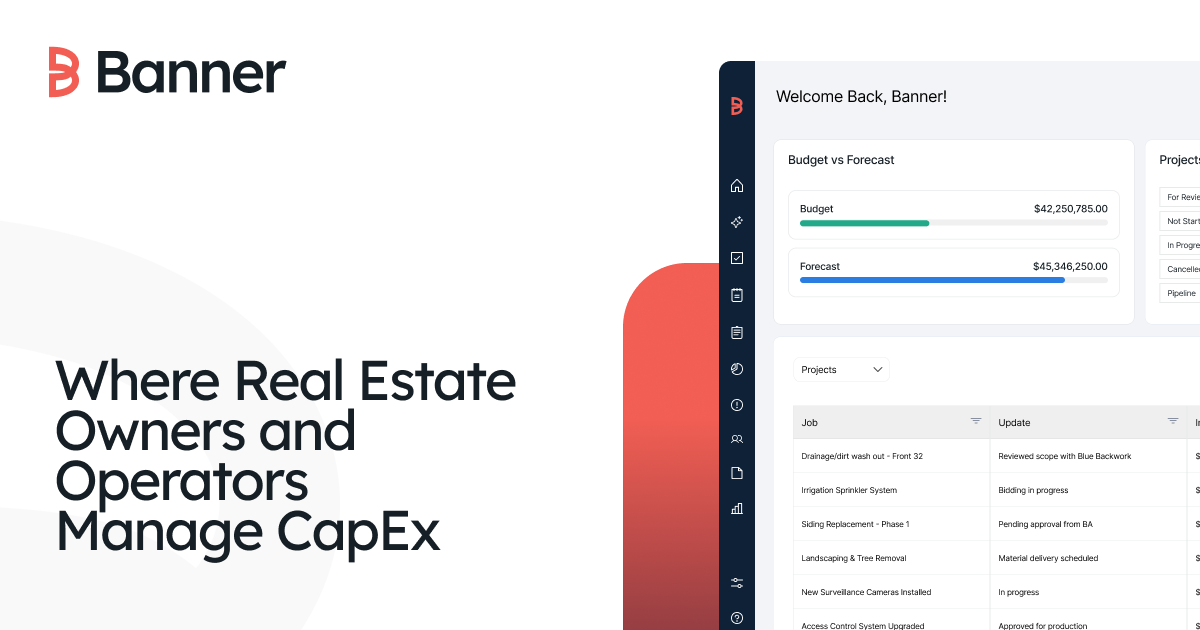
Banner consolidates communications, workflows, spreadsheets, and file-sharing into a single platform. The company says customers automate more than 80% of their administrative work and save up to 10% on project costs. The product splits roughly into four jobs that used to live in four different places.
Financial Management
Budgeting, approvals, invoicing, and lender draws - the money, in one workflow.
Project Management
Scheduling, documentation, and punch lists to keep projects on time and on budget.
Vendor Coordination
Bidding, bid leveling, contracting, and communication with the extended team.
Portfolio Analytics
Real-time visibility into capital programs across an entire portfolio.
The pitch is not "use our app." It's "stop emailing PDFs." That turns out to be a harder, more valuable sell.On Banner's product
The proof
The numbers that do the arguing
Where the work goes - before and after Banner
Illustrative split of administrative effort, based on Banner's stated 80%+ automation claim
Read it this way: four out of every five hours once spent shuffling spreadsheets get handed back. Banner's words, our chart - directional, not audited.
The customer list reads like a roll call of people who do not adopt software on a whim: LivCor, Starwood Capital, Morgan Properties, April Housing, Harbor Group International, RIDC, Summit, and Industrious. These are owners and operators of multifamily, commercial, and development assets - the kind of buyers who measure twice before they sign once.
The investors followed the same logic. The $10 million Series A, announced in October 2023, drew Blackstone Innovations Investments and Fifth Wall - two names that look at proptech for a living - alongside Pruven Capital, Basis Set Ventures, and Y Combinator.
When Blackstone invests in the software that manages real estate, it is worth noticing what they think the spreadsheet is costing everyone.On the Series A
The mission
An operating system, not an app
Banner describes its purpose plainly: to transform how real estate teams plan, execute, and track capital expenditure projects. The company states four values - Clients First, Excellence, Trust, and Speed - and they are less slogan than job description. When you handle critical financial data for institutional owners, trust is not a poster. It is the product.
The ambition behind the word "operating system" is real. Not one feature, but the layer every other workflow plugs into. Multi-year capital planning and today's punch list, finally living in the same place. That is a much harder thing to build than a dashboard - and a much harder thing to leave.
Anyone can build a dashboard. Banner is trying to build the thing the dashboards report to.On the mission
Why it matters tomorrow
The spreadsheet was never the point
Real estate is not getting simpler. Capital is more expensive, lenders want cleaner draws, and owners are squeezed to find returns in operations rather than easy appreciation. Every one of those pressures pushes in Banner's direction: toward visibility, accountability, and a single source of truth for where the money is going.
Banner is expanding past its multifamily core toward office, retail, and industrial. The bigger the footprint, the more the original bet pays off - because the problem was never specific to apartments. It was specific to the spreadsheet.
Return now to that asset manager, the one reconciling a roof replacement across a budget tab, a PDF, and forty emails. On Banner, that reconciliation does not happen, because the numbers never split apart in the first place. The budget, the bid, the invoice, and the lender draw share one record. The forty-email thread is a single screen. The scene that defined the job has quietly disappeared.
Banner's real product isn't software. It's the version of your Tuesday where the project just tells you the truth.The closing argument