Galaxy Backbone has an unusually revealing item on its website: instructions for changing the Wi-Fi password at the federal secretariat. Nearby are pleas about phones that will not boot and websites marked “unsecured.” For a company entrusted with national digital infrastructure, the support queue is a useful reality check. Government transformation still has to survive Monday morning at somebody’s desk.
That is the territory Galaxy Backbone occupies. Wholly owned by Nigeria’s federal government, it supplies the networks, computing space and shared technology services behind public institutions. It also courts private businesses. A ministry can connect offices, host applications and arrange recovery services; a company can buy connectivity or put servers in a professionally operated facility. The customer buys the means to run its work.
Its founding problem was duplication. In its account of its 2006 beginnings, Galaxy Backbone describes agencies buying technology separately, expensively and in silos. The assignment was to build common infrastructure: satellite hubs, a data centre, metropolitan fibre and redundant internet gateways. The proposition has enduring appeal to anyone who has watched neighbouring departments purchase incompatible systems. Buy the plumbing together. Give the people upstairs a chance to talk.
The first bottleneck was a payment
The ambition came with a construction bill. AidData records a $117 million contract with Huawei for the first phase of the National Information and Communication Technology Infrastructure Backbone, or NICTIB. A $100 million China Eximbank loan agreement followed in January 2013. These were infrastructure financing arrangements involving the Nigerian government, not a venture round for a software startup.
The early trouble was prosaic. AidData identifies delayed advance payments as a major reason implementation slipped: an initial payment in 2006 was followed by the remaining advance balance in December 2013. It dates completion of phase one to around August 2018. A network designed to accelerate government first had to wait for government to pay.
A second-phase loan signed in September 2018 committed RMB2.3 billion, reported at approximately $328 million, to extend the network across northern Nigeria. That amount is a financing commitment, not a verified final bill for everything Galaxy Backbone operates. The distinction matters: cables, buildings, equipment and ongoing service delivery produce different costs. Combining them into a single triumphant “investment” number would conceal more than it explained.
A national network meets an office switch
Construction was only part of the assignment. In September 2020, Galaxy Backbone announced federal approval to upgrade local area networks in government agencies. Its own explanation was refreshingly direct: LAN problems had long obstructed electronic government. The national backbone could carry traffic, but the network inside the building still mattered.
The company’s 2023 report returned to the issue, describing replacement of ageing equipment that had reached the end of its supported life. This is the operational lesson hiding beneath the ribbon-cutting photographs. A long-distance connection cannot compensate for every neglected component between the office entrance and an employee’s computer.
By the period covered in MOFI’s national asset report published in 2025, Galaxy Backbone’s service coverage was reported across 943 ministries, departments and agencies, with 400 eLTE towers, 20 fibre stations and 11,000 LAN endpoints. Those figures describe the estate it served, not a census of satisfied users. They nevertheless show why shared maintenance, configuration and support become substantial jobs in their own right.
The practical inference is simple: start a consolidation project with an inventory of what people actually use. Budget for the switches, access controls and support responsibilities as well as the impressive national link. Otherwise, the people testing your expensive infrastructure will experience it as a broken connection in an ordinary office.
Rent the room, the computer or the workflow
Galaxy Backbone’s services span several layers. Connectivity services include internet access, wide-area networking, dark fibre and managed networks. Colocation lets customers house their own servers. Cloud hosting lets them rent computing capacity instead. Backup and disaster recovery address a different question: what happens when the primary operation stops?
The cloud catalogue gives those layers product names. GxCP offers dedicated virtual machines for enterprise and government applications. GBB Shared Web provides managed web and application hosting. Cloud ECM covers correspondence, file sharing and document workflows; Cloud Mail provides government-domain email. Contact Plus supplies hosted contact-centre infrastructure. These products address recognisable administrative chores, from publishing a website to routing an incoming call.
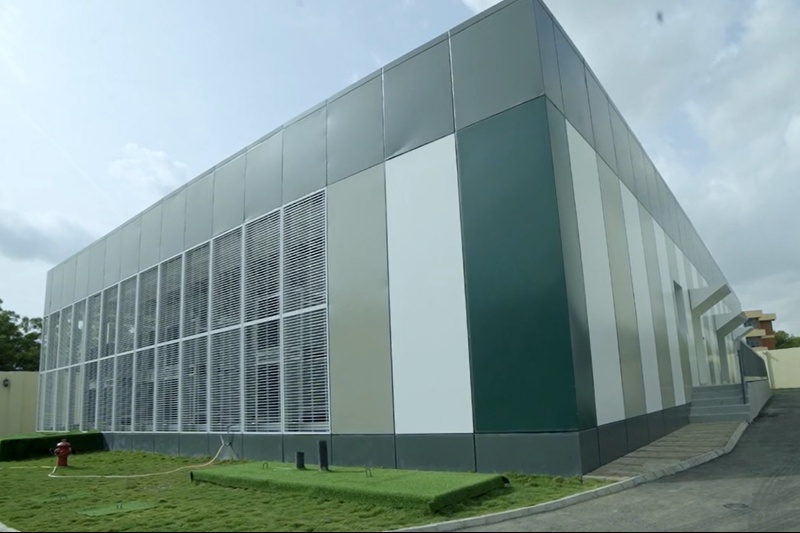
The physical anchor is a primary facility in Abuja and a secondary Tier IV facility in Kano, as described in the company’s data-centre material. The same material advertises generators capable of running for 14 days if public power fails. Even the cloud needs a fuel arrangement. That mundane detail explains some of what customers hand over when they stop maintaining their own server room.
For disaster recovery, the catalogue specifies pre-agreed recovery-time and recovery-point objectives. In plain language: agree how quickly the service must return and how much recent data loss is tolerable. Those are useful buying questions because “backup” alone does not tell a customer how the next working day will unfold.
Government is the anchor. Business is the pitch.
This is a service-contract business attached to a publicly financed infrastructure base. Customers can request quotes for their requirements. The 1Government software framework calls for subscription pricing, flexible tiers and participation by Nigerian software companies. Its intended economy is shared capacity and repeatable services, with less upfront spending by individual agencies.
Galaxy Backbone also has a market advantage that a commercial hosting company cannot easily copy: its government mandate. In August 2025, the company reported a federal circular reaffirming its role as the designated ICT infrastructure provider for federal institutions, including network services and hosting. That makes public-sector coordination part of the product, alongside computing and connectivity.
Private buyers have alternatives. Rack Centre markets carrier-neutral colocation in Lagos; Equinix’s Lagos facilities offer colocation and interconnection. Galaxy Backbone’s distinctive combination is federal relationships, shared administrative platforms and a national network connected to domestic data-centre services. Whether that combination wins a particular contract depends on what the buyer needs to connect and run.
Its commercial courtship became especially visible in July 2026, when it convened banking and fintech technology leaders to discuss digital trust, cloud migration and infrastructure performance. The company said financial institutions already used its services. The pitch places local hosting and continuity near the centre of its offer. It also puts Galaxy Backbone in conversations where service performance must persuade customers beyond its government base.
The backbone is learning to share the selling
Partnerships show how Galaxy Backbone intends to reach those customers. A December 2024 agreement with WIOCC combined the partners’ network capabilities in a bid to improve broadband reach and scalability. It was a practical acknowledgement that national connectivity benefits from connections between operators, not just more infrastructure within one organisation.
A May 2026 agreement with Simba Infrastructure makes the division of labour even clearer. The partners announced hosted unified communications and call-centre services. Simba would lead private-sector business development, while Galaxy Backbone would drive public-sector adoption and provide local hosting. Each party brought access to a different set of buyers.
The transferable idea is specific: share an infrastructure layer, then let partners contribute applications, integration and customer relationships. Galaxy Backbone’s 1Government policy similarly prioritises indigenous software providers and training. Owning the data centre does not require writing every application that runs inside it.
Its stated workplace values include innovation, accountability, customer focus and teamwork. Those are corporate intentions; the partnership arrangements show how collaboration is supposed to operate commercially. The more demanding cultural test is whether customers can get a problem owned and resolved when a service spans several organisations. A joined-up sales pitch needs a joined-up support path.

Now give the citizen a front door
The shift toward usable shared services reached a visible milestone in July 2026. Galaxy Backbone reported a soft launch of the Government Service Portal, services.gov.ng, with the communications ministry and the Korea International Cooperation Agency. The portal is intended to give citizens and businesses one place to discover and access government digital services.
The announcement described onboarding pioneer agencies, collecting feedback and improving integrations before a wider rollout. That sequence is revealing. The company began with common infrastructure; the newer task is to make separate government services feel navigable from the same front door. The launch establishes an initial step, rather than evidence that every service is already integrated.
There is a copyable method here: connect a limited group, observe the handoffs, train the users and expand after fixing the troublesome joins. It follows the phased approach in the 1Government framework. A portal can gather links quickly; getting the institutions behind them to exchange information and change their working practices takes a different kind of effort.
“empower government and businesses”From Galaxy Backbone’s published mission
The contract has to reach the desk
Galaxy Backbone’s argument for domestic hosting has sharpened around control of data and dependence on overseas platforms. Its November 2025 messaging explicitly pointed to global outages as a reason to favour Nigerian infrastructure. That explains the company’s stated sales emphasis. It does not establish that geography, by itself, removes the possibility of interruption.
For a buyer, the useful test is the whole service. Can the office reach it over more than one usable route? Who restores the application? Has anyone rehearsed recovery with real dependencies? Shared infrastructure is less helpful when an organisation retains incompatible workflows, leaves staff untrained or assumes a facility’s resilience automatically covers its software.
The company’s mission promises to “empower government and businesses.” The most convincing version of that promise is modest and measurable: a document moves, a call arrives, an application returns after trouble. Galaxy Backbone has spent two decades assembling the physical and institutional pieces. Its next test sits where the story began, with the person at the desk waiting for the connection to work.
Follow the connections
Explore Galaxy Backbone, its cloud products and GOVMail tutorial on the homepage. Visit the Government Service Portal, or browse company videos and its YouTube channel.