John Parris began with an ambition small enough to put a number on: a products company employing 10 to 15 people. By the time he left Smartronix at the end of 2020, the business was generating approximately $700 million a year, by his account. The original plan had become a rather charming piece of historical fiction. There is something disarming about a founder remembering the modest forecast after the much larger result.
Parris spent nearly 26 years at the company he co-founded in 1995. He held the business development and strategy brief before becoming chief executive. Yet the achievement he chose to emphasize on departure came from the late 1990s: helping the Marine Corps develop its enterprise network. The enormous revenue number supplied the scale. His choice of memory supplied the person.
That distinction makes his career more interesting than a simple ascent through increasingly impressive job titles. The founder associated with SMX, the company Smartronix eventually became part of, is now a co-founder and managing partner at Parraid. The newer business concentrates on telemetry and communications products. An ambition can change its address without entirely changing its mind.
A business degree, then the business of technology
Parris graduated from Indiana University’s Kelley School of Business in 1986 with a bachelor’s degree. Before Smartronix, he worked at Booz Allen Hamilton as a senior consultant. His subsequent career would bring together business development, technical services and the work of running a company. The business graduate’s eventual territory was full of networks, engineering requirements and customers whose buying decisions involved considerably more than a shopping cart.
At Smartronix, his fellow founders were Arshed Javaid and Alan Parris. The partnership matters beyond the usual founding photograph: all three appear again in the Parraid story. Their professional association survived the transformation of the first business and continued into the next. A company can acquire a new name faster than a working partnership acquires that much shared history.
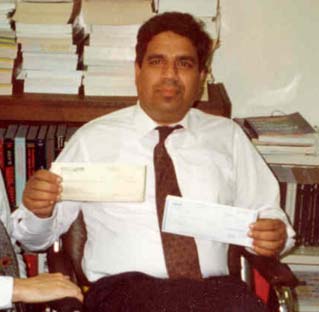
One early photograph shows John holding a document in the basement era of June 1995. The setting is ordinary, which is part of its appeal. Corporate history tends to polish the beginning until it resembles a headquarters waiting to happen. This beginning still looks like people getting a business underway. The photograph leaves the later scale pleasantly out of frame.
The work he remembered first
The Marine Corps project Parris later singled out ran from June 1997 through December 1999. Smartronix supported a worldwide network migration, consolidation of network connection points and development of the original Marine Corps Enterprise Network. On leaving the company, he specifically thanked John Burnette for believing in him and the business. More than two decades later, the introduction and the trust still merited a name.
It is a revealing way to describe growth. A founder could lead with the financing, the final revenue or the title on the door. Parris returned to a difficult customer assignment and the colleagues who helped make it happen. The memory ties the eventual size of the business to a particular piece of work rather than allowing it to float free as an abstract success.
The assignment also helps explain the distance between the original product ambition and the company that emerged. Smartronix became known for IT and engineering services, including network operations, cybersecurity and cloud work. Customers were buying technical capability applied to their own systems. The product-company plan had encountered a substantial market for people who could make complicated infrastructure work.
When the cloud joined the conversation
As chief executive from 2007, Parris led a business whose capabilities were expanding. An earlier company profile described annual revenue moving from $50 million to more than $150 million during his tenure. It also described his role as corporate strategist and evangelist. In technology businesses, that second word often arrives with a stage and a microphone. Here it accompanied the practical work of changing what the company could deliver.
Cloud computing became an important part of that change. Smartronix’s work included migrating Recovery.gov to Amazon’s cloud in 2010. The site made federal recovery spending information available to the public. Its move offered a concrete demonstration of cloud infrastructure in a government setting, where the questions extended beyond whether a website could load quickly. Cost, security and the ability to handle demand all belonged in the conversation.
By 2015, trade coverage described Smartronix’s progression from government IT implementation and operations into helping customers use cloud technology. Its government background remained relevant as it entered that market. A cloud service still needed someone to understand the customer, configure the environment and operate it. The infrastructure had changed; the obligation to make it useful had kept its job.
External rankings record part of that expansion without explaining the whole of it. Smartronix appeared at number 203 on the 2015 CRN Solution Provider 500 and number 144 in 2016, with Parris listed as CEO. Those positions give the story another dated marker. They describe the company’s place in a commercial landscape, alongside the much more personal landmarks a founder remembers.
“Thanks Elon, once again, for crushing Smartronix Management Team's excitement over company strategic plan.JOHN PARRIS / A PUBLIC LINKEDIN POST
Knowing when to bring someone else in
Parris also looked for capabilities outside the company. In June 2018, Smartronix announced a partnership with Concurrent Technologies Corporation. The combination linked Smartronix’s cloud, cybersecurity and engineering work with CTC’s applied research, engineering and manufacturing resources. Parris spoke about extending the companies’ capabilities across their customer bases. The premise was practical: some assignments become more approachable when the relevant expertise can work together.
The following year brought a larger structural change. OceanSound Partners recapitalized Smartronix in December 2019, and Smartronix began its combination with Trident Technologies. In July 2020, Peter LaMontagne was announced as chief executive of the two businesses. Parris, who had led Smartronix since 2007 and both companies since December 2019, moved to vice chairman.
The announcement credited him with taking an active part in finding his successor. That is a consequential detail in a founder’s career. Building a company and arranging for someone else to lead it demand different decisions. Parris framed the change around the next phase of growth and LaMontagne’s experience. By the end of that year, he had marked his last day at Smartronix.
The SMX identity followed in 2021. The name is useful for understanding where the original company’s history leads, but the chronology matters: Parris’s chief executive tenure belonged to the Smartronix years. His connection to SMX begins with that founding history, rather than with a claim to be its current CEO. A familiar founder and a current management team can occupy different chapters of the same business.
The original idea gets another turn
While Smartronix was moving toward a new ownership and leadership structure, its products engineering business was getting a separate home. The unit became Parraid on December 9, 2019; the public announcement followed in January 2020. Javaid described an opportunity to concentrate on electronics development and production. Alan Parris called it a return to the founders’ roots. The language was unusually literal for a new-company announcement.
Parraid inherited existing product lines and engineering capabilities. Its Hollywood, Maryland laboratory and production facility included approximately 30,000 square feet of dedicated space at the time of the announcement. The work ranged from embedded processors and circuit boards to mechanical packaging and rapid prototyping. This was a new corporate arrangement with a substantial workshop already behind it.
Its subsequent projects make that product focus tangible. In February 2021, Parraid said it had supplied a rugged USB 3.0 hub used during the entry, descent and landing stage of NASA’s Perseverance mission. The contribution was a specific component, and the company described it as such. Even a journey to Mars has room for the unglamorous necessity of getting devices connected.
In August 2022, Parraid announced a Navy Phase II Small Business Innovation Research award for Outside with Linux, or OWL. The proposed secure Linux power and data hub would connect tactical radios, peripheral equipment, applications and commercial computing devices in one rugged package. Parris discussed the gap between modern consumer devices and older communications infrastructure, and the potential to reduce integration costs. The problem was familiar in shape: useful technologies still needed a way to talk to one another.
Process received attention alongside invention. Parraid’s Radio Enhancements Program achieved a CMMI Development Maturity Level 3 appraisal in 2021 and again in 2023. The founders collectively credited their engineering team. Such milestones rarely make a vivid photograph, but they describe a business trying to make good engineering repeatable. A prototype has to work once. A company must keep delivering.
Thirty years, and the old slides still survive
Parris’s activities also extended into Maryland’s entrepreneurial institutions. TEDCO included him on its fiscal 2023 board of directors, identifying him through Parraid and his earlier Smartronix leadership. The connection placed a founder with experience of building a government technology business among people involved in supporting the state’s technology economy. It was a local institutional role in a career whose companies served customers much farther afield.
In 2025, he publicly celebrated Smartronix’s thirtieth birthday and brought out the original corporate presentation again. He drew attention to the early smart-electronics ambition and the first logo, and wished the company well for its next three decades. The affectionate interest in the old materials is striking. The opening chapter had retained its entertainment value after the financial figures became much larger.
Across those chapters, Parris’s career offers a useful complication to the tidy founder story. Smartronix grew through services. Parraid gave products a separate home. Leadership passed to a successor. The original collaborators continued working together. The first plan did not predict that sequence, and the sequence did not make the plan worthless. Years later, the small electronics company was still an idea worth returning to.
Follow the next chapter
Explore the companies, Parris’s own reflections and the projects along the way.