Seven months is a long time to wait for a new source of data. At the Home Office, Aker Systems says it brought that interval down to two. The improvement sounds like an administrative victory until you consider the work involved: information moving between organisations responsible for borders, immigration and policing. A queue in the data department can become a constraint on everyone downstream.
Aker's account of its Core Data Ingestion Platforms reports a 50-70% reduction in onboarding and integration costs, alongside updates that moved from daily or weekly cycles to minutes or seconds. These are supplier-reported project results, rather than a promise attached to every contract. But they give the company a more interesting introduction than the usual cloud vocabulary. Five months removed from a recurring task is something a buyer can understand.
Time to integrate a new data source, as reported by Aker. Project-specific results.
The company designed, built and operated the AWS-based platforms, standardising acquisition and sharing while automating onboarding and validation. The useful change was repeatability: each additional source no longer had to begin as an entirely fresh integration exercise.
“The service has proven itself to be a ‘business accelerator’”Andy Gregory, Home Office, quoted in Aker's case study
The first obstacle was permission to proceed
Aker works in the space between an organisation's ambition to use its information and the practical machinery needed to make that possible. Its customers include the Home Office, Cabinet Office, Foreign, Commonwealth & Development Office and Cboe Clear Europe. Government, financial services, and energy and utilities are its principal target markets. The common requirement is dependable access to information under demanding operational controls.
Its Cabinet Office INDEX case study is particularly revealing. The service, used by the national security and intelligence assessment community, needed to expand. Yet a Data Protection Impact Assessment was awaiting approval, holding up wider departmental onboarding. The constraint was not simply the speed of the computers. Security approval and operational readiness were preventing the service from reaching more users.
Aker says it mobilised within a week and made more than 200 architectural, technology and process changes, working alongside Naimuri. The reported outcomes included a successful IT Health Check, approval of the assessment and a cross-government security working group. A second phase added controls, automation and resilience. This was an outcome-based, fixed-price engagement: a specific obstruction, a defined piece of work and evidence that the obstruction had been cleared.
That example explains the company's appeal. A new dashboard is of limited help when a team cannot safely onboard the information behind it. Aker's proposition reaches back into the permissions, interfaces and operational practices that determine whether the dashboard will have anything useful to display.
Two products for the work nobody wants to repeat
The Cloud Enablement Platform, or CEP, addresses the environment in which applications run. Users describe their requirements through Aker's configuration language. The platform produces infrastructure definitions using reusable templates, with provision for security and networking. Generated code goes into the customer's own Git repository, giving the customer version history, visibility and room to customise.
There is a meaningful boundary to this product. Its current page specifies AWS support, with Azure and Google Cloud in development. Buyers should distinguish that product coverage from Aker's broader cloud-services capabilities. CEP also references an Aker-managed module repository. Ownership of generated code is useful, but a buyer still needs to understand the dependencies that keep deployments maintainable.
The Data Enablement Platform, or DEP, works on the information moving through those environments. It packages integration pipelines as reusable data products with metadata, data contracts and quality expectations. A searchable catalogue helps teams discover them; reusable patterns reduce repeated development; monitoring makes their behaviour visible. The point is to give the next team a known interface with stated expectations.
- 01 / CONNECTLegacy systems, files and live events
- 02 / GOVERNDefinitions, access rules and quality checks
- 03 / REUSEData products for applications and analysis
Conceptual illustration of Aker's approach, not a deployment diagram.
DEP's advertised features include no-code templates alongside code-based configuration, containerised services and an AI assistant for navigation and troubleshooting. Aker claims integration effort can often fall by 30-50% against traditional methods. That figure concerns integration effort, not an organisation's entire technology budget. Keeping the denominator attached is essential when savings enter a sales conversation.
A cloud specialist that also works on premises
Cboe Clear Europe provides a useful test of the company's positioning. For a new European equity derivatives clearing service, Aker delivered a real-time post-trade API connecting clearing members with the underlying clearing capability. Financial messages had to arrive in recognised formats, including FIX and FIXML, while the existing platform continued to play its part.
The architecture used Kafka Streams to track events and trade lifecycle state, with Kubernetes deployed on premises. Aker describes connecting the new service to the incumbent clearing platform through messaging integration. The practical lesson is modest and valuable: a modern interface can extend an existing system without requiring wholesale replacement before anything useful happens.
Elsewhere, the FCDO's consular programme combined Aker's cloud and data platforms with event-driven messaging and an intelligence service. Its case study describes replacing more than 36 legacy integrations and connecting digital services, Salesforce and contact-centre operations. Partner SVGC delivered Power BI dashboards and reports. Here, Aker's role was part of a broader delivery team, with the data infrastructure supporting the tools officials actually use.
These projects place Aker between cloud infrastructure providers, integration software vendors and large technology consultancies. Its distinction is the combination of proprietary automation, engineers who deliver the system and teams that operate it afterward. A customer's alternatives include building with native cloud services internally or assembling a software vendor and an implementation partner. The comparison should cover the whole operating responsibility, not just a feature list.
The bill has people in it
Aker's commercial model makes more sense as software plus delivery than as a simple subscription purchased with a credit card. Its G-Cloud 14 listing for Secure Cloud Data Platforms publishes a range of £400 to £1,500 per unit per day. That is a public service-pricing range; it does not establish a flat CEP or DEP licence price, or the total cost of a transformation programme.
The same listing describes planning, migration, testing and support. Aker's managed-cloud offering adds day-to-day operation, incident and change management, monitoring and continuing optimisation. For a buyer, the relevant cost calculation therefore includes the initial engineering, cloud consumption and the people responsible when something goes wrong. A cheaper build can still leave an expensive service to run.
Its separate cloud-cost assessment examines spending, overprovisioned resources, governance and forecasting. This is another clue to the company's market: organisations with enough infrastructure and internal complexity for operational housekeeping to become a serious commercial problem. A small team connecting a handful of ordinary applications may have much less need for this level of engineering.
Private equity, public systems, and a visit from Yoda
Aker Systems Limited was incorporated in 2016. Founder director Adam Fawsitt appears in LDC's 2020 investment announcement; Aker also identifies James Rowley as a co-founder, and its January 2026 staff-event presentation identifies CEO Darren Thomas as CEO and co-founder. The business grew around secure enterprise data infrastructure before broadening its commercial reach.
LDC invested in July 2020. According to the investor, Aker built an enterprise sales team within six months, invested in product automation and won two significant financial-services contracts during the partnership. Revenue grew by more than 50% and headcount doubled in a little over a year. These are historical growth measures from the investor's ownership period, not current annual growth rates. Abry Partners invested in September 2021 as LDC exited.
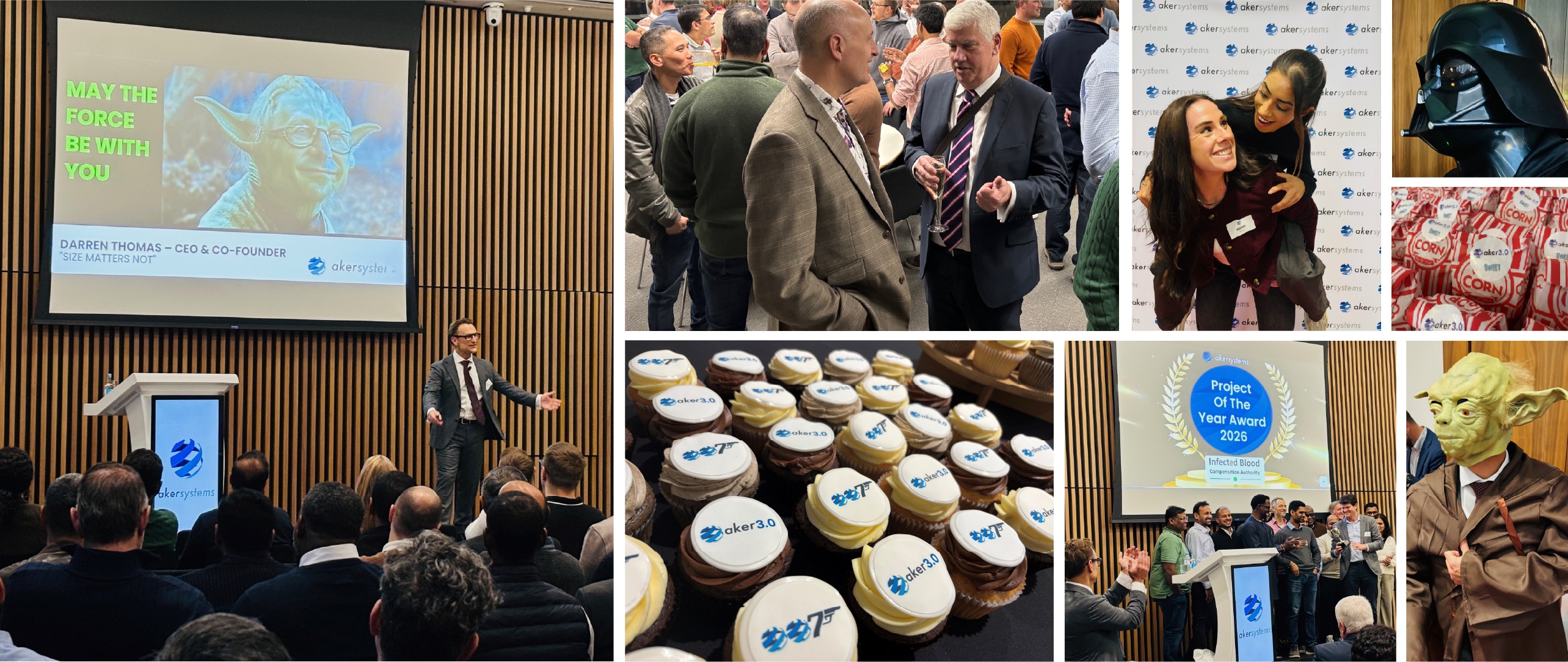
The people story is less buttoned-up than the client list suggests. Aker describes itself as remote-first, with virtual collaboration, training and at least two in-person gatherings a year. Its stated values encourage healthy debate and shared responsibility. Those are employer claims, but the staff-event photographs supply a more tangible detail: at its January 2026 meetup, the chief executive made an entrance dressed as Yoda.
The next sale may start with procurement
Two developments in 2026 show where Aker is pushing. In January, it announced a partnership with Prolinx combining data engineering with secure cloud integration and deployment across security domains. In June, it put consulting and delivery services on AWS Marketplace. The first expands how projects can be delivered; the second gives customers another established route to buy them.
Neither requires a dramatic change of corporate identity. They extend the same proposition: make difficult data work easier to commission, implement and operate. July's Tech for Good award at the Thames Valley Tech & Innovation Awards, which Aker associated with its policing modernisation work, also kept the public-sector story prominent.
Readers can copy the sequence behind these projects. Start with a specific blocked workflow. Give the data a shared definition and an accountable owner. Build reusable controls and interfaces. Measure onboarding time and integration effort. Then test whether the pattern works for the next source. The editorial lesson from Aker's case studies is that repeatability deserves to be measured as carefully as raw processing speed.
That approach depends on organisational participation. Reusable infrastructure cannot settle a dispute about who owns a dataset or what a field means. Aker's own guidance also acknowledges that some workloads suit batch processing and some systems should remain in hybrid environments. The useful question is what the job requires. For this company, five months out of a data queue is a persuasive place to begin answering it.
Follow the work
Explore Aker's platforms, project stories and conversations with its team.