The telephone was the clue. In a case published by Futurism Technologies, a printed-circuit-board manufacturer had a growing dealer network and an aging enterprise system. Distributors wanted balances, shipment updates, payment dates. Calls rose to 500 from a previous range of 200 to 300. People needed for other work were answering questions the business already had the information to answer.
Futurism built an AI chatbot using Microsoft’s language tools, Azure-hosted SQL Server, and a backend connecting conversation to records. The company reports a 60% reduction in support calls. The useful detail is the connection: a conversational interface gave dealers another route to information. That is a compact introduction to a company with a very long services menu.
- What it sells: software development, AI, cloud, cybersecurity, and the work of connecting business systems.
- What it owns: products including Diginyze commerce, BOT AMI, and industrial IoT offerings.
- Who should look: businesses whose customer experience depends on several systems working together.
01 / THE INFORMATION PROBLEMA bigger business. The same old handoffs.
Founded in 2003 by Sheetal Pansare, now President and Global CEO, Futurism operates in the busy territory between technology advice and implementation. Its expertise spans application development, testing, product engineering, data work, and ongoing infrastructure management. Customers can commission a system, connect it to existing software, and engage the company to support parts of the operation afterward.
Delivery also depends on the people doing the connecting. Futurism describes collaboration, continuous learning, and initiative as company values. In March 2024, it reported a second consecutive Great Place to Work certification. That is a dated workplace credential, but it gives some substance to the people side of a business whose offerings include engineering teams and ongoing operational support.
The customer mix includes manufacturers, retailers, healthcare organizations, financial-services businesses, and telecom operators. One named example is Venture Manufacturing, a maker of linear products such as actuators. Futurism’s case study describes weak relevant web traffic and a website that was awkward on mobile. The response combined website design, digital marketing, and branding. Here, the obstacle was reaching customers before an order existed.
my order?
business record
information
02 / COMMERCE, WITH THE BACK ROOMThe storefront has company.
Diginyze makes Futurism’s thinking easier to see. The flagship commerce platform puts an online store alongside customer relationship management, enterprise resource planning, point of sale, marketing, and analytics. It supports business-to-business and consumer selling, with separate marketplace offerings. Recommendations and search sit beside such unromantic necessities as inventory, vendors, and payments.
“Today, managing a business online is not just about putting up a website,” Pansare said in a 2021 conference announcement. The product follows that premise. A merchant needs the promise on the product page to survive the trip through stock records, checkout, and fulfillment. Bringing those functions together is Diginyze’s proposition.
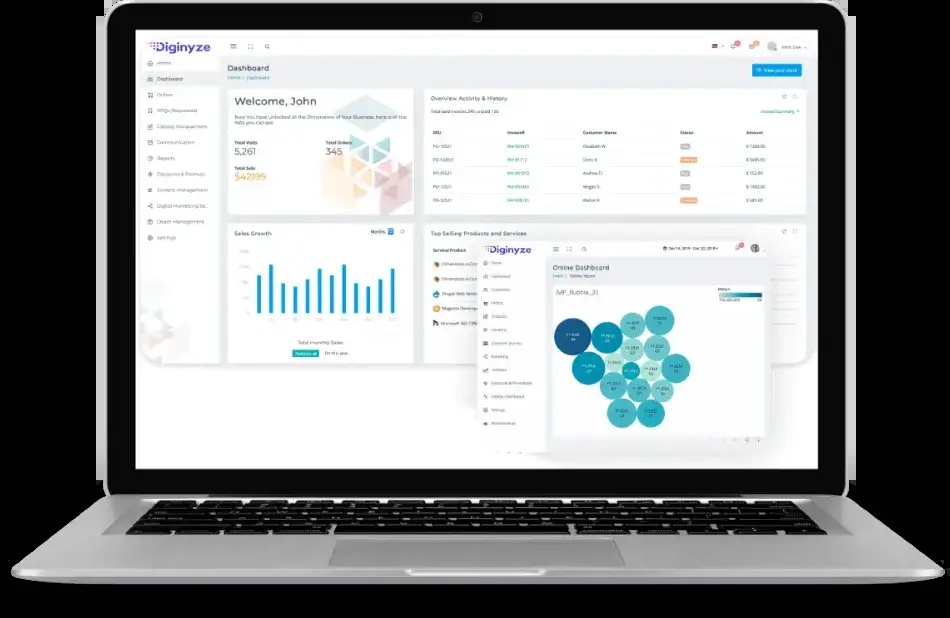
For a distributor, that means evaluating how an order reaches stock control and accounts. For a retailer, it means checking whether online and in-store activity can share the necessary records. These are useful demonstration requests because they follow the sale beyond the attractive storefront. A feature list alone cannot establish whether a particular business fits.
That also explains its market position. A buyer can assemble a store, CRM, ERP, and integration partners separately, or consider a bundled platform backed by an implementation firm. The latter offers a more concentrated relationship. The tradeoff is dependence on that provider’s capabilities, integrations, and support. Buyers should test their own awkward workflows in a demonstration.
03 / INVENTORY HAS A MEMORYThe warehouse is part of the website.
In another Futurism case, an industrial machinery supplier’s expansion outpaced its inventory tracking. Goods became harder to locate; orders suffered errors and delays. The intervention included RFID and barcodes, real-time stock updates, links to existing ERP systems, reporting, and staff training. Futurism reports the following results for this unnamed customer:
One vendor-published customer case; results are not a forecast.
Read the intervention closely and training deserves its place beside the technology. A tracking system depends on people using it correctly. The reader can copy that discipline: connect the records and teach the workflow. The figures make a useful shortlist of measurements to discuss with a supplier, rather than a ready-made business case.
Futurism’s January 2024 DeepHub Integrator announcement adds a specific credential to this work: integration of location technologies under the omlox standard. Its Hannover Messe 2026 campaign emphasizes industrial AI, connected factories, IIoT, automation, and IT/OT security. The business extends beyond screens into the movement of physical things.
04 / FOLLOW THE METERWhat the connection costs.
The commercial model combines consulting and implementation with recurring software and managed services. Diginyze’s published Starter Cloud tariff is $1,500 monthly or 2% of gross merchandise value, whichever is greater. Enterprise and Marketplace pricing is custom. At $75,000 in monthly GMV, the two starter calculations meet; above that, the percentage determines the platform fee.
Illustration: max($1,500, 2% × monthly GMV). Platform fee only; excludes any implementation, migration, payment-processing, tax, or additional service charges. Published pricing checked October 21, 2026.
Security brings another recurring relationship. Futurism describes Eagle Eye as a managed SIEM service powered by IBM QRadar, and EndPoint Secure as a managed endpoint offering using IBM MaaS360 and Watson technology. The distinction matters: Futurism packages and operates underlying technology, adding implementation and service around it. Its partner program also offers managed service providers training, support, and service-level agreements.
05 / THE BUYER’S EXPERIMENTStart with one broken handoff.
My reading of these examples is that Futurism fits a buyer with connected operational problems and a need for outside delivery capacity. Its breadth can put several responsibilities in one relationship. A narrowly scoped software requirement may call for a smaller specialist instead. The scope should follow the problem.
A useful first project has an owner, a baseline, and a handoff worth fixing.
THE BUYER’S TEST / EDITORIAL TAKEAWAY
Choose a repetitive question or costly error. Count it. Identify which system holds the answer and which person owns the process. Then test whether the connection improves the work. That is an inference from the cases, not a promised outcome. Unreliable stock records, inconsistent tagging, or inaccessible legacy systems can undermine the approach. The appealing possibility is modest and practical: fewer people chasing information, with more time to act on it.