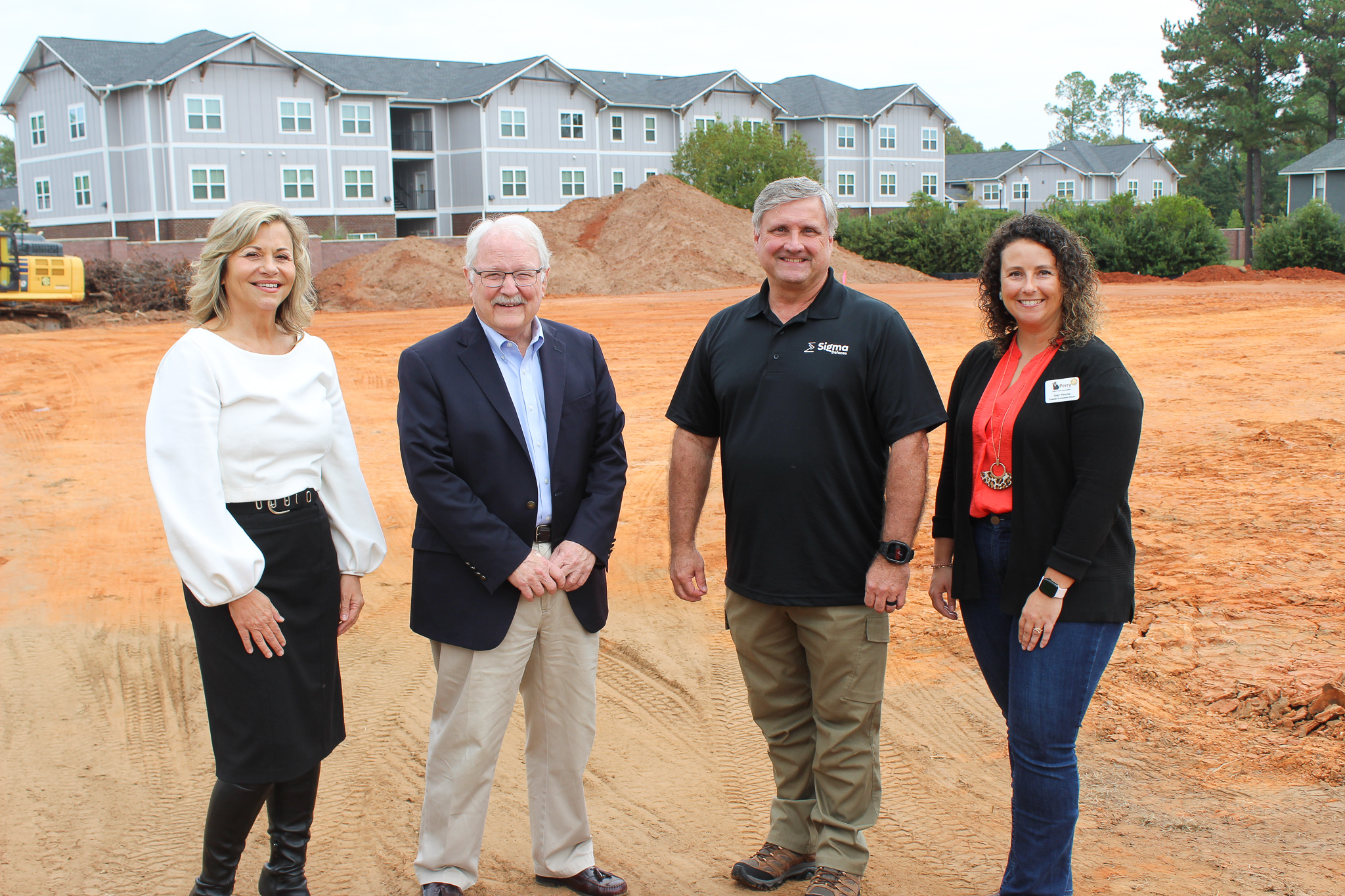
At a construction site in Perry, Georgia, Scott Ritchie stands on orange earth in a black Sigma Defense polo. Beside him is Mayor Randall Walker. Behind them are piles of dirt, an excavator and the ordinary evidence of something being built. For a business concerned with signals moving through air and space, it is a pleasingly solid setting.
The occasion was the October 2023 groundbreaking for a new production facility. Ritchie had co-founded Sigma Defense with Thor James in 2006. He had moved to Perry in 1976. Those dates give the photograph a second meaning: a founder helping put another piece of his business into a place that had been part of his life for decades.
By August 2024, the facility was ready for its ribbon cutting. Looking back, Ritchie said, “I never imagined we would achieve what we have today.” There is something refreshing about a founder allowing the future to have surprised him. Corporate histories tend to acquire a suspiciously tidy plot once the buildings are finished.
His story has several kinds of continuity: military service followed by work for military customers, a founder who stayed through a change in ownership, and a company whose expanding reach kept a physical foothold in its founding town. The most revealing question is what he chose to keep building there.
An intelligence problem with a delivery address
Ritchie’s professional territory is intelligence data transport. The phrase is dry enough to need watering, but the underlying problem is easy to understand. A sensor can collect something valuable. That information still has to reach someone who can use it. Between collection and understanding sits a considerable amount of engineering.
When Sagewind Capital invested in Sigma in 2021, the business was described in practical terms: airborne intelligence, surveillance and reconnaissance sensor data transport, supported by tactical relay and backhaul systems. The customers included the Defense Department and the intelligence community. The work connected information collected near an operation with operators and analysts elsewhere.
Consider the distinction between owning a camera and getting its pictures to the right desk. In a military setting, the journey may involve aircraft, ground equipment, satellite connections and networks. Each part has to cooperate with the next. An impressive sensor is only one participant in that arrangement.
This is useful context for understanding Ritchie’s career. His expertise spans the journey from collection through networking to processing and dissemination. The interesting unit of work is the connection between systems. That gives his business history a different center of gravity from the familiar tale of a founder with a single invention.
The company’s technical vocabulary can be imposing. The human purpose is more straightforward: help information arrive where it can support a decision. A reader need not memorize the acronyms to understand why getting the handoffs right matters.
Twenty-two years before the founding
Before Sigma, Ritchie served for 22 years in the U.S. Air Force, retiring as a Chief Master Sergeant. It is a substantial first career to place ahead of a second. The founding date, 2006, marks the start of the company; it comes well into the working life of its co-founder.
His education includes a Bachelor of Arts from Mercer University, an MBA from the University of Georgia, and program management and acquisition credentials from the Defense Acquisition University. Taken together, these qualifications sit at the intersection his later work would occupy: technical programs, business decisions and the machinery of government purchasing.
That combination helps explain the shape of the company he helped establish. Sigma brought engineering, integration and program management to defense customers. Building such a business means making technical work fit an institutional setting, with customers whose requirements extend beyond an attractive demonstration.
There is also one pleasantly accessible detail amid the credentials: Ritchie is a Georgia Bulldogs fan. His university allegiance gives the profile a brief escape from its forest of capital letters. Somewhere between an MBA and a tactical relay system, there is room for football.
The founder who stayed for the next chapter
January 2021 brought a change in Sigma’s ownership and leadership. Sagewind Capital announced an investment. John Wilcox became chief executive and Matt Jones became president. Ritchie moved into the chief growth officer role; fellow founder Thor James became chief operating officer. Both founders remained with the company and retained significant equity ownership.
The arrangement matters because a founder’s story can continue after the chief executive title changes hands. Ritchie’s involvement extended into a different phase of the business, with new executives and an investor joining the organization he and James had established fifteen years earlier.
Wilcox already knew the business from its beginning. His background included serving as chief information officer of U.S. Special Operations Command. Jones had led SAP NS2 Mission Systems. These were connections to the same world of intelligence and defense technology in which Sigma operated.
The investment offered a route to expanding customers and capabilities, including acquisitions. Ritchie publicly welcomed that prospect. It is a concrete expression of ambition: keep working on the mission while making the company capable of doing more of it.
The financial terms were undisclosed. The more illuminating detail for this story is the continuity of participation. Ritchie stayed, with a new responsibility and a continuing ownership stake. The founder became part of the next management arrangement rather than a name confined to the company’s opening chapter.
- 1976Moves to Perry
- 2006Co-founds Sigma with Thor James
- 2021Stays through Sagewind investment
- 2026Speaks for Sigma’s GEAR Lab partnership
A building makes growth visible
The Perry expansion gave that next phase a street-level expression. At the October 27, 2023 groundbreaking, local officials joined Sigma executives and employees. The project put defense production and local employment into the same conversation. For residents, a new facility also means a familiar question: what work will happen here?
The answer involved hardware and software for military communications and command systems. At its August 27, 2024 dedication, the building measured 13,400 square feet. Sigma described it as a global hub for its operations and projected more than 30 technical jobs in the region within the following year. That was a hiring expectation at the opening, rather than a completed employment tally.
Those two measures tell different stories. Floor area describes a place to do the work. A jobs projection describes the intended effect on the people around it. Keeping them distinct makes the local significance easier to see without turning a plan into a result.
The project also gives Ritchie’s remarks about Perry their weight. This was a decision involving production capacity in the town where he had arrived long before Sigma existed. A hometown connection becomes more tangible when it has equipment, working space and room for additional staff.
For an enterprise built around transporting information over distance, the building offered a useful reminder of where the work begins. Someone still has to develop, integrate and deploy the systems. Even a business concerned with the tactical edge needs a place to put its tools.
The production facility dedicated in August 2024. Space for hardware, software and the work of connecting them.
From the production floor to a place to learn
In May 2026, another Middle Georgia project added a different kind of workspace to the story. Sigma announced sponsorship and a technical partnership for the Georgia Engineering, AI & Robotics Lab at the Museum of Aviation in Warner Robins. The name contracts neatly to GEAR, a rare acronym that seems to have enjoyed its assignment.
The partnership involved hardware donations and systems integration work with the Museum of Aviation Foundation’s IT team. The aim was an on-site, AI-enabled platform for students, educators and local businesses. Sigma also participated in the lab’s advisory committee. These are practical contributions to an educational setting, using capabilities related to the company’s everyday work.
Ritchie spoke about the need to “prepare students for the demands of tomorrow’s workforce.” The phrasing connects the lab to the production facility without pretending the two are the same project. One provides a setting for professional technical work; the other gives learners a setting in which to encounter technical subjects.
There is a useful change of scale here. Intelligence infrastructure involves moving information among systems. Education involves helping people acquire the understanding to build and maintain those systems. The second task takes longer to measure, and its outcomes belong to the students as much as to any sponsor.
For Ritchie, the announcement extended a pattern visible in the Perry project: pairing a technical undertaking with an investment in the surrounding community. The connection rests on specific actions, from contributing hardware to supporting space where learning can happen.
“Prepare students for the demands of tomorrow’s workforce.”
Scott Ritchie · GEAR Lab partnership, May 2026 · excerpt
Still making the connections
Ritchie now serves as Executive Vice President of Sigma Integrated Solutions. The title places him inside a company that has continued to change since he helped found it. His earlier service as president and CEO remains part of the story, alongside the growth role he took during the Sagewind transition.
The career has an unusually clear geographic thread. Perry appears first as a place he moved to, then as the founding location of a business, then as the site of a production expansion. Nearby Warner Robins supplies the setting for a more recent educational partnership. The map gets larger without erasing those points.
The construction photograph catches that relationship particularly well. Ritchie is standing in a place where the plans have become disturbed earth but have yet to become a finished building. There is no need to supply a heroic pose. The mayor, the company polo and the machinery behind them explain the occasion.
A military career, a co-founder’s responsibilities, a changing executive role and a local learning project can look like separate entries on a résumé. Here they share a practical concern: what has to be connected so that useful work can happen? After twenty years of Sigma Defense, that question still gives Ritchie something to build.