Terry Crowell wanted a few minutes with the boss. A hydro maintenance specialist working at Oxbow Power Plant, he had heard Lisa Grow would be visiting Hells Canyon. He sent a message asking whether she had time. She did. They met in the break room at the Oxbow Shop, where Crowell told his chief executive how much he appreciated working for the company.
It is an unshowy scene: a maintenance worker, a CEO, a conversation at a power plant. Crowell remembered being comfortable talking to her. For a business whose product travels enormous distances, that small distance between people matters. A company can print its values on excellent paper. A worker asking for a conversation gives those values something more demanding to do.
Grow has spent nearly four decades at Idaho Power. She arrived in 1987, a newly qualified electrical engineer, and became president and CEO of the utility and its parent, IDACORP, on June 1, 2020. In between, she learned different pieces of the enterprise. Her route to the top involved an unusually long acquaintance with what happens underneath it.
The second woman through the engineering door
In 1987, Grow graduated from the University of Idaho with a bachelor’s degree in electrical engineering. Idaho Power hired her that year. She was the second female engineer the company had ever employed. That detail belongs beside the degree: she had trained for the work, and she was entering a workplace where women doing that work remained uncommon.
The distinction acquired another chapter in 2020, when she became the first woman to lead Idaho Power and IDACORP as president and CEO. Thirty-three years separated the engineering hire from the executive appointment. Enough time for a career to acquire several chapters before anyone gets to the apparently obvious ending.
By 2005 she was vice president of delivery engineering and operations. In 2009 she moved into senior leadership of power supply. These are substantial changes of subject within the same company. Delivery concerns getting electricity where it needs to go; power supply brings the generation side into view. Her résumé crossed both sides of the customer’s light switch.
Joins Idaho Power.
at Boise State.
of both companies.
as commencement speaker.
A second degree, twenty-one years later
Grow earned her MBA at Boise State University in 2008, twenty-one years after completing her engineering degree. By then she was already a vice president. The order is worth pausing over. She had experience to bring into the classroom, along with a business whose technical decisions came attached to budgets, customers and consequences.
Her power supply responsibilities ranged across operations and maintenance of the generating fleet, plant engineering and construction, environmental affairs, water management, planning and wholesale electricity and gas operations. The list is less tidy than the title. Water, machinery, markets and construction all had to fit inside the same working understanding of the business.
She later became senior vice president of operations and chief operating officer. In October 2019 she became Idaho Power’s president. Board appointments at both Idaho Power and IDACORP followed in February 2020. Becoming CEO that June completed a progression through responsibilities that had steadily widened. One employer had provided a considerable variety of educations.
There is a useful distinction between knowing a company’s history and having participated in its work. Grow’s background includes both. The engineering graduate had become responsible for people whose expertise extended far beyond any one degree. The more of the company she encountered, the more there was to understand.
The job becomes about people
In a 2021 interview, Grow described her responsibility in terms of keeping the lights on, looking after employees and maintaining the company’s financial footing. Customers and workers came first in her explanation of how owners would be served. The order gives some texture to a title that otherwise sounds mostly financial.
“It became a job about taking care of humans.”Lisa Grow, 2021
That statement is useful alongside Crowell’s memory of the Oxbow conversation. The interview describes an intention. The break-room encounter supplies a modest example of how access works in practice. Neither requires a leadership slogan. Somebody doing the maintenance had something to say; the person responsible for the company made time to hear it.
Electricity is a collective undertaking, and the CEO cannot personally perform all the work on which the promise depends. There are specialists keeping generating equipment ready, engineers planning delivery and crews maintaining the physical system. The chief executive’s familiarity with operations matters, but so does her willingness to leave room for other people’s knowledge.
Grow’s own account of career development includes learning to ask questions. Early hesitation about appearing uninformed gave way to a recognition that questions could help her lead. It is a particularly useful adjustment for someone whose responsibilities kept expanding: each promotion introduced more work that could not be mastered merely by carrying forward the last job’s answers.
Idaho grows. The equipment must follow.
The state around Grow’s company has been changing faster than the dates on her résumé suggest. New homes and large industrial projects create demand for electricity. By September 2026, she was discussing growth on a scale she had not previously experienced in her long career. The problem had become central to her public explanation of the job.
For 2025, Idaho Power reported approximately 2.3 percent growth in retail customers and $1.1 billion in cash capital expenditures, excluding specified construction financing and asset-removal accounting items. Those figures describe the company’s activity. They also show the scale of the decisions being made during Grow’s tenure, beyond the individual customer’s familiar monthly bill.
Cash capital expenditures at Idaho Power, with the exclusions stated above.
Retail customer growthApproximately 2.3%Growth in a service territory becomes equipment, land, construction, permits and financing. A new arrival may experience the process as a date when power becomes available. The utility must work backward through everything required to make that date possible. The grand language of economic development eventually meets the rather less glamorous question of whether the necessary equipment is ready.
Grow brings an engineer’s respect for physical constraints to this discussion. Population, business investment and computing demand can change rapidly. The electricity system still has to function as a system. Her task includes reconciling the appetite for new capacity with the expectations of customers already depending on it.
The future has a very long lead time
Idaho Power’s stated goal is to provide 100 percent clean energy by 2045. The ambition sits on top of a long history of hydroelectric generation. For Grow, whose earlier responsibilities included water management and power supply, the connection between natural resources and electricity production is part of the operating business she learned before becoming CEO.
In the company’s 2022 reporting, she and the board chair described adding solar purchases and beginning construction of utility-scale battery storage. They also discussed the Boardman to Hemingway transmission project, designed to help move energy between where it is generated and where it is needed. These were plans and milestones from that period, each with its own practical timetable.
The same report described efficiency and demand response alongside construction. That pairing is revealing. Preparing for demand includes building things and helping customers change how much electricity they need, or when they need it. The work stretches from large transmission projects to decisions made by individual households and businesses.
Grow’s education in the utility has therefore continued beyond the executive appointment. New technology arrives within an older obligation to deliver dependable service. The company has to decide what to adopt, what to build and how to pay for it. Curiosity is useful here because the questions keep changing while the obligation persists.
Back to the beginning, facing the other way
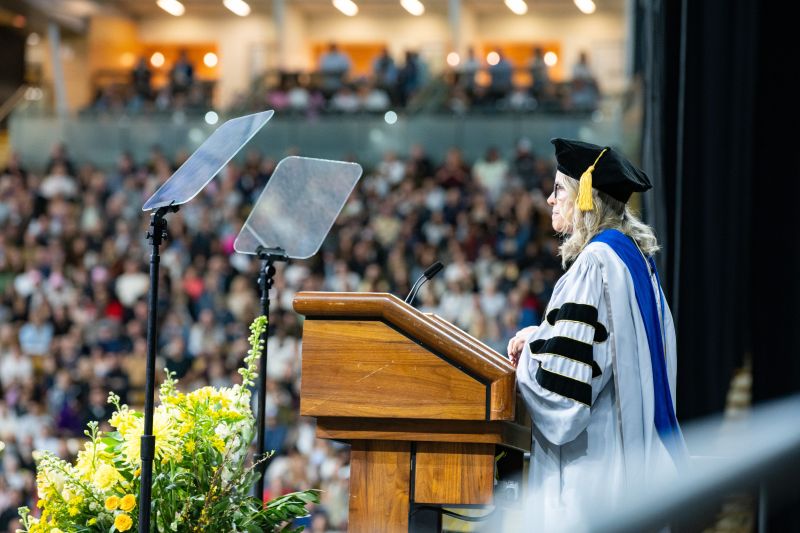
In May 2026, Grow returned to the University of Idaho as the commencement speaker in Moscow. The university that had trained her as an engineer now put her in front of a new graduating class. In photographs from the ceremony, she stands at a lectern in academic regalia, with the audience spread out beyond the teleprompters.
Afterward, she wrote about remembering the uncertainty of being a graduate. Looking back had made the unplanned turns in her own career easier to see. She encouraged the class to value connection and to leave room for joy. The advice was broader than career advancement, coming from someone whose career had eventually made her responsible for an entire utility.
Her advocacy for STEM education and the future workforce gives the return another meaning. She is speaking to people who may one day help operate the kind of system she leads. The professional story that began with an engineering qualification has become partly a question of who will receive that training next.
Her responsibilities now extend beyond electricity. American Water appointed her an independent director in August 2025. In 2026 she is also chair of the Federal Reserve Bank of San Francisco’s Salt Lake City Branch board. These assignments add other institutions to a working life still rooted in Boise and Idaho Power.
The break room at Oxbow and the commencement lectern belong to the same story. At one, Grow made time for an employee whose work kept equipment running. At the other, she addressed people just starting to discover their work. Between them sits her own long education in a company. She has the chief executive’s title now. There are still questions to ask.
Keep the conversation going
- Lisa Grow on LinkedIn ↗
- Idaho Power: officer biography ↗
- Listen: Grow and Darrel Anderson on Idaho Matters ↗
- Watch: Idaho Power with CEO Lisa Grow - BVEP ↗
- Listen: Grid Forward Chats - transmission and renewables ↗
- Read: Grow’s 2026 commencement reflection ↗
- Read: September 2026 leadership feature ↗
- Idaho Power on YouTube (company channel) ↗