Tamla Olivier wanted to be a lawyer. Then a high school guidance counselor sent her to a weekend program at Cornell, and a different career began to look interesting. Industrial and labor relations offered a way to study what happens inside organizations: how people work, how they are managed, and why some get the chance to move ahead. She went on to graduate from Cornell’s School of Industrial and Labor Relations. The future chief executive of Baltimore Gas and Electric had found her subject well before she found her industry.
It is an appealing beginning for someone who now runs a business associated with poles, wires, pipes, and enormous amounts of equipment. Her first professional specialty was people. The connection matters because electricity delivery, however technical its machinery, eventually becomes a human encounter. Someone opens a bill. Someone answers a call. Someone climbs into a truck when the weather has made staying indoors seem an excellent idea.
Olivier became BGE’s president and chief executive on May 1, 2025. She was the first woman to lead the company. By then, she had already led a home-services business, worked in customer operations, and overseen operations at three utilities. The appointment brought her back to Baltimore with a broader remit and a familiar concern: whether the organization’s work actually reaches the people depending on it.
A career in the people department
Before energy, there were financial services and manufacturing. Olivier held leadership positions at T. Rowe Price, United Defense, and Wells Fargo. Those names describe quite different workplaces, but her responsibilities repeatedly involved helping organizations change and preparing people to take on more responsibility.
At T. Rowe Price, where she spent 11 years, she introduced a supervisor program to prepare promising employees from diverse backgrounds for management roles. At United Defense, her work included implementing a people-development model as the business moved toward systems integration and software development. At Wells Fargo, she supported divisions dealing with default servicing and affordable housing. These were practical assignments inside businesses with practical demands.
There is a useful clue here to the executive she would become. Organizational change looks tidy on a presentation slide. In a workplace, it means people learning new responsibilities, managers changing habits, and somebody deciding who gets a chance. Her early career put her close to those decisions.
She joined Constellation in 2010 as an executive director of human resources. Later, she became a vice president supporting its commercial businesses and Exelon’s enterprise risk management organization. Her responsibilities were expanding across the business. The distance between understanding an organization and running one was beginning to shrink.
- 2010Human resources
Constellation - 2016Home services
BGE Home - 2021Three utilities
Pepco Holdings - 2025President & CEO
BGE
From the household to the whole system
In October 2016, Olivier became president and CEO of BGE Home and Constellation Home, while also serving as a Constellation senior vice president. Home energy services meant dealing with customers’ immediate, tangible needs: heating and cooling equipment, repairs, improvements, and the business of keeping a household functioning.
The distinction between BGE Home and BGE matters. The home-services operation was a separate business; running it was an earlier chapter in her career. She moved to the utility itself in January 2020 as senior vice president and chief customer officer, with responsibility for customer operations.
That sequence gave her experience on both sides of the doorstep. She had led a business selling home services and then took responsibility for how a regulated utility served its customers. Different commercial arrangements, different obligations, and the same awkward truth: a company’s internal explanation of its performance may bear little resemblance to a customer’s experience of it.
In November 2021, the scope widened again. Olivier became chief operating officer of Pepco Holdings, whose utilities include Atlantic City Electric, Delmarva Power, and Pepco. Her work now stretched across Delaware, the District of Columbia, Maryland, and New Jersey. The career that began in human resources had reached multi-utility operations.
The return trip to Baltimore
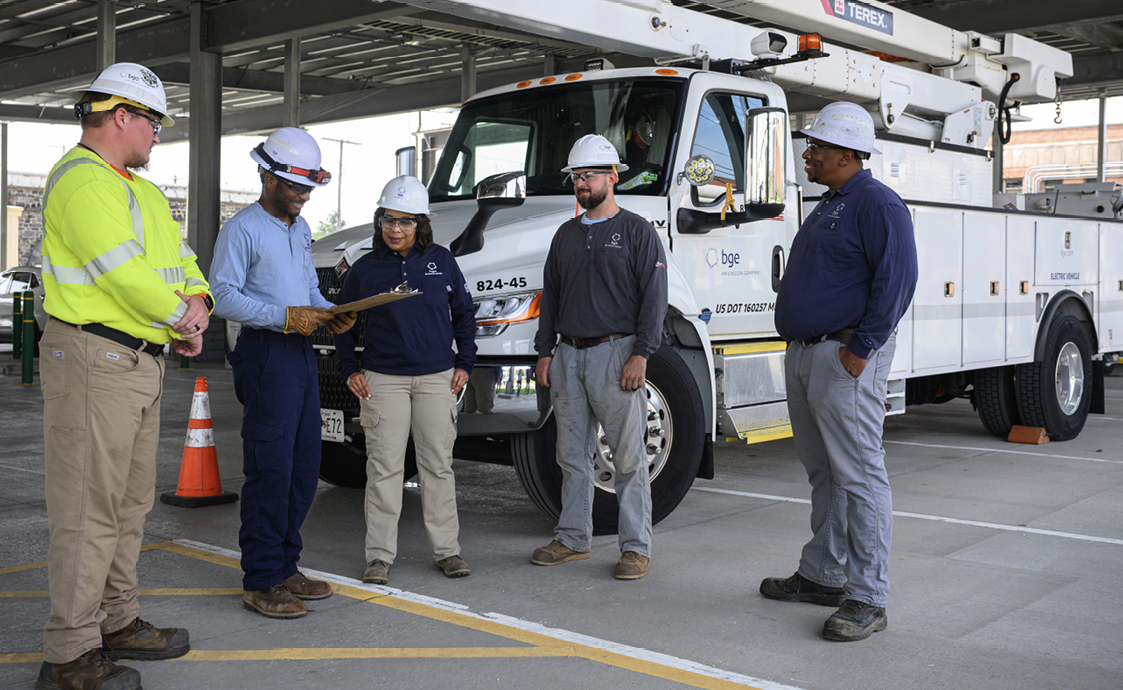
At Pepco Holdings, Olivier and her teams worked through major infrastructure upgrades, including Pepco’s Waterfront substation and Delmarva Power’s Indian River transmission project. The company achieved record reliability during her tenure. These are team results, involving the employees who plan, build, maintain, and operate an energy system. Olivier’s responsibility was to lead across that system.
When she announced her return to BGE, she credited the people at those three utilities and pointed to their work on reliability and grid improvements. Her promotion followed years of widening operational responsibility. She succeeded Carim Khouzami, who moved into an Exelon role overseeing transmission and development.
Returning also meant resuming a relationship with a city where she had spent much of her career. “Baltimore feels like home,” she said in July 2025. She described a community willing to work with people who were serious about progress. That attachment has accompanied her professional ambitions for years, through nonprofit commitments as well as executive jobs.
The title carried an additional distinction. BGE had existed for more than two centuries before a woman became its chief executive. Olivier acknowledged the significance while emphasizing the work required to get there. There was history in the appointment, and there were customers expecting service the following morning. A utility is particularly good at supplying the second half of that sentence.
“Baltimore feels like home.”
Tamla Olivier · July 2025
The bill arrives with her company’s name on it
Her return came at a difficult time for household budgets. Rising energy costs made affordability a central question of her leadership. For customers, a bill is a single amount due. For a utility executive, it contains separate costs and responsibilities. Explaining those distinctions is necessary, though an explanation alone does not make the amount smaller.
In a 2026 interview, Olivier used DoorDash to explain BGE’s role: the company delivers the energy rather than producing it. It was a notably everyday comparison for a business usually explained in the language of regulation and infrastructure. The analogy helps locate BGE within a larger system. It also makes clear why a delivery company becomes the public face of costs originating elsewhere.
In June 2025, BGE and United Way of Central Maryland announced a customer relief fund, supported by an Exelon donation. BGE’s initial allocation was $15 million. Eligible residential customers could receive one-time grants of $250 to $750, with applications opening July 1. The design paired the utility with a community organization able to administer assistance.
By November 2025, the program was reported to have assisted more than 30,000 families. Relief on that scale is a concrete response to a concrete problem. Its temporary nature also shows why Olivier keeps returning to longer-term questions about Maryland’s energy supply.
She has argued for more in-state generation and for cooperation among policymakers, regulators, utilities, and other partners. That is her stated agenda, rather than an accomplished solution. Delivering reliable service while making bills more manageable remains the test. Both promises eventually arrive at the same kitchen table.
Initial BGE allocation, administered by United Way of Central Maryland.
The less glamorous uses of clever technology
Olivier’s public discussion of artificial intelligence offers a revealing example of her approach. In 2025, she described using data analysis to improve decisions about trimming trees around utility infrastructure. Growth patterns, rainfall, and the kinds of vegetation involved could help determine when work was necessary.
Tree trimming is unlikely to dominate a glossy presentation about the future. It does, however, connect technology to ordinary operating decisions: where to send crews, when to do the work, and how to spend money effectively. In her telling, the value of the tool depends on the usefulness of the decision it improves.
In September 2026, she discussed artificial intelligence and reliability with University of Maryland Baltimore County president Valerie Sheares Ashby. Their conversation connected the utility’s work with higher education and research. The emphasis was on combining technology with human expertise, a formulation that fits a career spent moving between organizational development and operations.
Olivier was named the 2025 Technologist of the Year by the Women of Color STEM Conference. The recognition sits alongside a career that began outside engineering. Her route makes a useful point for students considering energy careers: the industry needs people who understand organizations, customers, and change as well as the equipment itself.
A place at the table, and the nerve to use it
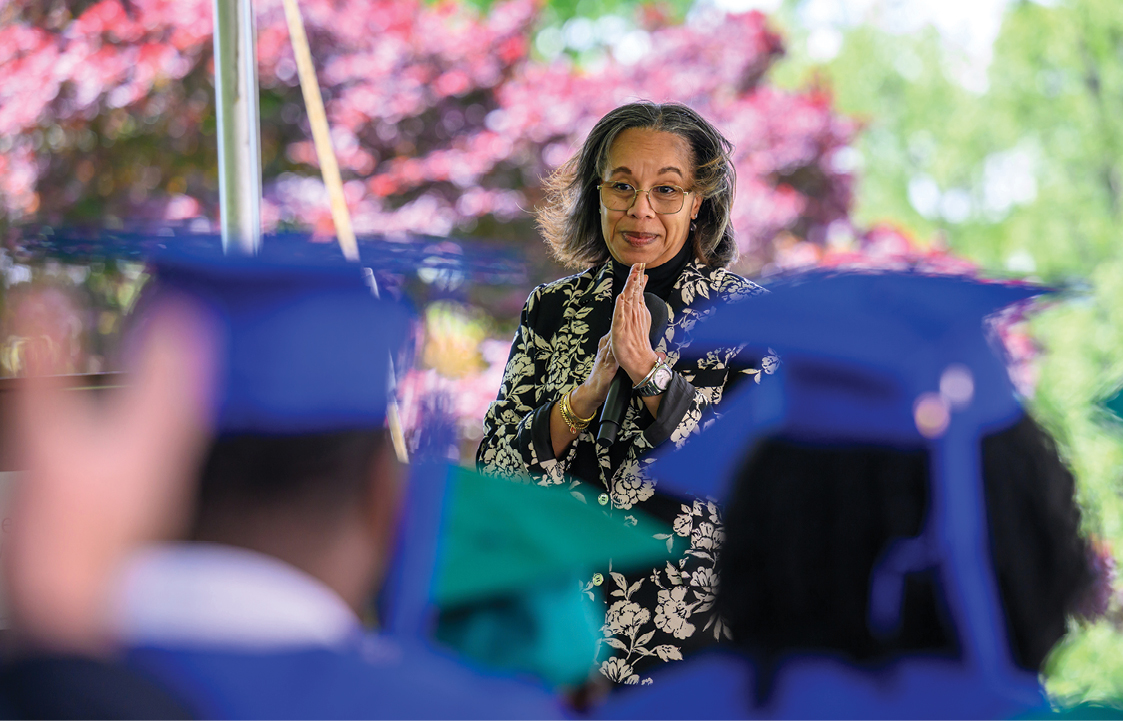
Asked about a career lesson in 2025, Olivier offered a compact instruction: “Ask for what you want to get what you need.” The advice has appeared more than once in her public comments. It challenges the expectation that diligent work will automatically be noticed and rewarded.
Her emphasis on speaking up is matched by her work on developing talent. She serves as vice chair of Maryland’s Governor’s Workforce Development Board, a role she took up in November 2025. It places workforce preparation alongside her responsibility for a business that depends on trained employees. The original interest in how people advance has survived every promotion.
She has also made room for conversations with other leaders through her Spark Series. Guests have included Maryland Aviation Administration chief Shannetta Griffin and Maryland Bankers Association president Tisha Edwards. The subjects range across organizations and communities, with attention to the experiences that shape leadership. Hosting gives Olivier another way to ask questions, rather than simply answer them.
In October 2026, speaking with Doni Glover, she returned to the matter of confidence. “Owning your brilliance matters,” she said. Her advice concerned women and people of color taking their place in rooms where decisions are made. It was a public message with the same practical premise as her earlier career counsel: participation requires making yourself heard.
For Olivier, the question has grown with the job. Once it concerned asking for a professional opportunity. Now it includes listening when customers ask for relief, employees ask for a future, and Maryland asks how it will power its economy. Her career has given her experience across those conversations. The next measure of it will be what the people on the other side receive.