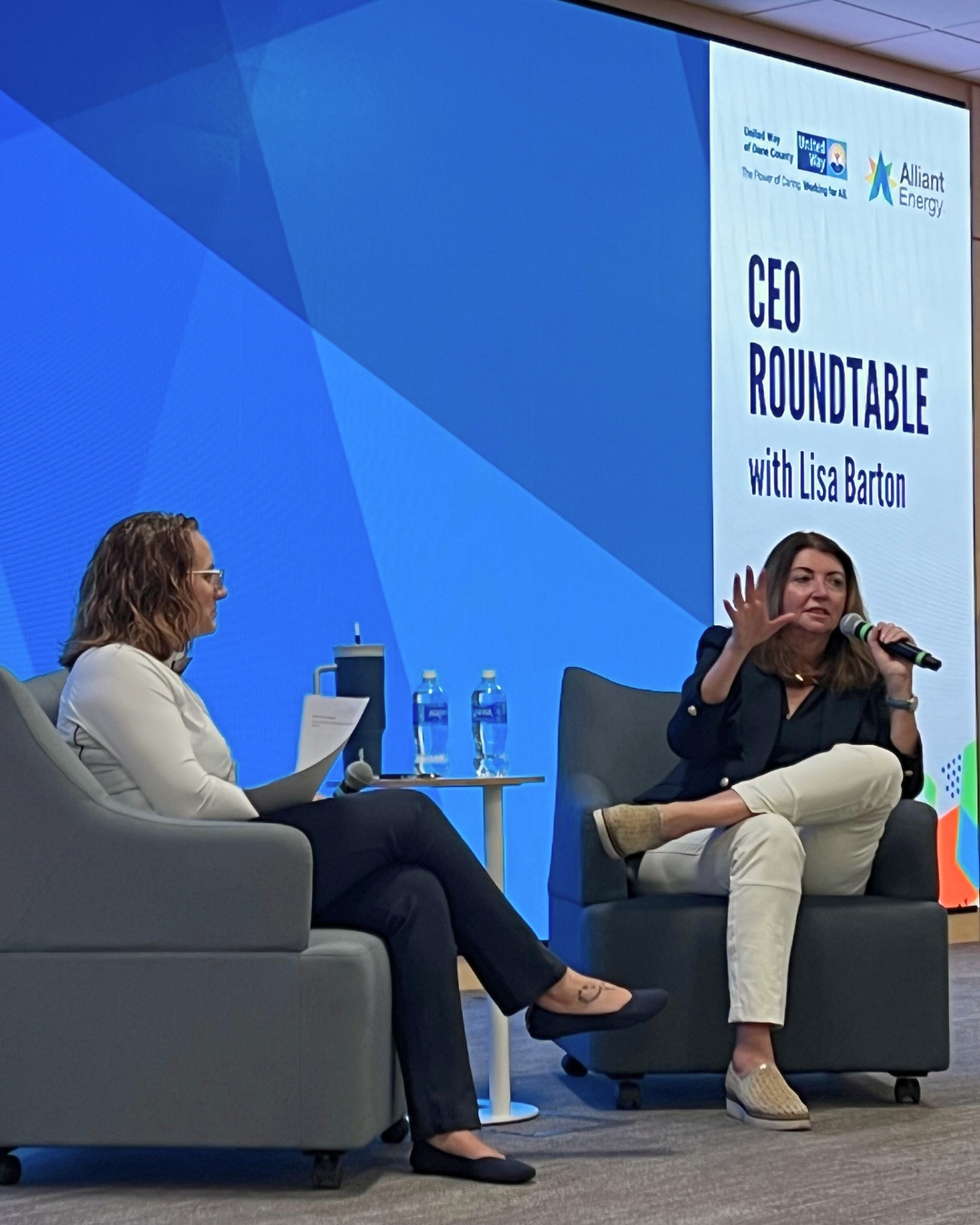
Lisa Barton noticed the quiet people. They had ideas worth hearing, but the room kept moving without them. Her response was to make their thinking audible to everyone else. At a 2025 leadership roundtable in Dane County, she gave that habit a modest job description: “So, I became a translator.”
It is an unexpectedly useful introduction to a utility chief executive. Electricity has plenty of translators already: transformers change voltage, meters turn consumption into numbers, bills turn those numbers into something people would prefer were smaller. Barton’s version works between human beings. An engineer, an attorney and a regulator can consider the same project and hear three different questions. Her career has given her practice with all three.
Since January 2024, she has been president and CEO of Alliant Energy. The company supplies electricity and natural gas in Iowa and Wisconsin. Her responsibilities also include the CEO roles at its two utility subsidiaries, Interstate Power and Light and Wisconsin Power and Light. Those names sound reassuringly old-fashioned. The demand arriving at their doorstep is rather less so.
The engineer who went to law school
Barton graduated from Worcester Polytechnic Institute in 1987 with an electrical engineering degree. A Connecticut native drawn to mathematics and science, she found encouragement from a professor whose enthusiasm helped steer her toward electrical power engineering. A career can begin with an enormous ambition. It can also begin with a teacher making a subject feel alive.
The professional world she entered offered fewer women to follow. She has described an engineering-school ratio of roughly ten men to every woman, followed by an industry where the imbalance was greater still. Remembering a course at MIT, she once said, “I could not even find a women’s restroom.” It is a small detail with an architectural punch line: belonging sometimes depends on whether the building expected you.
Her early employer was Northeast Utilities, now Eversource. Her work eventually ranged across engineering, regulation, legal matters, compliance, marketing and customer service. She earned a law degree at Suffolk University along the way. The combination meant that a technical proposal and the legal machinery surrounding it did not have to arrive on separate planets.
There were departures and returns. She worked in legal practice and energy consulting, developing power procurement and market strategies, before rejoining Northeast Utilities in 2002. Back there, she helped establish its North American Electric Reliability Corporation compliance program. Reliability rules sit precisely where her two disciplines meet: engineering describes what a system must do; law helps establish what an organization must answer for.
A conceptual map of her training and responsibilities, rather than a sequence of separate careers.
Learning the distance between a plan and a power line
In 2006, Barton joined American Electric Power. Transmission became a substantial part of her working life. The word lacks the immediate appeal of a wind turbine or a solar field, but it describes the network that lets electricity travel from where it is generated to where it is needed. A generating plant without a route to customers is a very expensive place to admire machinery.
Her responsibilities grew through transmission leadership and into the wider utility business. In January 2021, she became AEP’s executive vice president and chief operating officer. The remit brought together utility operating companies, generation, transmission, procurement, supply chain and fleet operations. The job required attention to the connections between departments as well as the connections on a network diagram.
She also took the grid’s case beyond the company. In Senate testimony in 2015, Barton described transmission as an enabler of new technologies, drawing a parallel with the data networks that had expanded what people could do with their devices. The comparison put an unfashionable piece of infrastructure into a familiar frame. New possibilities depend on the systems underneath them.
Developing people was another recurring assignment. At AEP, she worked with human resources on the GOLD program, short for Growing Outstanding Leadership through Development. Its purpose was to expose younger employees to work beyond their own positions. In a large transmission organization, someone could know a particular job thoroughly while barely encountering the range of careers around it. The program made those other routes visible.
Her own continuing education was similarly broad. It included Harvard’s mediation program for lawyers, executive study at the University of Virginia’s Darden School and MIT’s Nuclear Reactor Technology Program. These were additional programs, alongside her engineering and law degrees. Taken together, they suggest a professional habit of adding another way to understand the problem before her.
“So, I became a translator.”
Lisa Barton, at a Dane County leadership roundtable, 2025
A new address, a larger electricity bill to explain
Barton arrived at Alliant Energy in February 2023 as president and chief operating officer, while becoming CEO of its Iowa and Wisconsin utility subsidiaries. In October, the board announced that she would succeed John Larsen as Alliant’s CEO on January 1, 2024. Larsen moved into the executive chairman role. Her move to the top followed less than a year inside the company, after a much longer apprenticeship across the industry.
The business she now leads has a very public test of competence. Customers need service they can depend on and prices they can manage. Investors expect the company to earn a return. Communities want room for employers to expand. Every major infrastructure proposal sits among those expectations. Engineering can establish whether something is possible; it takes considerably more work to establish how it should be paid for.
By April 2026, Alliant had signed five electric service agreements representing approximately 3.4 gigawatts of contracted data center demand. That is a measure of contracted demand, rather than electricity already being consumed. The distinction matters. A signed agreement begins a long chain of planning, construction and coordination before the promised activity becomes an everyday load on the system.
Different measures: contracted customer demand and projected growth. Neither figure represents a completed outcome.
In July 2026, the company said it expected 60 percent load growth by 2031. Forecasts are conditional; they belong in the future tense. But the scale explains why Barton’s earlier work in networks, rules and operations matters to her present job. The digital economy still needs physical connections. Announcing a customer is one event. Serving that customer year after year is a different undertaking.
The useful question for an executive with her background is how those pieces fit. Contracts, generation, transmission and the timetable for a customer’s expansion must be considered together. So must the effect on existing customers. For a utility leader, an attractive growth figure carries a practical obligation: turn the agreement into working infrastructure without losing sight of the people already connected.
A room where bad news can get in
At the Dane County roundtable, Barton described the importance of colleagues feeling “comfortable bringing you bad news.” There is a practical engineering logic to that preference. A problem that reaches a manager early can be worked on. A problem that stays politely out of sight still exists, enjoying the additional advantage of being unattended.
Her community commitments extend beyond the industry. She has chaired United Way of Dane County’s Workforce Delegation, which considers how families can improve their earnings as the economy changes. Her arts work has included chairing the Columbus Symphony Orchestra’s board during her AEP years. In Madison, her board service includes the Overture Center for the Arts. She has also served on the Greater Madison Chamber of Commerce board.
Those commitments offer a wider view of what makes a place work. An orchestra and an electric utility have different products and rather different noise levels. Both depend on coordination, skilled people and a community willing to invest in a shared institution. Her involvement in the arts places her in rooms where the value of a city is discussed in terms beyond its demand for electricity.
She has also served on Commercial Metals Company’s board since 2020, taking her governance work into steel manufacturing and recycling. That role sits alongside her energy-industry responsibilities. The businesses have different products, yet both put investment decisions into physical assets that must keep working over time. It is another setting in which an executive has to connect a financial decision with the practical circumstances of the people carrying it out.
In a May 2026 podcast conversation with Tiffany O’Donnell, Barton described herself as someone who likes puzzles and fixing things. She recalled wanting to become an architect and spoke about the importance of relationships. The detail fits the career: she has repeatedly worked where separate pieces, and separate groups of people, have to be brought into a usable arrangement.
Back where she learned to think
On May 14, 2026, Barton returned to WPI to address its graduate commencement and receive an honorary doctorate. The electrical engineering student of 1987 was now speaking to graduates facing their own unsettled relationship with technology. She emphasized judgment. With information increasingly available, she said, “It will be the ability to think.”
Later that month, WPI announced her election to its board of trustees, with a five-year term beginning July 1. Returning as a speaker supplied a ceremonial ending to one journey. Returning as a trustee created another set of responsibilities. Education had carried her into engineering and then law; now she would help govern the institution where that first professional preparation began.
Her career leaves an interesting proposition for anyone trying to become useful in a complicated organization. Technical knowledge matters. So does learning the rules. Then comes the patient work of getting an idea across a room, particularly when its author is the person everyone else has overlooked. Barton gave that work a plain name. The power industry has given her plenty of occasions to practise it.