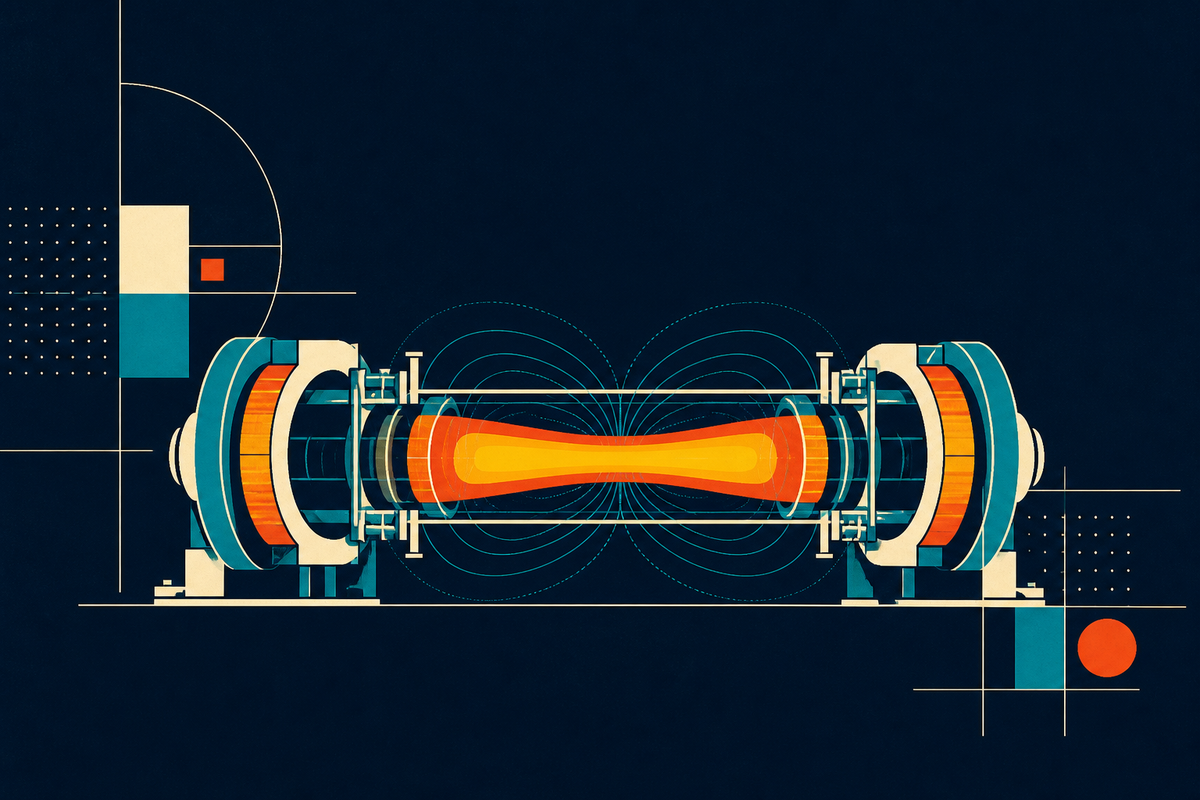
In the standard picture of magnetic fusion, a ring wins the beauty contest. The plasma loops around a torus, safely distant from any open end. Realta Fusion has chosen the less fashionable silhouette: a long cylinder pinched by powerful magnets at either end. On a schematic, it resembles a barbell. In company language, it is a magnetic bottle. In business terms, it is a wager that simplicity has been undervalued.
The Madison, Wisconsin, startup emerged in 2022 from a University of Wisconsin-Madison research program. Its founders include CEO Kieran Furlong and four UW scientists whose specialties span plasma physics, heating, blanket design and materials exposed to plasma. They are revisiting a machine that American fusion research largely abandoned four decades ago, now armed with high-temperature superconductors, radio-frequency heating and computation that the old programs did not have.
“A straight machine is easy to draw. The hard part is persuading its hottest particles not to take the obvious exit.”
The bottle and its two corks
A plasma is a furious cloud of charged particles. Realta's machine places it inside an axisymmetric chamber, with its strongest magnetic fields at the ends. As particles approach either end, the rising field can reverse their motion, bouncing them toward the center. The arrangement avoids the twisted coils of a stellarator and the continuous doughnut of a tokamak. It is geometrically legible, with components that can be reached from the side and a middle section that can, in theory, be made longer.
The design's famous flaw is right there in the name: mirrors are imperfect. Some particles scatter into a “loss cone” and escape through the ends. Realta argues that stronger magnetic fields shrink that route, while modern techniques can steady the plasma. It also wants to make the leak earn its keep. Charged particles exiting the ends carry kinetic energy that may be recovered directly as electricity, leaving the neutron share of deuterium-tritium fusion to become useful heat.
In June 2026, a converter fitted to the WHAM research device drew multiple amps at about 100 volts from plasma kinetic energy - enough to illuminate a few bulbs. The caveat matters. WHAM did not make net electricity, and the company said most of the converted energy originated in the power used to heat and sustain the plasma, not in fusion reactions. This was a proof that a collection grid could work on the machine, not proof of a commercial power plant.
Why industrial heat goes first
Realta describes its future systems as CoSMo - compact, scalable and modular. Its target list is revealing: data centers, chemical plants, metal recyclers, remote mines and other heavy industrial sites. These customers need continuous energy, often in places where an intermittent supply is awkward and a new transmission line is slow. Many also consume heat directly. A reactor that delivers steam or process heat can avoid converting every thermal unit into electricity and then, somewhere else, converting electricity back into heat.
Data centers
Round-the-clock electricity close to fast-growing loads.
Chemicals
Firm process heat where combustion is difficult to replace.
Metals
High-duty energy for recycling and industrial furnaces.
Remote mines
Transportable fuel and local heat and power without a large grid.
That is Realta's market distinction as much as its physics. Commonwealth Fusion Systems and several tokamak developers are oriented toward grid-scale electric plants. Realta talks about a range from roughly 50 to 500 megawatts electric, small enough at the lower end to match an industrial campus and extensible by adding length to the center. Its stated early ambition is energy around $100 per megawatt-hour, with a longer-term aim of $40. Those are targets, not demonstrated costs.
A machine before the machine
The physical program begins with WHAM, the Wisconsin HTS Axisymmetric Mirror at UW-Madison. ARPA-E financed its construction; Commonwealth Fusion Systems designed and built the superconducting magnets; national laboratories and research institutions contributed equipment and expertise. In 2024, WHAM produced first plasma at 17 tesla, described by the team as the highest magnetic field used in a magnetic-confinement plasma experiment.
Alongside the steel, vacuum and cryogenics sits RealTwin, the company's digital-twin effort. Realta has adapted decades of plasma codes for mirror geometry and run large particle simulations in a private cloud environment with support from Amazon Web Services. The Department of Energy later recognized a whole-device modeling milestone aimed at a tandem mirror with projected scientific gain of at least five. Modeling can narrow the design space. It cannot replace the machine that must eventually hold a burning plasma.
Names on the roadmap sound borrowed from a comic-book workshop: WHAM, Anvil, Hammir and, for the future facility, The Realta Forge. The Forge has a particularly Wisconsin address. In July 2026, Realta selected OM Station, the former Oscar Mayer plant in Madison, for its headquarters and R&D complex. State and city incentives are valued at up to $55 million, tied largely to investment and performance. Realta says the site could eventually support more than 600 jobs.
Partners in a pre-market market
Commercial fusion is young enough that competitors still need one another. Commonwealth Fusion Systems is building a tokamak, but in 2026 it agreed to design and manufacture integrated magnet systems for Realta's future devices. The arrangement gives Realta access to established HTS manufacturing, cryogenics, power systems and structural engineering. It gives CFS a customer and a new line of magnet revenue. Two different reactor geometries can share the same scarce industrial base.
Kyoto Fusioneering supplies another part of the puzzle. Realta purchased its high-powered microwave gyrotrons for plasma heating, and the two companies plan joint work on heating systems, neutron sources, blankets and fuel-cycle technology. UW-Madison remains the scientific home of WHAM. The Energy Department's milestone program provides public money only after agreed technical steps, asking Realta to bring substantial private cost share.
Private backing has arrived in stages: a $9 million seed round led by Khosla Ventures, then a $36 million Series A led by Future Ventures in 2025, followed by a reported $9.5 million Silicon Valley Bank credit facility in early 2026. The Series A was intended to finish Anvil's design. Construction of large fusion hardware will require later rounds and considerably more capital.
“What we want to avoid is seeing a few companies blow up spectacularly and spoil it for the rest of the industry.”Kieran Furlong, CEO, on fusion's hype cycle
A different lane in a crowded field
The private fusion market is not one race so much as a collection of bets on confinement, fuel and customer. Tokamaks have the deepest experimental record but require a tightly integrated ring of systems. Stellarators promise steady-state operation with more intricate magnets. Zap Energy tries to stabilize plasma without large external magnets. Helion's pulsed machines emphasize direct electricity recovery. TAE Technologies pursues a linear configuration with a different plasma and fuel strategy. Realta sits in the magnetic-confinement family, yet its straight axisymmetric chamber gives it a distinct manufacturing and maintenance argument.
Its commercial model is still being formed because there is not yet a product to price or finance. The company currently sells equity and debt to investors, matches private capital against public milestones, and turns that money into designs, experiments and a supply chain. Eventually it expects value to come from industrial heat and power. Whether Realta will own plants, sell machines, license designs or sign long-term energy contracts has not been publicly settled. Those choices will depend on how much capital each plant requires and how customers prefer to buy reliability.
The expertise required is unusually broad for a company of roughly 60 people. Its public roster includes experimental and computational plasma physicists, neutral-beam specialists, cryogenic and pulsed-power engineers, mechanical designers, nuclear engineers, project managers and facilities staff. The stated internal values - caring, credibility, transparency and urgency - read like guardrails for a laboratory being pushed toward industrial delivery. The next phase adds another culture test: translating academic openness into controlled manufacturing without losing the habit of stating precisely what an experiment proved.
That transition is why The Realta Forge matters beyond its address. A purpose-built facility can bring machine assembly, supplier qualification and operations under one roof, while keeping the company near UW's plasma and nuclear engineering talent. The former factory also makes the strategy visible: Realta does not want to remain a physics project that occasionally fabricates hardware. It wants to become a manufacturer whose product happens to contain a plasma hotter than the sun.
Where the wager can break
Realta has no commercial fusion customer and no plant producing net energy. Between WHAM and a saleable machine sit harder plasmas, longer operating periods, neutron damage, tritium handling, breeding blankets, maintainable components, licensing, supply chains and plant economics. A 17-tesla field is an enabling result; it does not solve those problems. A simulation showing a credible gain is a design milestone; hardware must confirm it.
Realta has demonstrated high-field confinement and small-scale direct energy conversion. It has not demonstrated scientific breakeven, net electricity or a commercial fusion plant. Its advantage remains a thesis being tested: stronger end magnets plus a simple linear chamber may reduce capital cost, ease maintenance and open a practical industrial-heat market.
That is also why Realta is interesting. Its story is not merely another date for fusion's arrival. It is a specific attempt to rearrange the problem. Make the reactor straight. Buy the hardest magnets from a company already learning to manufacture them. Sell useful heat as well as electrons. Turn an imperfect mirror's escaping particles into recoverable power. Grow the middle rather than enlarging every dimension at once.
The magnetic mirror lost the institutional contest once before. Modern superconductors have earned it a new experiment, not a verdict. In Madison, a machine with two ends is trying to find a commercial beginning.