Brian Berzin likes a fusion machine with the manners of ordinary infrastructure. It should be buildable without a guild of metal-bending sorcerers. It should tolerate the tiny errors that creep into physical things. It should be serviceable after years of heat, vibration and work. Ideally, it should keep running while the sun goes down, the wind changes its mind and the grid asks for another dependable block of power.
This is a wonderfully unromantic way to approach the process that lights the stars. Fusion conversation tends to drift upward, toward temperatures in the millions of degrees and promises measured in civilizations. Berzin keeps tugging it back to the factory floor. What does the magnet cost? How quickly can another one be made? What happens when the assembled machine differs slightly from its drawing? Who repairs it in year 27?
Those questions explain Thea Energy, the company Berzin co-founded in 2022 with Princeton fusion scientist David Gates and co-founder Matt Miller. Thea is pursuing a stellarator, one of the two deeply studied families of magnetic-confinement fusion machines. Stellarators are steady-state by nature and avoid the damaging disruptions associated with some other magnetic configurations. Their old irritation is visible at a glance: the magnets can resemble a French cruller designed by a mathematician during a storm.
A career shaped like a useful detour
Berzin began with electrical engineering at Lehigh University and added finance. During college, a small technical project became a company. He has described that experience as his first taste of building both a thing and the organization around it. The pairing would become his professional grammar: circuit diagrams on one page, capital tables on the next.
After college he moved to New York, where his work included investment banking, growth equity and venture capital. At Aeterna Capital Partners, he helped grow a multifamily investment office spanning venture and private-equity opportunities. Investing, he later observed, gave him many views of company building - “10 to 50 data points rather than just one.” It is the sort of sentence an engineer might use to explain why he wandered into finance.
In 2017 he crossed from judging companies to operating one, joining General Fusion. At the time, he recalls, North America had only a few private fusion companies. He rose to vice president and officer, taking on corporate strategy, commercialization and capital-markets work. He also caught what he calls “the fusion bug,” an affliction whose principal symptom appears to be thinking about power-plant economics while other people are eating dinner.
Three disciplines, one machine
The hardware can be plain. The field cannot.
Berzin knew Gates through the compact fusion network connecting New York, Columbia and Princeton Plasma Physics Laboratory. Gates had spent decades at PPPL, where the stellarator itself was invented in 1951. Their conversations gathered around an ARPA-E-funded project and a provocative possibility: preserve the stellarator's mature physics while dispensing with much of its sculptural hardware.
Thea's answer is an array of smaller, flat magnets made with high-temperature superconducting material. Each coil can be controlled individually. Together, under software control, the array synthesizes the intricate magnetic field needed to confine a twisting ring of plasma. The principle has cousins in radar and telecommunications, where many simple elements cooperate to produce a precise result.
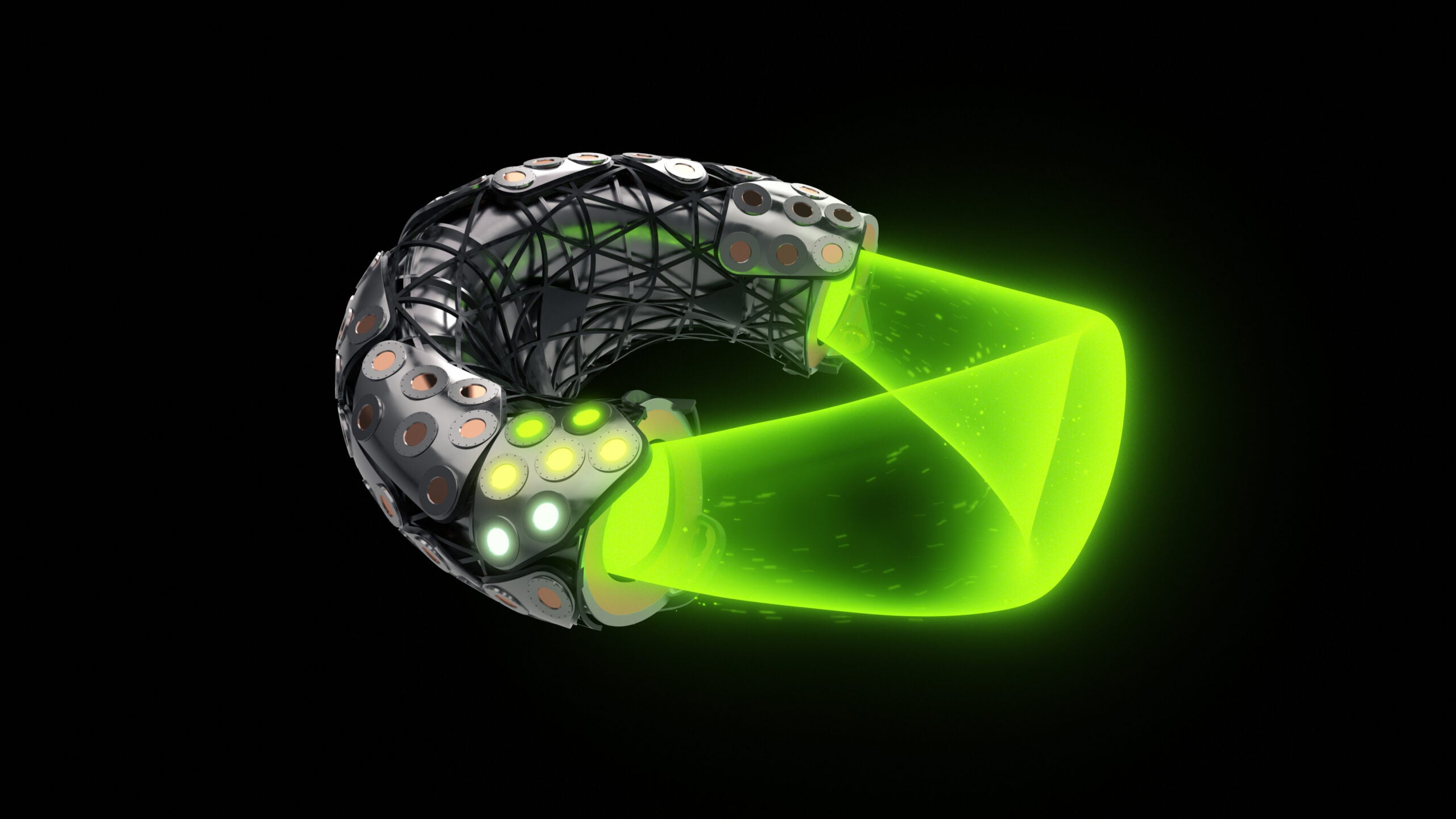
There is a subtle but consequential business idea inside the physics. Conventional stellarator coils demand extraordinary fabrication and assembly precision. Thea accepts that real hardware contains variation, then tries to correct that variation through control. Precision has not vanished. It has moved from difficult metalwork into a layer that can be measured, updated and tuned.
Berzin once compared the company's winding machine to an extra-large VCR. The joke lands because it shrinks a celestial ambition into something tactile: tape, tension, repetition. A fusion plant assembled from repeatable parts has a chance to become a product. A plant dependent on artisanal miracles remains an exhibition.
A machine before a market
The first large test of the thesis is Eos. It is designed to create power-plant-relevant, steady-state fusion and validate Thea's planar-coil architecture at integrated scale. Berzin has contrasted that goal with a pulse lasting a few seconds. The commercial question is not merely whether fusion occurs, but whether a system can sustain operation, recover gracefully and support the working life expected of energy infrastructure.
Eos also has a second proposed life as a neutron source. In a later operating phase, Thea expects it could support development of blanket and fuel-cycle technologies, produce tritium and make medical radioisotopes. That makes Eos both a demonstration for Thea and a possible workshop for other parts of the fusion industry.
Helios is the next machine, the commercial power-plant architecture intended to follow. Thea completed its preconceptual design milestone in 2025, and the Department of Energy certified it in early 2026. The plan places Eos operation in 2030 and Helios deployment in 2035. Fusion schedules deserve a raised eyebrow; Berzin's response is to expose progress to peer review, publish designs and divide the journey into hardware and program milestones that outsiders can inspect.
The test has moved to New Jersey
In January 2025, Thea opened a headquarters in Kearny, New Jersey, with laboratory and manufacturing space for rapid magnet prototyping. The location matters. Fusion is often narrated through national laboratories and giant international projects. Kearny puts the work beside the warehouses, freight lines and old industrial bones of the New York harbor. The setting gives Berzin's argument a physical address.
By late 2025 the team had grown beyond 80 people. In May 2026 Thea announced a $100 million Series B led by US Innovative Technology Fund, with General Innovation Capital Partners and Linse Capital among the participants. The money is meant to expand magnet manufacturing, add a second Northern New Jersey facility and accelerate Eos. The company also said it was speaking with more than a dozen potential power buyers, hyperscalers and utility partners.
This is where Berzin's investor years stop looking like a previous career. Commercial fusion requires enormous patient capital, but it also needs the discipline to decide what each dollar is supposed to prove. A coil validates manufacturing. An array validates control. Eos validates integration and prolonged operation. Helios has to validate the economics of a plant. The sequence is simple enough to print; accomplishing it will be neither simple nor cheap.
The useful obsession
Berzin's public manner is that of a translator with deadlines. He reaches for donuts to explain topology, radar to explain magnet arrays and natural-gas plants to explain the daily standard of reliability. Yet he is also blunt about what software cannot wish away. Fusion still requires exact fields, superconducting hardware, materials that live near energetic neutrons and systems capable of handling ferocious conditions.
His recurring word is practical. It appears beside manufacturing, construction, maintenance and cost. For founders outside energy, there is a portable principle here: complexity is not always defeated by removing it. Sometimes it is relocated. Put the difficult work where feedback is fast, where corrections are cheap and where improvement can continue after the product leaves the factory.
The larger aspiration is direct. Berzin says fusion is deeply consequential work. Thea's version would supply steady, zero-emission power, built in enough copies to matter. Between that sentence and an operating plant sits an unglamorous parade of coils, test stands, permits, hires, suppliers, construction schedules and software releases.
That may be why his story fits the stellarator so neatly. Both are hybrids. The machine combines proven plasma physics with new manufacturing logic. The founder combines engineering fluency with the comparative habits of an investor. Neither side is decoration. Fusion needs its dreamers, certainly. It may also need someone asking how the VCR-sized winding machine performs on a wet Wednesday morning in Kearny.