A city can be so admired that people forget to ask what it makes. Venice poses that question rather sharply. After the 2019 Aqua Granda flood came the pandemic, and with it a brutal interruption to the visitor economy. The familiar picture of a beautiful, vulnerable city acquired an awkward economic footnote: beauty needs an occupation.
- VeniSIA builds businesses from research and intellectual property.
- It matches corporate problems with validated technologies.
- Its manufacturing programme connects prototypes with factories.
The city that needed another occupation
Carlo Bagnoli, a professor of strategic innovation at Ca’ Foscari, and Maria Claudia Pignata conceived VeniSIA in 2020. The name originally stood for Venice Sustainability Innovation Accelerator. Their proposal was to attract people with something to build: researchers, entrepreneurs and industrial partners. In 2024, the initiative became a recognised university spin-off. The university connection remained; the company acquired a different set of responsibilities.
Today, Bagnoli is Head of Strategy and Pignata is CEO. VeniSIA calls itself a deep-tech venture studio. Its raw materials are scientific discoveries, intellectual property and industrial problems. Its intended output is a business capable of taking a useful technology into the world. The lagoon supplies the motivation; laboratories and manufacturers supply much of the machinery.


A patent is a beginning, not a business
Consider the distance between a promising discovery and a customer. A researcher may have a defensible invention without a team, a market or a way to manufacture it. A corporation may have the opposite problem: customers, equipment and an urgent technical need, but no suitable solution. VeniSIA has separate programmes for those separate predicaments.
Venture Building starts with university and research-centre projects and intellectual property. Its published process includes scouting, readiness assessment, a validation plan and IP strategy. Co-Innovation starts with industrial partners’ challenges and looks for technologies already capable of meeting them. The July 2026 presentation specifies technology readiness levels seven to nine: an operational prototype through to a system ready for commercial deployment.
Human Venturing works inside an existing organisation. Employees receive a challenge, generate ideas, refine them into an initial business model and pitch management. The current schedule totals twenty hours. It is an unusually concrete answer to the vague instruction that employees should somehow become more entrepreneurial between meetings.
The factory has something the founder needs
The Manufacturing Accelerator addresses a less glamorous problem than invention: repetition. Making something once does not establish that a factory can make it reliably, economically and at scale. VeniSIA maps manufacturers’ assets, finds compatible startups, and helps organise prototype tests and manufacturing feasibility assessments before strategic and financial planning.
The commercial arrangement is revealing. Manufacturing companies cover assessment and matching costs. Startups can compensate them for production services, or the parties can agree a work-for-equity arrangement. Production expertise becomes something a young company can buy or negotiate for. That gives the industrial partner a role more substantial than appearing on a slide beneath the word “ecosystem.”
“if it works in Venice, it will work anywhere”
VeniSIA’s stated vision
This places VeniSIA between familiar market categories. A technology-transfer office can help research leave a university. An accelerator can develop a young company. An investor can provide capital. VeniSIA’s proposition spans those handovers and the additional handover to production. Its team includes technology, finance and legal leadership alongside materials and biotech/IP expertise. The value depends on those people solving the next problem together.
€4.5 million, with the label attached
Argo provides a useful example of the network at work. Announced by CDP Venture Capital in December 2022, the tourism and hospitality accelerator had an initial allocation of €4.5 million, including about €3.4 million from CDP’s Accelerator Fund. The launch plan envisaged roughly thirty startups over three years, five months of acceleration and approximately €75,000 in pre-seed investment per selected startup.
About €3.4m from CDP’s Accelerator Fund
Programme allocation announced in December 2022
VeniSIA and LVenture Group, subsequently Zest, were the operators. Intesa Sanpaolo, its Innovation Center, Human Company and Scuola Italiana di Ospitalità supplied further expertise and connections. The €4.5 million belongs to the programme’s budget. It should not migrate, through careless retelling, into a funding round supposedly raised by VeniSIA.
A separate April 2024 partnership with Canova SGR connected VeniSIA’s origination network with the Nova 1 fund. The announced objective was financial support for selected deep-tech companies, accompanied by commercial and technological development. Again, the company’s role was to connect a venture with the next capability it needed.
Twenty-three ideas walk into Palermo
The biodiversity programme with the University of Palermo makes that process countable. A call opened in July 2025. Scouting involved approximately seventy professors, researchers and doctoral candidates and produced twenty-three applications. Eight projects were selected on 8 October. Workshops, coaching and mentoring were designed to help those research teams develop entrepreneurial plans.
Selection is a starting gate, not evidence of eight commercial successes.
VeniSIA’s portfolio gives the sustainability brief some texture. BioMulch is developing biodegradable agricultural mulch film. NutriUp proposes turning fruit and vegetable waste into nutraceutical ingredients. Plastique is developing a PVC plasticiser from waste vegetable oils. These descriptions identify development projects and intended applications; they do not establish sales or measured environmental benefits.
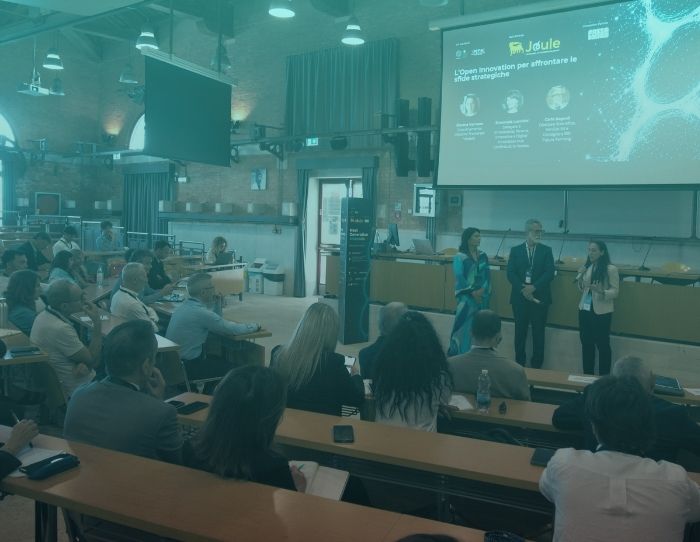
In June 2026, the fifth Co-Innovation edition narrowed the lens to next-generation materials, with Eni Joule, industrial support from Versalis and Fassa Bortolo. Polymers, elastomers, advanced recycling and AI-assisted materials discovery supplied the agenda. Sustainability here has acquired a useful specificity: which material, which process, which industrial partner?
The part worth borrowing
The practical lesson is to match support to the stage of the invention. A research idea needs validation; an operational prototype needs an industrial test; a production candidate needs manufacturing capability. Copying the programme name achieves little without a partner able to run that test. For a founder or research team, the useful first move is to identify that missing capability. For a manufacturer, it is to inventory the assets another business might need.