A €40,000 startup award sounds like a cheque you can take straight to the laboratory. At PoliHub’s Encubator, the arithmetic is more interesting: €25,000 goes toward developing the project, while €15,000 pays for access to acceleration. The money buys time for the invention and help with the question that can make inventors squirm: who, exactly, is going to buy it?
That division offers a useful introduction to PoliHub, the deep tech hub of Politecnico di Milano. Its territory is the awkward stretch between an experiment that works and a company that can sell what it makes. Batteries, medical technology and industrial engineering belong here. So do market research, patent decisions and conversations with people who control purchasing budgets.
Founded in 2013, the Milan organization now describes itself as part of Tech Europe Foundation. The institutional setting is changing; the commercial problem remains recognizable. A university can produce a promising technology without producing a ready-made business. PoliHub has built programs around helping people cross that gap. The interesting part is what happens between the application form and the celebratory photograph.
A wind tunnel is a useful neighbor
PoliHub’s Milan base sits beside the university’s Bovisa campus, whose surroundings include engineering and design laboratories, a fabrication lab and a wind tunnel. That is a revealing address for an accelerator. Some founders need someone to inspect their pitch. Others need equipment, specialist knowledge and a place where the physical behavior of their invention can be investigated.
The same emphasis appears in Lecco, where a second hub was established in 2020. Its facilities include 3D printing, laser cutting, industrial textiles and robotics. The attraction is practical proximity: people building technical businesses can find a wider set of relevant capabilities around them. Access still depends on the particular arrangement; a desk does not automatically confer the keys to every laboratory.
In a 2023 interview with INNLIFES, then-identified CEO Enrico Deluchi put the appeal neatly: “Noi, in pratica, vediamo il futuro da vicino.” Roughly translated: we see the future up close. It is a good description of the vantage point. Whether that future becomes a viable product is the work still to be done.
The first customer gets a vote
PoliHub’s startup services begin with fundamentals: identifying early customers, validating the problem, sizing a market and considering patentability. Later-stage support moves toward an initial commercial offer, fundraising strategy, intellectual property and hiring. These are separate jobs. A convincing answer to one does not quietly settle the others.
For a founder, the useful discipline is to identify the next uncertainty precisely. Does the technology perform outside controlled conditions? Does a buyer care enough to pay? Can the team protect what it has developed? The point of asking separately is to make the next piece of work testable. Another polished presentation may leave all three questions untouched.
The audience stretches beyond enrolled students. PoliHub’s general calls address Italian and international early-stage startups, including teams that have not yet incorporated, and academic spinoffs. Individual programs set their own eligibility rules. A researcher should therefore choose a route by the technology’s maturity and the team’s needs, then read the terms. The word “accelerator” tells you surprisingly little about the actual offer.
“Noi, in pratica, vediamo il futuro da vicino.”Enrico Deluchi, INNLIFES interview, November 2023
181 ideas. Fifty places to do the work.
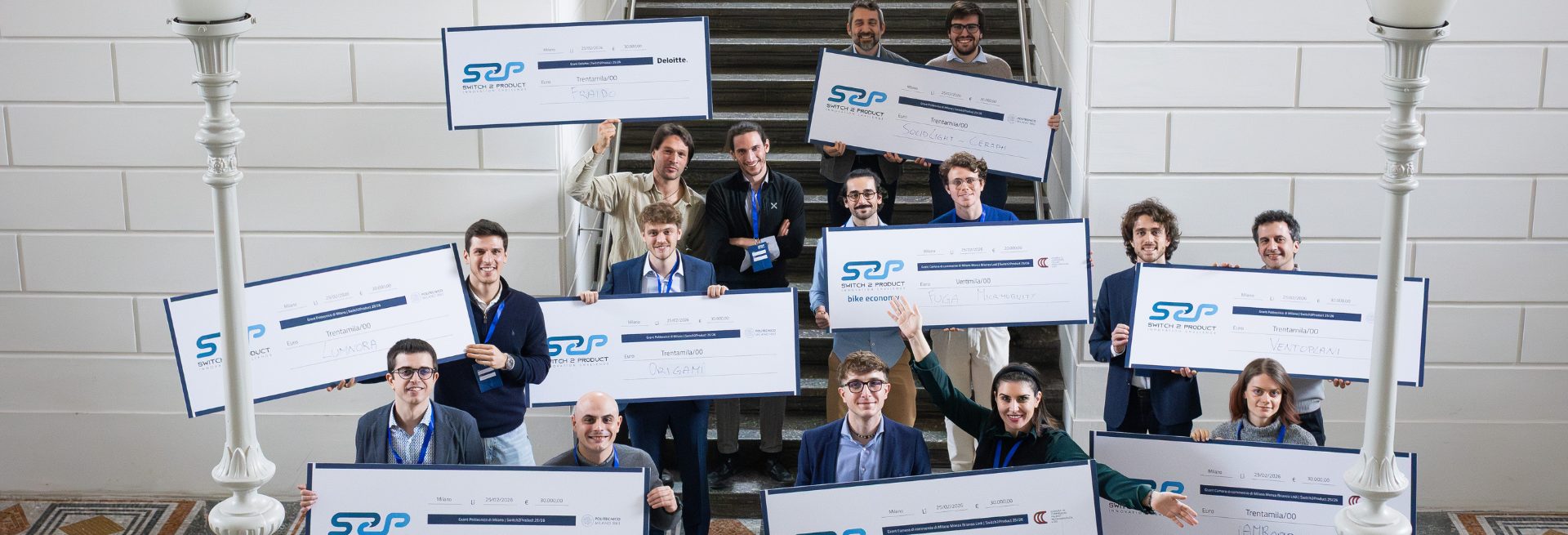
Switch2Product supplies a concrete example. Its 17th edition evaluated 181 projects, recognized ten winning teams and selected 50 projects for a three-month incubation program starting in March 2026. Each selected team was to receive a dedicated mentor with relevant experience. The organizers were the university’s Technology Transfer Office, PoliHub - called TEF Bridge in the announcement - and Deloitte’s Officine Innovazione.
The winning ideas make the category less abstract. Voice Shield by Realynx tackles synthetic voices and audio deepfakes. FUGA MICROMOBILITY proposes a folding cargo bike. SolidLight develops ceramic photonic components made using 3D printing. This is a broad technical intake, but each team faces the same assignment: establish a credible route from an interesting capability to a specific use.
The distinction between winning and getting support matters. Incubation reached well beyond the teams holding prize cheques. For anyone designing a similar initiative, that is a useful choice to examine: selection can allocate different kinds of help, rather than funnel everything into a single winner. Recognition makes a photograph; a longer intake creates more opportunities to test business assumptions.
Read the €40,000 in two parts
Encubator, organized with the chamber of commerce and Politecnico di Milano, focuses on climate and sustainability technologies. Its published offer describes four months of acceleration and an equity-free €40,000 award. The development allocation is €25,000; the remaining €15,000 is for acceleration. That call is marked closed.
€25,000Project development
€15,000Acceleration access
Equity-free award. Four-month program. Figures describe this offer, not a universal PoliHub price.
For applicants, the lesson is simple enough to copy: separate money available for building the product from money committed to services. Then ask what each component must accomplish. A grant total is an incomplete budget. Technical work, commercial validation and founder time all need a place in the plan, even when only some appear on the award cheque.
The program also includes meetings with companies and investors. That makes sense for technologies intended for energy systems, materials or industrial applications: prospective adopters can help expose the conditions a product must meet. The invitation to meet them is an opportunity to gather evidence. It should be treated as the beginning of a commercial conversation.
Two businesses make the argument tangible
Sinergy Flow illustrates how much work can sit behind the phrase “energy storage.” Founded in 2022, it develops flow batteries for stationary storage lasting more than eight hours, using sulfur-rich industrial byproducts. PoliHub reported a €7 million late-seed round in February 2026, following work that included a proof of concept with A2A.
The next tasks described were industrial development, commercial-scale validation and preparation for market entry. These are useful milestones for understanding deep tech: financing pays for another stage of evidence. It does not make engineering and adoption questions disappear. The progression is also a reminder that an accelerator’s cohort calendar and a technology’s development calendar can be very different things.

ISAAC offers a different kind of evidence. The university-born company develops active mass damper systems intended to reduce buildings’ movements during earthquakes. In March 2026, PoliHub reported a €14 million investment round and installations including Genoa’s San Martino hospital and the port’s pilot tower. The report put ISAAC’s 2025 revenue at approximately €9 million.
A hospital installation and a battery proof of concept represent different stages of adoption. Both are more informative than a generic claim about innovation. They give readers something to inspect: where the technology is used, what remains to be validated and what further capital is meant to finance. These are the startups’ activities and finances, distinct from those of the hub.
The other customer wears a company badge
Established businesses also buy into the proposition. PoliHub describes an annual Innovation Partnership, a tailored Venture Program and Innovation Matching for groups of companies with shared needs. The offer combines access to emerging technologies with a process for deciding whether they address a business problem. That gives the hub a corporate-services role alongside its work with founders.
Its business model therefore brings together startup services, corporate programs, workspace and institution-backed initiatives. A corporation supplies a need; a startup offers a possible solution; the hub helps organize the encounter. The commercial test is whether that encounter leads to useful work. Attendance at an event alone says little about whether a company can deploy the technology.
There are alternatives. I3P, attached to Politecnico di Torino, also supports technology-intensive startups through advice, mentoring, fundraising help and workspace. PoliHub’s distinguishing context is its Milan university network and now its TEF connection. For a founder comparing the two, the sensible question is which setting contains the expertise, partners and program conditions that the project actually requires.
A wider door, then a European chapter
PoliHub has changed its approach before. Contemporary reporting in 2015 described a move beyond an incubator primarily serving internal university startups and spinoffs. Stefano Mainetti, then managing director, explained that opening outward brought more startups and changes to scouting, mentoring and financing support. The report also described a temporary ranking setback as the model changed. That is a documented adjustment, rather than a tidy origin myth.
The next transition is larger. PoliHub’s live homepage identifies it as part of Tech Europe Foundation. The university describes TEF Foundry as a program built on Switch2Product’s experience, scheduled from October 2026 through June 2027. It has three phases, with teams selected onward according to results and participation. Entry requirements include at least two people, a qualifying university connection and a minimum technology readiness level.
The practical implication is that access depends on both fit and progress. A solo founder without the required affiliation would not qualify for that particular route. A team that wants introductions without doing validation may also find the structure demanding. For the right research team, however, the proposition is concrete: time, expert help and successive tests of whether its science can become a business. The first customer still gets a vote.
Visit, follow, watch
Explore PoliHub, its startup calls and newsroom, or the next chapter at Tech Europe Foundation.
Follow on LinkedIn, X, Instagram and Facebook. Watch the PoliHub YouTube channel or Recordati’s interview with Enrico Deluchi.