In November 2018, a research team received €50,000 from Patras Science Park. The team was BIOPIX, working in diagnostics. The next revealing steps were commercial: a mentor, a business developer, and, in December 2019, a company. By September 2020, BIOPIX had raised funding from Metavallon. Between the laboratory result and the investment cheque sat a series of small, deliberate interventions. That is where this science park earns its keep.
- For founders: offices, laboratories, business support and research connections.
- For researchers: help with intellectual property, commercial planning and investor introductions.
- The lesson: budget for the work between invention and a customer.
A science park is an easy thing to misunderstand. The name suggests buildings, perhaps some landscaping, perhaps an optimistic sign. In Rio, on the edge of Patras, the buildings are real. But the interesting product is the arrangement of people around them: scientists, founders, established companies and intermediaries who know whom to call when an experiment needs a business plan.
01 / A room, and what comes with it
Established in 1989 through a research-linked initiative associated with FORTH and its Institute of Chemical Engineering Sciences, PSP became an independent, state-owned public limited company in 2001. It occupies a particular corner of the market: incubation for technology businesses that benefit from being close to research. ICT, biotechnology, clean energy and industrial technologies all fit that description.
The practical offer starts with space. Its 2025 company brochure describes approximately 4,800 square metres of facilities, including about 1,900 for hosting companies. Units range from 25 to 170 square metres. There are shared meeting and event facilities, plus services such as accounting support, patenting assistance, staff development and business planning, supplied directly or with partners. A young company can spend less time assembling its own miniature administration.
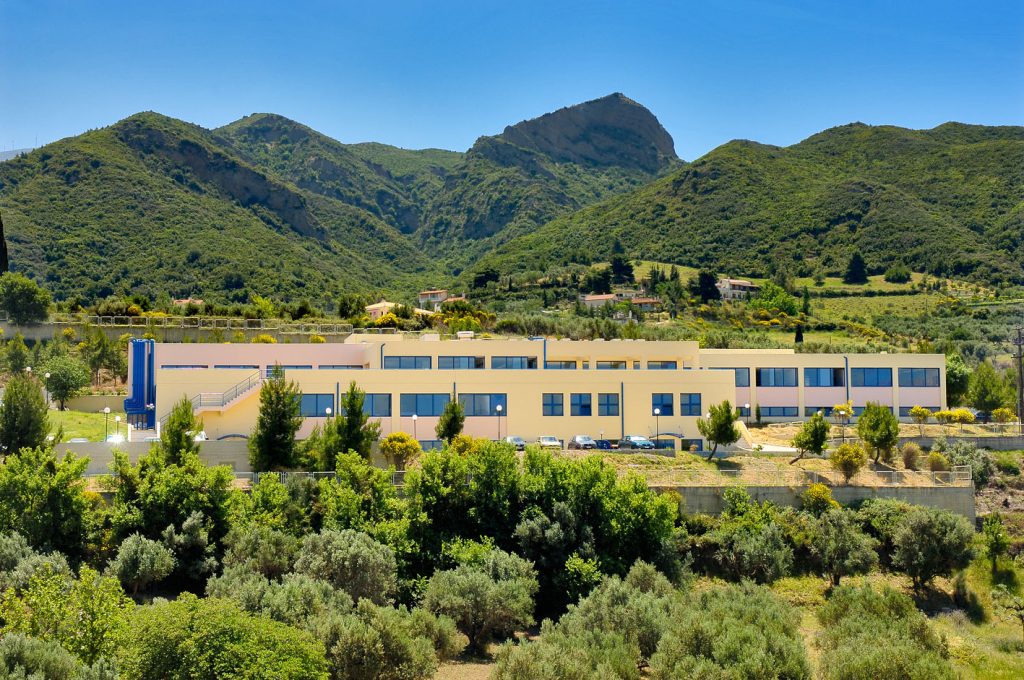
The customers include startups, spin-offs, SMEs and multinational development centres. BioDetect, a University of Patras spin-off established in 2025, illustrates the scientific end: it provides molecular diagnostics for aquatic, animal and environmental health. At the same campus, p-NET brings together 21 shareholders around digitalisation, testing and skills. This is a mixed working community, with different routes to market.
The business model follows those activities: accommodation and administrative services, business-growth support, and participation in regional and European projects. Compared with a general workspace, the research connections and technology-transfer work give PSP a specific purpose. A team deciding where to locate should ask which of those capabilities it will actually use.
There is another clue in its graduated-company directory. Think Silicon, Brite Solar, Antcor and Bytemobile appear among the businesses that have moved through the park. Leaving can mean needing more space. PSP describes companies maintaining their connection after relocating, so the relationship can survive the tenancy. For a founder, that changes the question from how long an office is available to which relationships might remain useful. The technology-transfer office works on the same longer horizon: identifying research, connecting it with industry, and helping manage the intellectual property. A lease has an end date; a research or business relationship can continue.
02 / Fifty thousand euros buys a question
The proof-of-concept programme began in autumn 2018. Its published design set an annual budget of €500,000 for ten ideas, with up to €50,000 per project. Private donors financed the awards. Separate administrative expenses were estimated at €50,000 annually, which PSP undertook to cover. These figures describe the programme’s intended economics; they are no measure of the park’s revenue.
What did the money purchase? The programme describes work on commercial viability, intellectual-property exploitation and business plans, accompanied by mentoring and introductions. BIOPIX’s documented sequence makes that concrete. Its €50,000 award was followed by mentoring, a business-development hire and incorporation. Six meetings with the advisory board appear in its progress account. There was scientific work, certainly, but also sustained attention to how a company would function.
The commercial emphasis is explicit. The programme’s FAQ puts market need ahead of technical and scientific content when describing its primary focus. That is a useful discipline for a research team. Ask who needs the result, how the result might reach them, and what must happen before somebody can pay for it. Make those questions part of the funded work.
03 / The support system needs support
In 2020, the machinery faltered. The spring proof-of-concept round was cancelled because of COVID-19. An October announcement cancelled the autumn round too, citing the pandemic and restrictions on donations. This was a failure of continuity in the funding mechanism. Even a carefully designed route to commercialisation depends on somebody paying to keep the route open.
PSP’s staff later confronted a broader version of the problem. Writing in 2024, they identified gaps in sustainable service funding and staff development. Experience in SPREAD2INNO helped shift their thinking toward distributed local networks: organisations sharing the job of supporting startups. A4SUSTINNO would test the approach across nine regions in eight countries. The intended benefit was wider service coverage with lower shared costs.
“Members of the PSP Network are expected to help each other whenever possible”From the park’s published Work Ethic code
That rule makes the strategy less abstract. The code asks members to respond to requests and share opportunities and talent. For another region trying to copy the model, the practical starting point is a map of available expertise. Find the patent adviser, the commercial mentor and the industry contact already nearby. Then give their cooperation a repeatable form.
04 / A door into CERN, with homework attached
PSP became Greece’s CERN business incubation centre in 2019. The programme connects entrepreneurs with CERN technologies, technical advice and licensing opportunities, alongside local business support. Its historical offer advertised up to €40,000 and 40 hours of free expert consultation. Those terms belong to a page carrying a 2020 deadline. Prospective applicants should check present arrangements before planning around them.
The same realism applies to ordinary admission. PSP asks for a viable proposition, adequate starting capital and a business plan. Management assesses the fit; the board decides, subject to factors including space. A company needing only a desk may gain little from this research-heavy arrangement. An early scientific idea without commercial preparation also needs to understand the limits of each programme.
The park continues to advertise new activity, including an ENHANCED Startup Accelerator entry dated October 2026. Its older proof-of-concept site currently says submissions are temporarily closed. Founders should choose a specific service and establish its availability. The enduring lesson is modest and useful: put commercial work beside scientific work early, give it people and a budget, and keep checking who will sustain both.