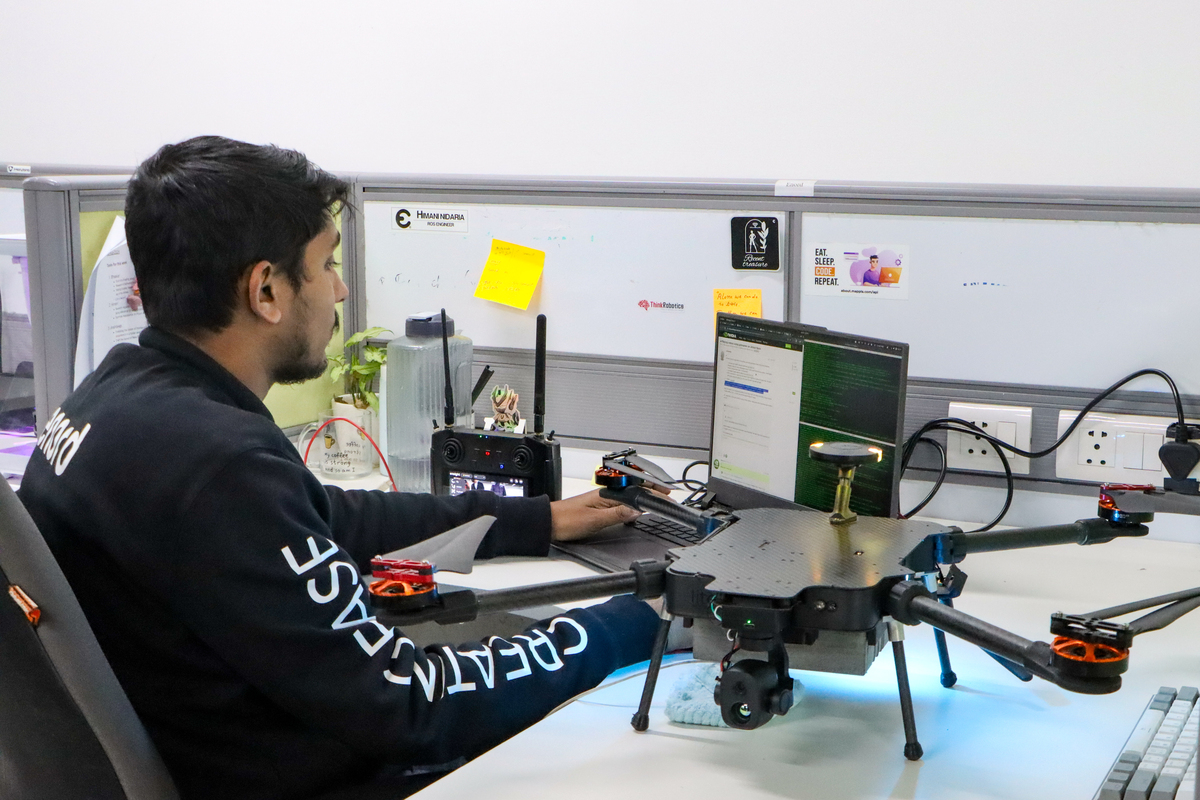
A drone takes up a remarkable amount of desk. In a photograph from IIITD Innovation & Incubation Center, its arms spread across a workstation while a young man works at a laptop behind it. There are cables, a controller, sticky notes. It is a useful picture of entrepreneurship: a machine occupying space, demanding attention, waiting for somebody to make the next thing work.
- Technology founders can seek physical or virtual incubation.
- PRECUBE helps early ideas reach validation and business planning.
- Seed support is advertised up to ₹50 lakh, with committee approval.
The center sits within IIIT Delhi’s academic orbit. Its proposition is practical: connect founders with the people, equipment, and support that an early company would otherwise have to assemble separately. For someone building technology, the difficult question is often very specific. Who can help test this? Where can we build it? Which money can pay for that experiment?
A university connection you can use
IIIT Delhi promoted the center as a not-for-profit Section 8 company; it was incorporated in June 2017. That structure helps explain its place in the market. It serves technology entrepreneurs through incubation and acceleration, bringing technical and management support into the same institutional setting. It is a company built to help other companies get started.
The academic connection supplies the distinctive ingredient. The center describes collaboration with faculty, research scholars, and peer startups. Its focus spans artificial intelligence, cybersecurity, data science, robotics, and drones. The practical attraction is proximity to relevant expertise. A founder choosing this setting should be able to name the technical question that makes a university relationship valuable.
That is also how to compare it with an alternative such as FITT at IIT Delhi, which offers prototyping facilities, mentoring, funding programs, and business support. These organizations occupy similar territory. The useful distinction for an applicant is the match between a particular product and the institution’s available people and facilities.
Start before the company does
PRECUBE, the center’s pre-incubation program, addresses the stage when an idea still needs interrogation. It offers help refining a business plan and validating the idea, alongside mentoring, interactions with incubated startups, AWS credits, and access to the Design & Innovation Lab. The order matters. An idea needs scrutiny before it earns a larger commitment.
For teams further along, physical incubation provides an on-campus route, with applications invited throughout the year. Virtual incubation offers another relationship for founders who do not need permanent workspace. Technical and business mentoring appear in both propositions. Applicants should make the arrangements concrete: which facilities are available, how access works, and what support their particular project needs.
The money has instructions
The seed-support offer reaches up to ₹50 lakh, subject to committee decision, with exceptional cases potentially exceeding that amount. This is meaningful support for a young company. It is also an evaluated offer: an applicant must distinguish the advertised maximum from the amount a committee might actually approve.
NIDHI-PRAYAS does a different job. Its published limit is ₹10 lakh for physical prototype development. Software-only projects are excluded, although software within a hardware prototype can qualify. The grant cannot pay the innovator’s salary or incubator usage charges. Those rules make it an experiment budget with boundaries, rather than a general company bank account.
The institution connects several public systems: DST supports its technology incubator and PRAYAS role, MeitY supplies the TIDE 2.0 framework, and the center also operates within Delhi-government and Startup India seed-support arrangements. These are separate routes with separate purposes. A founder benefits from understanding which one addresses the present problem, rather than treating every scheme name as another promise of cash. The incubator’s expertise includes helping entrepreneurs navigate that institutional landscape while they continue developing the product.
Workspace has its own economics. The July 2022 incubation policy listed ₹3,000 for pre-incubation, ₹6,000 per workstation per month for incubation, and ₹18,000 as a one-time virtual-incubation fee. Treat those as historical benchmarks; obtain current terms before budgeting. The center’s model combines public support, service fees, and startup investment activity.
Two very different things to build
The center’s NIDHI-SSP portfolio page names Swapeco Solutions, behind ScrapUncle, and Arivation Fashiontech, behind Arista Vault. ScrapUncle lets people arrange doorstep pickups of recyclable materials and get paid. Arista Vault develops smart utility products. One begins with an everyday disposal problem; the other puts technology into objects people use.
The contrast tells an applicant something useful about the clientele. Students and researchers are part of the audience, alongside external technology entrepreneurs. Incubation can concern a service organized through an app or a physical product. Eligibility for any particular funding scheme remains narrower than the range of companies an incubator may support.
A little friction in the testimonial
One detail on the center’s website deserves a second look. AristaVault co-founder Atul Gupta praises the foundational space and networking, then adds a qualification: “though more hands-on support could enhance the experience.” It is a small piece of friction in a place normally reserved for applause.
“though more hands-on support could enhance the experience.”Atul Gupta · AristaVault co-founder
For a prospective incubatee, that observation turns a vague promise into a useful conversation. Ask how frequently mentors meet founders. Ask who follows up after a technical obstacle. Ask how introductions become working relationships. The center’s events include a NIDHI Accelerator 2025 Demo Day, Hack4Health, and a fintech hackathon. Participation creates opportunities; the founder still has to use them.
Bring the next experiment
The alumni fellowship adds financial and incubation support for IIIT Delhi graduates. The Entrepreneur-in-Residence program targets idea validation and proof-of-concept development. Together, the offerings recognize that founders arrive with different problems. A graduate deciding whether to pursue a venture needs a different kind of help from a team already testing hardware.
The copyable lesson is to choose support around the next piece of evidence you need. Identify the test, the person who can help, the facility required, and the permitted funding. A software-only founder seeking PRAYAS would be choosing the wrong route. A hardware team with a precise experiment has a much clearer conversation to bring to that crowded desk.