Consider a dental chair. Its job is to hold a patient in the right position while somebody does delicate work inside a mouth. When its controls are awkward, the inconvenience belongs to the dentist, the assistant, and the patient. A sensible invention might leave much of the chair intact and change how it moves. That was the premise of an electronic dental-chair conversion kit supported through SJCE-STEP’s NIDHI-PRAYAS work in Mysuru.
- A nonprofit incubator linking engineering expertise with business support.
- Physical prototyping, shared equipment, mentoring and funding pathways.
- Distinct programs for inventors building something and startups trying to sell it.
The chair is the clue
The dental project appears in the official PRAYAS beneficiary record. A JSS institutional account describes its purpose: adding electronic controls to a manual chair to improve ease of working. The attraction is wonderfully untheatrical. Here is an existing object, an identifiable user, and a specific irritation. Nobody needs to invent dentistry before beginning.
That small example explains a great deal about SJCE Science & Technology Entrepreneurs Park, usually shortened to SJCE-STEP. It helps people turn technical ideas into enterprises. Sometimes the immediate task is making a prototype. Sometimes it is finding out whether anyone will buy the result. The difference matters. A successful mechanism and a successful business must pass different tests.
The beneficiary list ranges across water metering, EV electronics, aeroponics and medical equipment. More recently, it includes Padakattu, a modular Kannada learning kit with magnetic letters and audiovisual support. These are project descriptions, rather than certificates of commercial success. They show the questions entering the workshop: how to control, measure, move, teach, or make something useful.
A campus with a second purpose
SJCE-STEP began in 1985, long before today’s familiar startup vocabulary became routine. Its institutional sponsors included India’s Department of Science and Technology, Karnataka government bodies, IDBI and SJCE. The original proposition was practical: engineering knowledge could create enterprises if somebody supplied the managerial help alongside the technical help.
Today the incubator sits within the JSS Science and Technology University campus. Its users include students, researchers, individual inventors, startup teams and industry professionals. Training and consultancy are part of the offer alongside incubation. The engineering campus supplies a setting in which a founder can seek expertise without first assembling a private research department.
An older ISBA directory described SJCE-STEP as a registered society, with software, electronics, embedded systems and product-based healthcare among its areas of focus. Those categories still help explain its place in the market. It operates between education, applied engineering and early enterprise formation, where an inventor may possess specialist knowledge and little experience of selling it.
Other incubation routes exist across Karnataka, including centres in Bengaluru, Manipal and Hubballi. SJCE-STEP’s particular appeal is the combination of a Mysuru base, campus expertise, prototyping support and a long institutional history. For someone building locally, access to people and machines can matter as much as the prestige of a distant address.
Money for the first working version
The awkward stage comes when an idea needs cash before it can produce convincing evidence. SJCE-STEP’s published PRAYAS offer addresses that stage: up to ₹10 lakh for physical prototyping, a twelve-month project period and funding released against milestones. Its stated terms leave the intellectual property with the innovator and take no equity or royalty.
Those are the centre’s advertised terms; applicants should check the current call and scheme version. A grant ceiling is a maximum, rather than a promise to every applicant. Nor is prototype money a budget for every subsequent business expense. Its value is giving a selected inventor room to demonstrate that an engineering concept can work.
Milestone releases • Innovator retains IP
Check current call terms before applying.
The facilities offer makes the money more useful. SJCE-STEP lists a makerspace exceeding 5,000 square feet, with 108 tools, including 3D printers, laser cutters, measuring instruments and wire EDM equipment. It also advertises guidance on materials, feasibility, testing and manufacturing. Shared tools let multiple inventors work without each buying a workshop.
Its nonprofit structure and public-program support explain part of the economics. Grants, campus resources, training and consulting sit alongside incubation services. Separate seed-support programs address company development and carry their own conditions. A founder should ask which agreement covers which expense; the friendly umbrella word “support” can conceal several quite different transactions.
The useful embarrassment of changing your mind
Then comes the customer. SJCE-STEP’s 2022 accelerator began in July and ended with November investor pitches. Participants worked through customer validation, marketing, sales, financial modelling and mentoring. The contemporary report says some startups changed their ideas or strategies to fit the market.
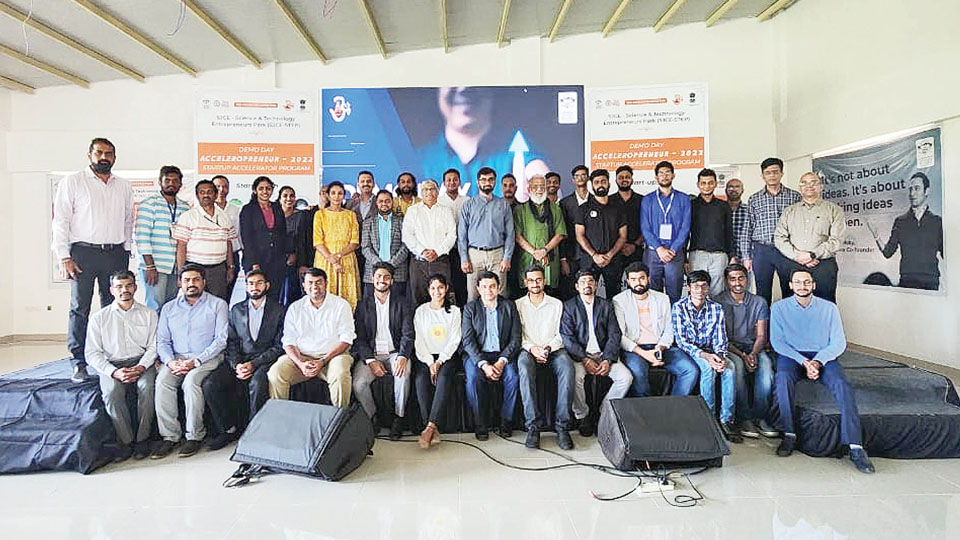
A pivot is an admission that the original plan needs revision. Here it belongs inside the process. The lesson a reader can copy is straightforward: arrange contact with customers early enough for their response to change what you build. Technical mentoring can improve a product; customer discovery can change the product’s purpose.
This distinction also clarifies the limits. A working device still needs buyers, reliable production and a way to reach its market. A lab cannot settle those questions by itself. The incubator’s combination of technical and commercial support is useful precisely because passing one test leaves the next test waiting.
A city builds its own runway
By late 2025, the network was visible in a different room. A Karnataka Acceleration Network showcase hosted by SJCE-STEP brought together 18 startups. Government support, KDEM and JAIN Launchpad helped assemble the event; its investor panel included Capital-A, 3One4 Capital and other venture networks.
“think with purpose, validate ideas and find their first customer”Sudhanva Dhananjaya, at the 2025 KAN event
December’s fortieth-anniversary announcements pointed toward larger infrastructure: ₹10 crore in TBI 2.0 assistance for the host university over five years, and a proposed JSS Innovation & Research Park exceeding 200,000 square feet, with completion expected in 2028. These are commitments and plans, rather than finished capacity.
The copyable principle is smaller than a research park. Put equipment, engineering advice, business guidance and funding routes within reach of the same founder. Make the first experiment possible, then invite the customer into the conversation. For SJCE-STEP, the dental chair is a useful place to start: a modest problem, taken seriously enough to build something.