A brick is an awkward object to put in a pitch deck. It has weight. It must survive water, pressure and the opinion of a contractor who has used ordinary bricks for years. Angirus, an Udaipur startup making building materials from waste, had to work through all of that. Its connection with IIM Udaipur Incubation Centre makes the incubator’s job unusually easy to picture: someone has to help pay for the machinery and the tests.
- Management expertise, mentors and workspace for founders building a business.
- Separate routes for ideas, prototypes, women-led ventures and rural impact.
- Funding comes with selection rules; a published ceiling is no promise of a cheque.
In a testimonial published by the centre, Angirus founder Kunjpreet Arora describes scarce resources limiting hiring, manufacturing and testing. Seed support helped the company buy equipment and get products examined by third-party laboratories. This is an account of incubation with the furniture removed. The useful unit is the next piece of work a founder can finally afford.
01 / The brick has to persuade someone
Angirus was formed in 2020 to turn otherwise troublesome waste into bricks and paver blocks. Its product, Wricks, uses recycled plastic and industrial waste. An account from NSRCEL, another incubator that supported the venture, describes repeated formulation trials and the difficulty of securing reliable waste supplies. Good intentions did not settle the recipe or organize the supply chain.
The same account identifies a revealing moment: a contractor responded enthusiastically during a pilot because he needed strong, environmentally considerate building materials. That feedback gave the experiment a commercial reason to continue. For another founder, the copyable lesson is straightforward. Find the person whose working day your invention improves, then ask what evidence they need before buying.
IIM Udaipur’s centre occupies the stretch of road where those questions become expensive. Established in 2016 with Department of Science and Technology approval, it brings business-school expertise to venture creation. Its stated priorities include inclusive growth. Faculty knowledge sits alongside advice from professionals, technology specialists and practitioners, rather than remaining confined to a classroom timetable.
02 / Several doors, several price tags
Its users include aspiring founders, students, working professionals and operating startups. They need different things. Someone exploring an idea may need a method for judging it. A team with a prototype may need testing money. A venture preparing to grow may need an investor introduction. The centre’s offerings reflect these different starting points.
Take the historical Idea to Startup program, run with Moonpreneur. The 2023 offer put participants into groups of four or five with a mentor and a shared problem statement. Twelve topics covered business, finance, design thinking, marketing and communication, leading to a pitchfest. Its four-month timetable advertised a ₹12,000 fee and an early-bird discount. Participants bought structured practice; potential funding was an opportunity, rather than the purchased product.
The nonprofit’s model combines host-institute support, public entrepreneurship schemes and program partnerships. Historical paid training exists beside free offerings and selective finance. Calling all of it “funding” loses the distinctions a founder needs. A stipend supports a person; a grant supports specified work; an investment has its own terms.
The centre’s published Startup India Seed Fund offer lists grants up to ₹10 lakh, seed investment up to ₹30 lakh and twelve months of incubation. These are advertised limits. In the same program’s testimonials, Machenn Innovations founder Vishnu T U reports support arriving within 40 business days. His account links that timing to product development and a market launch.
“We got the grant sanctioned and credited within 40 business days.”
Vishnu T U · Machenn Innovations founder
Testimonial published by IIMUIC
03 / Inclusion has an attendance requirement
Samriddhi, meaning prosperity, offers a particularly concrete expression of the centre’s priorities. Its 2024 women-founder program described two tracks: one for existing startups and another for women who had an idea but had yet to start. The four-month offer was free, with grants up to ₹7 lakh for startups and stipends up to ₹2 lakh for idea-stage founders.
Free, however, did not mean casual. Financial support required 90 percent attendance as well as legal eligibility. The program expected workshops, coaching and market research; its demo day brought participants to campus. That design treats access and effort as compatible. A founder unable to make the time would have difficulty meeting the published conditions.
The six-month Deep Rural Impact program takes a different problem seriously: building for rural communities. Its offer includes market-launch plans, potential client connections, mentoring and committee-recommended grants. Applicants can come from across India. There is no application fee. The emphasis on education, health and livelihoods makes the intended beneficiary visible, even though the program accepts different sectors.
04 / An introduction still needs a business
For technology ventures seeking larger backing, the centre’s SAMRIDH page specifies matching support up to ₹40 lakh. It also requires a minimum ₹40 lakh hard commitment from an angel or venture investor. An applicant needs an eligible technology business at MVP or early traction stage. A founder hoping the program will supply the first investor should read that condition twice.
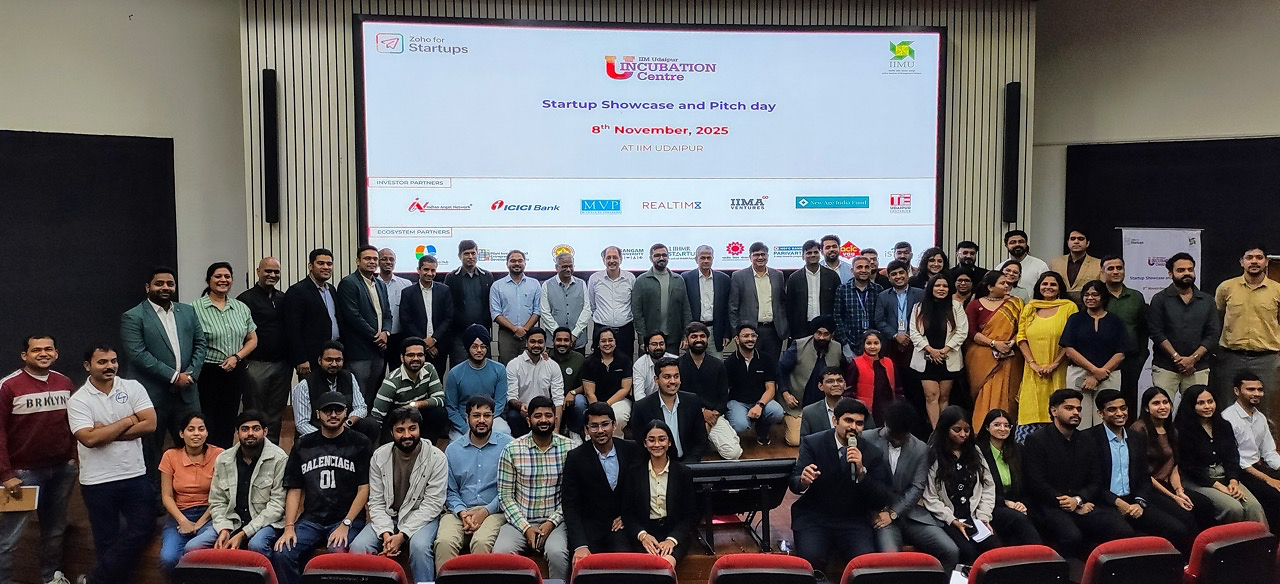
Introductions nevertheless matter. The November 2025 showcase, organized with Saksham and Zoho, brought together more than twenty startups and over ten investors. Pitches ranged from audio learning to sustainable packaging and property-management software. The event offered feedback and conversations; attendance itself establishes no investment outcome. That distinction makes the occasion more useful to understand.
Other academic incubators, state programs and private accelerators offer alternative routes. Angirus’s participation at NSRCEL shows that support can overlap. IIM Udaipur’s particular proposition is the combination of management expertise, public finance routes and programs addressing women founders and rural markets. Choose it by the work it can help you complete. A brick still needs a buyer, however impressive the room in which it was introduced.