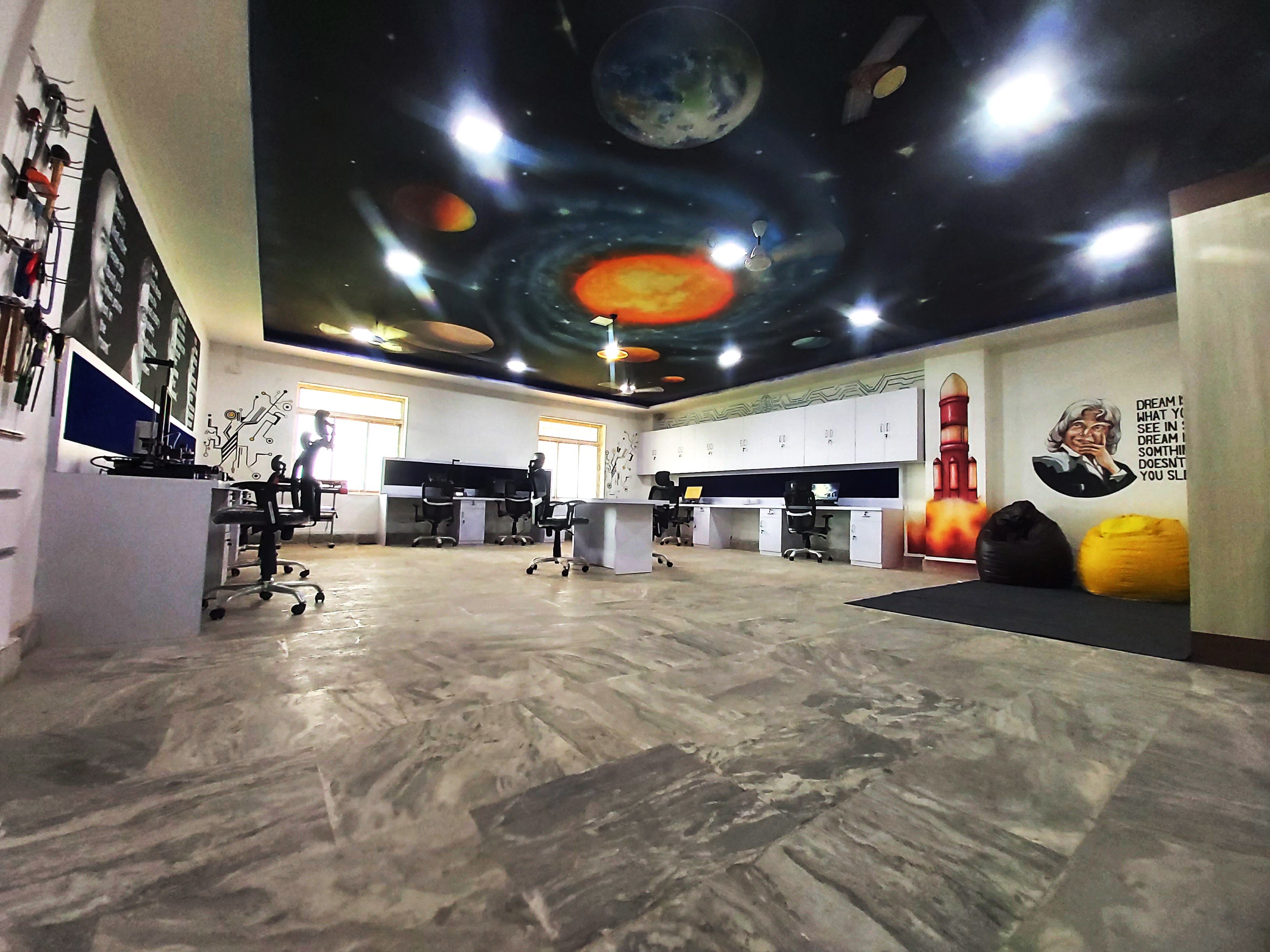
There is a solar system on the ceiling of AIC-Nalanda’s FabLab. Planets hover above desks, a painted rocket stands beside the cabinets, and a portrait of A.P.J. Abdul Kalam watches over the room. It is a cheerful setting for the less celestial business of starting a company: making something work, figuring out who needs it, and finding enough money to keep going.
That combination of ambition and practical assistance explains this Bhubaneswar institution. AIC-Nalanda Institute of Technology Foundation is a nonprofit technology business incubator hosted by Nalanda Institute of Technology and supported by Atal Innovation Mission, NITI Aayog. Its job is to help founders move from an idea toward a product and a business. The offer includes facilities, mentoring, intellectual-property assistance and introductions to people who might finance or buy what comes next.
Its interests are unusually grounded for an organization surrounded by startup vocabulary. Alongside AI, connected devices and data analytics, the centre explicitly names agricultural machinery for smallholding farmers and technology-led education ventures. The underlying question is useful: what can an entrepreneur build that someone nearby can actually use?
The college wanted companies, too
Founded in 2018, AIC-Nalanda describes itself as Odisha’s first Atal Incubation Centre. Founder director Malaya Kumar Padhi presents the initiative as an extension of the Nalanda group’s educational work. His formulation is compact: “Education, Employment and Empowerment.” An engineering institution could teach people how technology works; an incubator could help them organize a livelihood around it.
That ambition includes founders working for underserved communities. In his published message, director general Tapan Kumar Chand connects entrepreneurship with rural empowerment, women’s participation and retaining intellectual talent in Odisha. These are stated aims, and they explain the centre’s broad brief. A farm implement and a digital service can belong in the same institution if both need help becoming viable businesses.
“Collaboration, rather than competition is its vehicle of growth for the startup ecosystem.”
Dr. Tapan Kumar Chand
Director General’s message
The emphasis on collaboration also clarifies its position in the market. Regional founders have alternatives, including KIIT Technology Business Incubator and IIT Bhubaneswar Research and Entrepreneurship Park. AIC-Nalanda’s proposition is the particular combination of its college base, practical facilities and partner network. Choosing among such institutions is a question of fit: the relevant equipment, the right mentor and access to the people a particular business needs.
A different door for each stage
Incubation can sound like one long workshop. AIC-Nalanda separates parts of the journey. IdeaNest is its cohort-based pre-incubation program for people at the idea or early startup stage. It concentrates on entrepreneurial understanding and the business skills needed to begin. That gives a newcomer a more specific starting point than a general invitation to “innovate.”
Sanvriddhi addresses a different problem. Its published description targets Odisha-based startups at market entry or early revenue, when the conversation moves toward business strategy and the challenges of operating in a particular field. A founder still exploring an idea and a founder already trying to sell need different kinds of attention.
Business fundamentals
Technical support
Commercial strategy
The foundation’s general application process asks for a business plan reviewed by an internal committee. Its criteria include technical merit, the founding team, intellectual-property potential, commercial viability, market timing, break-even expectations, impact and scalability. Those are revealing questions. A persuasive problem statement has to survive contact with a timetable and an explanation of how the enterprise will support itself.
For an applicant, the preparation follows from those criteria: explain the user, the product, the team’s ability to deliver and the route to revenue. This is an editorial reading of the process, rather than a promise of admission. A project can have social value and still need much more work on its commercial case.
The less glamorous tools earn their place
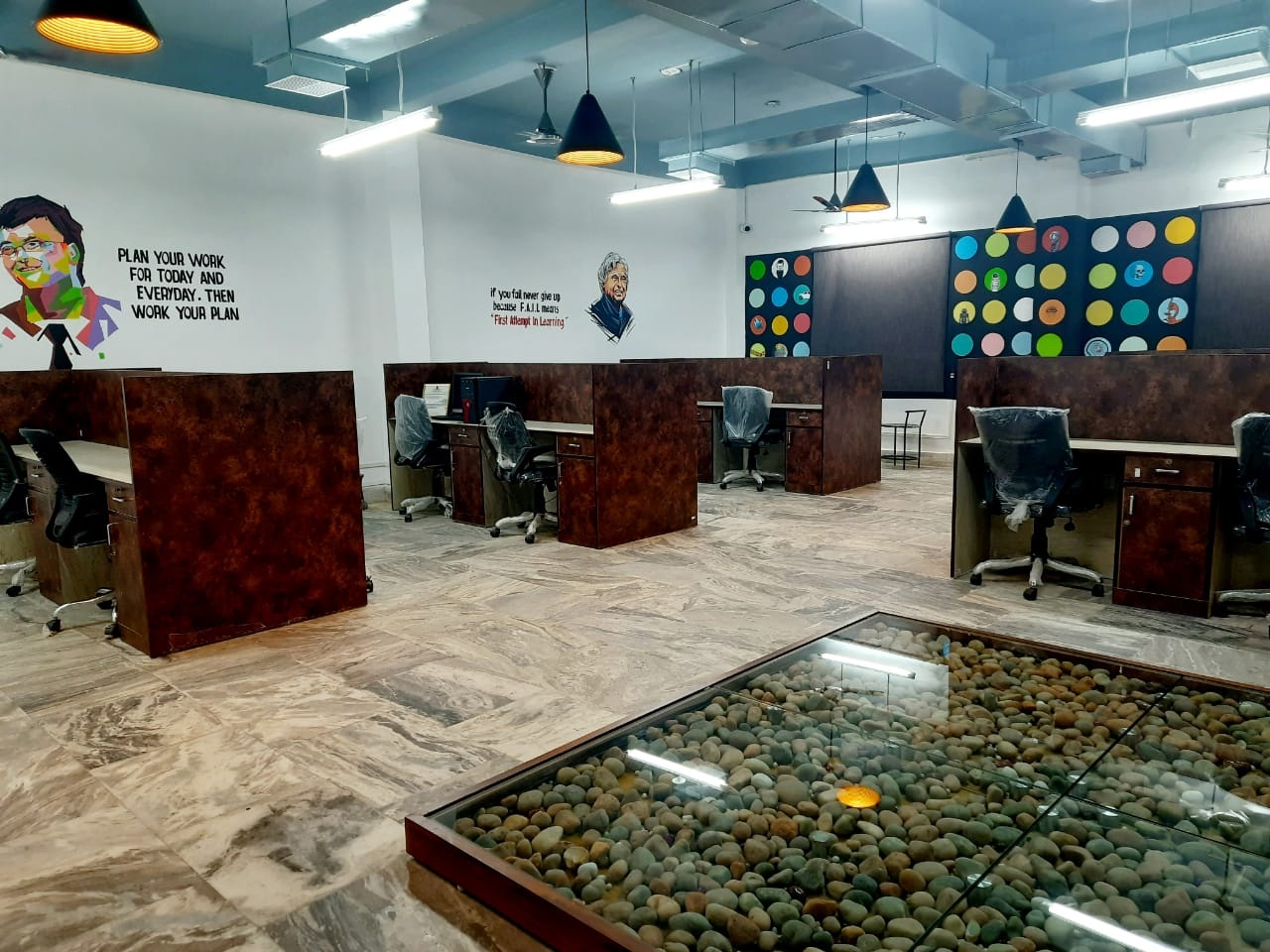
The centre lists workspaces, meeting rooms, conference facilities, internet access and maker resources among its services. It also lists corporate credits from Amazon Web Services, Google Cloud, Zoho and Bugasura. For a small team, these provisions address different expenses and tasks: somewhere to work, somewhere to meet and tools to support a digital product.
AIC-Nalanda’s expertise extends into the paperwork around invention. Its Intellectual Property Coordination Cell offers help with filing, registration, certification and licensing. The cell lists the National Research Development Corporation, S.S. Rana & Co. and the National Law University Odisha Incubators Forum as institutional partners. That places specialist legal and commercialization knowledge alongside the technical work.
The distinction between building and protecting matters. A prototype demonstrates a possibility; decisions about names, rights and licensing concern how an enterprise will use and commercialize its work. The cell gives founders a place to take those questions. Its published client list includes businesses such as Aromasymphonies, GauravGo and Imaginxt, showing that the offer reaches beyond a classroom exercise.
Follow the money carefully
AIC-Nalanda operates as a government-supported nonprofit incubator. Its model brings together shared infrastructure, program delivery and partnerships serving entrepreneurs. Startup funding is another part of that work: the centre describes routes to government grants, debt and equity, as well as investor pitch sessions. Each is a different financial relationship.
Funding facilitated for startups
AIC-NITF website, accessed September 2026. This is not the foundation’s revenue, valuation or a financing round.The centre’s website also reports more than 70 active startups. These are self-reported figures, useful as an indication of activity rather than a measure of investor returns. “Facilitated” describes support in getting money to ventures. It does not mean the foundation itself raised that sum, nor does it establish how much any individual applicant will receive.
There are concrete examples beneath the broad claim. Its July-September 2025 newsletter reports ₹13.8 lakh for Arth-X and ₹10 lakh for HYbionics through MSME Idea Hackathon 4.0. Separately, Protrainy’s August 2025 funding announcement named AIC Nalanda among participants in a seed round led by IIMA Ventures. Protrainy develops training for core engineering professionals, a close fit with the incubator’s educational roots.
The founder’s practical money question is therefore specific: which program, for which activity, and on what terms? The centre’s SISFS description covers proof of concept, prototypes, trials, market entry and commercialization. Before budgeting, an applicant should establish participation charges, any equity or repayment obligations, and the conditions attached to support. An introduction to an investor belongs in the opportunity column of a plan, not the cash balance.
Tourism and women founders get a route to market
The Odisha Tourism Acceleration Program illustrates how a broad incubator can narrow its attention. AIC-Nalanda and Merstra Foundation announced the program on January 16, 2025, for tourism, travel and hospitality ventures. Its offer connects business guidance with industry and investor access. A tourism founder needs advice suited to that trade, not merely a seat in a technology workshop.
Market access can also mean an exhibition stand. AIC-Nalanda’s April-June 2025 newsletter records its role as incubation partner for the National Women’s Business Mela in Bhubaneswar. Eight women-led startups from the centre joined an event featuring more than 200 women entrepreneurs. That is a tangible expression of its inclusion agenda: businesses getting room to present themselves.
The connections continued into 2026. IIM Bangalore’s July digest describes NSRCEL Women Startup Program meetups in Bhubaneswar involving AIC-Nalanda and other local partners. Across the two meetups, more than 100 aspiring entrepreneurs participated. AIC-Nalanda CEO Durga Prasad Gouda joined a panel about businesses rooted in community. Here, the institution’s role is convening people around a business problem and giving founders access to a wider conversation.
The network has work to do
AIC-Nalanda’s partnerships are most interesting when they produce something identifiable. A government account of FundStack 3.0 credits the foundation with managing the 2023 event alongside Startup Odisha, from outreach through delivery. That is operational work on a state investor summit, with responsibilities beyond lending a logo to the invitation.
Other agreements cover narrower gaps. FundOn’s announced partnership brings pitch decks, financial projections, market research and mock pitches to incubated ventures. CEO VINE’s July 2025 agreement concerns publishing and digital visibility for startups. These services address preparation and communication, both necessary when a young business is trying to be understood by someone outside its immediate circle.
StartConnect gives that networking offer a public entrance. The platform invites startups to reach organizations in AIC-Nalanda’s partner network. Its logic is straightforward: founders should be able to approach a useful connection through the institution. The value ultimately depends on what happens after the introduction - a discussion, a test, a commercial opportunity - rather than the length of the partner list.
The next applicant might be in Class 6
In September 2026, AIC-Nalanda announced the Odisha School Innovation Challenge. Its invitation targets teams in Classes 6-10 with working prototypes or advanced proofs of concept. The themes span health, water, energy, industry and sustainable cities; the published application deadline is September 30. This extends the institution’s interest in practical innovation to people well before their first company.
The useful lesson in AIC-Nalanda’s approach is the connection between stages and services. An idea needs testing; a product raises questions about rights; a business needs customers and sometimes capital. Another institution can copy that organization of support, provided it has relevant expertise and partners willing to do the work.
For founders, the same logic sets the limits. Access to facilities does not establish demand, and a mentoring session cannot substitute for a viable business. AIC-Nalanda offers places to work on those questions. Beneath the painted planets, the next useful milestone is reassuringly small: something that works, for someone who needs it.
Go inside the network
Explore AIC-Nalanda’s programs, application criteria, IP support and StartConnect. Watch the centre’s YouTube channel and explore its Startup Katha conversations.
Follow LinkedIn, X, Instagram and Facebook. Read about the CEO VINE partnership and NSRCEL’s Bhubaneswar meetups.