An entrepreneur with an idea and an entrepreneur with a customer may occupy adjacent desks. They inhabit different worlds. One needs to discover whether a problem is worth solving. The other needs to discover whether solving it can become a business. At Atal Incubation Centre- BIMTECH, in Greater Noida, that distinction supplies the organizing principle: give founders support appropriate to the question they are trying to answer.
- Four tracks separate idea validation, incubation, revenue growth and funding.
- Khoj offers a virtual, zero-equity starting point.
- Workspace and government schemes have specific prices, terms and eligibility.
- The practical lesson: test the next assumption before buying the next ambition.
A business school with a different assignment
AIC-BIMTECH began its journey on January 20, 2018, backed by the Birla Institute of Management Technology and the Atal Innovation Mission of NITI Aayog. The institutional pairing matters. A business school brings management knowledge; a public innovation mission brings access to a wider support system. The founders arriving here need to turn those resources into something less ceremonial: a workable company.
The centre is sector agnostic. Its portfolio includes logistics platform TruckSuvidha, sustainable-goods venture Uneako and Vymanik Aerospace. This breadth gives the place an unusual assignment. Advice useful to a drinks business might concern distribution; advice useful to a drone company might concern technical validation. The incubator has to connect a common business problem with the right specialist.
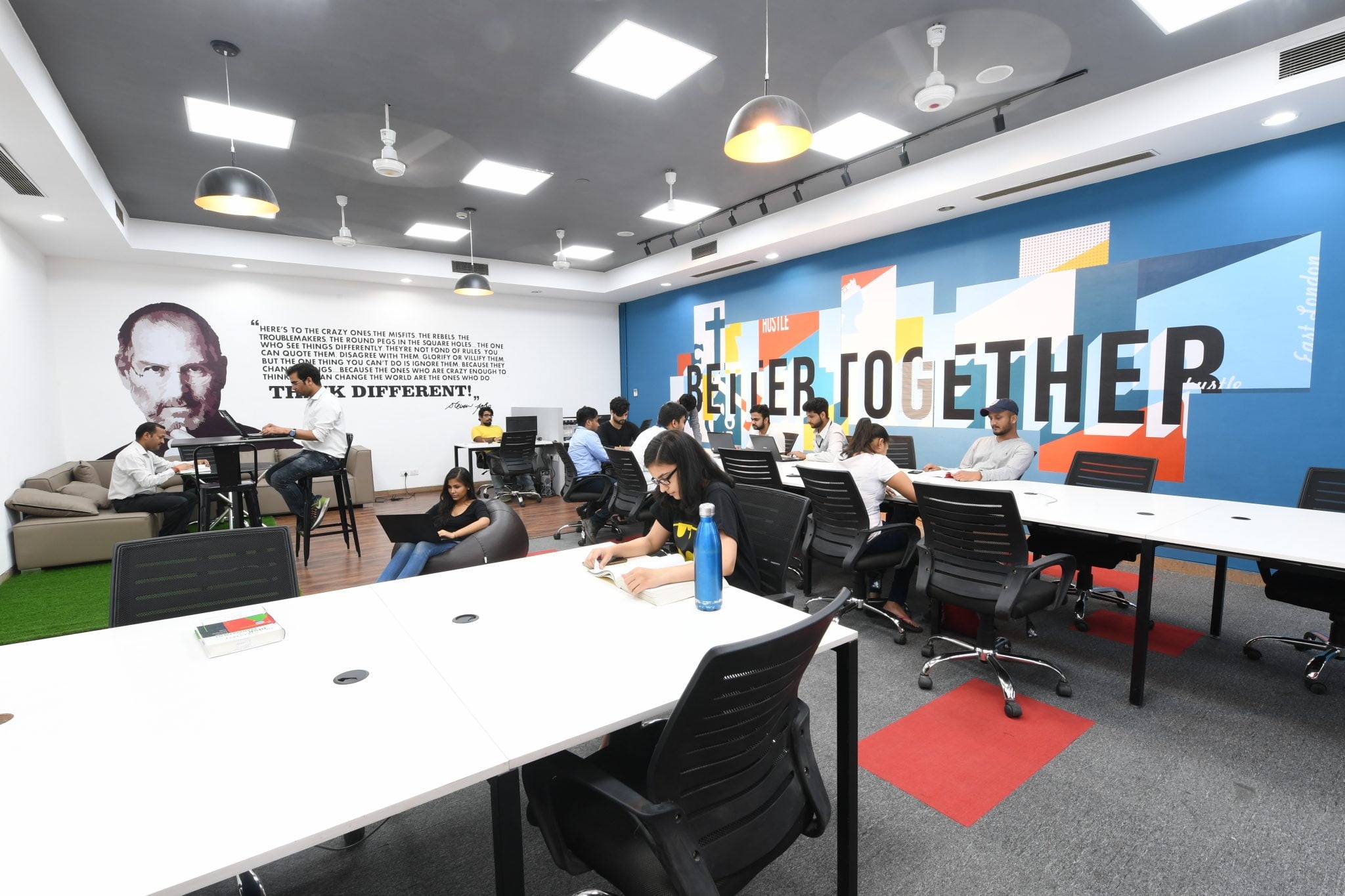
Its customers are aspiring entrepreneurs and selected startups, with programs stretching from early concepts to revenue-stage ventures. Freelancers and small teams can also use the workspace. In the market, AIC-BIMTECH sits between university entrepreneurship centres, private accelerators and ordinary shared offices. Its particular combination is business mentoring, a campus base and routes into government-backed startup support.
Four names for four different problems
Khoj begins with an idea that needs testing. Prarambh supplies an eight-week incubation period. Gurukul addresses ventures already earning revenue. Udaan concentrates on preparation for, and access to, capital. Read together, the names describe a sequence of evidence: a plausible problem, a usable product, a repeatable business and a proposition someone might finance.
That separation is useful because founders can confuse activity with progress. A polished pitch does not establish demand. Registration does not establish a route to market. An investor introduction does not establish investment readiness. A staged program gives each task a place, and makes it easier to ask whether the previous task has actually been completed.
TruckSuvidha co-founder Ishu Bansal describes mentors who “challenged our distribution assumptions” in a testimonial published by the incubator. The phrase is more revealing than a generic endorsement. Distribution is an assumption until someone has found a reliable way to reach customers. A useful mentor can make a founder revise the plan before the market makes the revision expensive.
“challenged our distribution assumptions”Ishu Bansal, TruckSuvidha co-founder
From AIC-BIMTECH’s published testimonial
The cheque has conditions attached
Capital access is a substantial part of the offering, but different instruments do different jobs. AIC-BIMTECH was selected for the Startup India Seed Fund Scheme in 2021 with a ₹5 crore allocation. Its current scheme page reports 61 funded startups and marks applications closed. That is a record of a funding channel, not an invitation to treat every advertised ceiling as cash available today.
SISFS separates grants of up to ₹20 lakh for proof of concept and prototypes from investment support of up to ₹50 lakh for commercialization and scaling. The latter can involve convertible debentures or debt. A founder comparing opportunities needs to compare repayment, conversion and milestones as carefully as the number on the poster.
Proof of concept / prototypes
Commercialization / scale
GENESIS EIR addresses earlier technical uncertainty. The centre advertises milestone-linked, non-dilutive assistance up to ₹10 lakh for eligible innovators, with Tier II and Tier III locations a priority. Its criteria include early technology readiness, startup age and previous government assistance. A promising idea alone does not settle those requirements.
What support costs, in money and attention
The incubator’s economics vary by service. Its 2023 annual report listed Khoj as free, Prarambh at ₹4,999, Gurukul at up to two percent equity and Udaan on a success-fee model. Those are historical terms; they demonstrate why “incubation” is too broad a word to price without specifying a program.
Current workspace listings are more concrete. A main-campus monthly seat is advertised at ₹5,000 plus 18 percent tax; the SupremeWork partner hub lists ₹3,500 plus tax. Day passes are ₹300 and ₹250 respectively, before tax. These charges buy a place to work. The larger value depends on whether the surrounding people and services resolve a real obstacle.
Time belongs in the calculation too. The Stanford Seed Spark offering describes five months of online entrepreneurship learning. Mentoring, workshops and customer discovery demand attention that could otherwise go into building. Participation makes sense when the learning changes a decision, rather than merely adding another certificate to the company folder.
Look beyond the usual startup room
On February 24, 2026, FDDI signed an agreement with AIC-BIMTECH for joint incubation, mentoring and capacity building. Footwear, leather, fashion and retail are among the intended sectors. The agreement’s promise is access to relevant expertise and industry links; the announcement establishes an intention, rather than measured commercial results.
BaithakX takes a less formal approach to access, bringing founders, mentors and investors into curated mixers over tea. The attraction is easy to understand. A founder can ask a precise question in conversation that would disappear inside a presentation. The value of the gathering rests on who attends and what happens after the cups are cleared.
Copy the sequence, then demand evidence
The transferable lesson is to name the next uncertainty. Does anyone need the product? Can it work? Will anyone pay? Can the sale repeat? Then choose support that helps answer that question. Founders needing specialized scientific facilities should assess the actual equipment and expertise; those needing immediate cash should check open allocations and instrument terms. A network helps most when there is a clear request to carry through it.