There is a revealing item on Sona Incubations’ facilities list: an ultrasonic cleaner. It sits in the same inventory as CNC milling and turning machines, a hardness tester and a 3D printer. Most startup advice begins with a market. This list begins with things that can be cut, shaped, tested and cleaned. For a founder making a physical product, that is a rather persuasive introduction.
- A campus incubator in Salem, with a stated 15,000-square-foot facility.
- Fabrication access, business mentoring and an IIT Madras incubation connection.
- Separate routes for accelerator participation, innovation grants and seed support.
Sona Incubation Foundation is a Section 8 nonprofit company within the Sona Group of Institutions. Its advertised interests include wearables, assistive technology, deep tech, fashion technology and Industry 4.0. These are fields in which an attractive presentation can conceal an inconvenient object: a device that still needs to work. Sona’s offer makes sense at precisely that point, when invention acquires a materials bill.
A machine shop is an argument
The foundation combines coworking with technical facilities, mentorship, legal guidance, intellectual-property support and introductions to markets and investors. It also offers help finding student interns from Sona’s institutions. Its users include innovators, students, faculty, researchers and early-stage entrepreneurs. The general application accepts several stages of venture development; individual programs narrow the invitation.
Consider the difference between renting a desk and gaining access to a fabrication environment. A desk gives a founder somewhere to sit. A milling machine makes another kind of work possible. Bringing equipment, technical advice and commercial questions into the same institutional orbit could shorten the journey between noticing a defect and trying another version. That is the practical promise of the model, rather than a measured claim about development speed.
The facilities list gives the proposition substance: CNC equipment, printing and testing tools accompany meeting rooms and a 60-seat auditorium. Expertise here spans making a product and organizing a company around it. Ordinary coworking addresses workspace; an independent workshop addresses fabrication. Sona packages those needs with business support. Its appeal depends on a founder actually needing that combination.
Borrowing the network
In August 2021, Sona and IIT Madras Incubation Cell announced a partner-incubator agreement. The arrangement covered mentoring, infrastructure, training and investor connections, alongside adoption of incubation processes and a platform for tracking incubatees. The original announcement specified an initial three-year period of access. Sona continues to advertise the co-incubation relationship on its website.
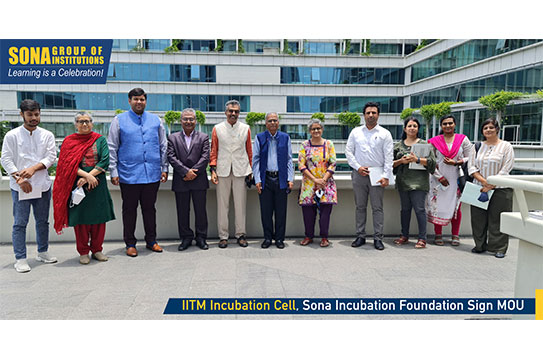
The geographical idea is useful. A founder can begin with local engineering resources while seeking expertise from a larger network. Relocation need not be the first administrative task. In the partnership announcement, IIT Madras professor Ashok Jhunjhunwala described looking for institutions with serious research and student participation in industry projects. The campus’s technical work was part of the attraction.
For another institution, the copyable move is to start with capabilities it already possesses and attach missing expertise through a partner. For a founder, the corresponding move is to ask which resource is holding up the next experiment. An introduction has value when it leads to the person, tool or customer needed for that experiment.
A fee, a timetable, some unromantic rules
Sona’s second-cohort brochure describes a three-month accelerator for teams already prototyping or developing a product. Nine workshops cover customer discovery, product development, business models, pitching, acquisition, finance and scaling. Monthly check-ins are intended to identify bottlenecks. A final presentation records progress.
Per selected startup · three months
Prototype materials and travel cost extra.
The fee becomes nonrefundable once the program begins. Founders must attend the sessions, disclose conflicting commitments and contribute actively. The brochure even warns against naming friends or relatives who do no work. Entrepreneurship has many glamorous accessories; an imaginary cofounder is apparently one too many.
The program format also deserves attention. The newer Cohort 5.0 listing describes three offline days, with ₹12,000 per startup covering up to two participants and accommodation charged separately where applicable. A founder comparing programs should compare the actual schedule and entitlements. A familiar cohort name is a poor substitute for reading the offer.
Two pots of money, different jobs
Government-backed support gives the incubator another role. In July 2024, reporting described recommendations of ₹5 crore under DST’s NIDHI i-TBI program and ₹2 crore through Startup India Seed Fund, with an institutional contribution attached to the former. Those were recommendations for incubation support, rather than a conventional venture round.
December 2025 reporting from THINK Salem described a more specific result: 12 startups signed NIDHI grant agreements worth ₹50 lakh; five received ₹60 lakh in Startup India seed investment. The two mechanisms should remain distinct. An agreement to support a prototype and an investment in a venture do different work.
Bars compare announced rupee amounts, not outcomes or disbursement dates.
The nonprofit structure sits alongside paid programs and publicly supported funding routes. July 2024 reporting also described Sona taking equity participation when backing selected ventures. That makes the founder’s agreement consequential: a workshop fee, a prototype grant and an investment each bring their own terms. The sensible comparison is the support received, the obligations accepted and the money left for building.
The foundation’s Ignite program advertises awards of ₹2 lakh to ₹10 lakh for eligible early-stage technology ventures. Its funding page emphasizes pilot trials, business-model refinement and investor and customer connections. For applicants, selection matters as much as the headline amount. Joining a cohort and receiving an award are separate propositions.
“We provide the Infrastructure. You build the Company.”Sona Incubations
The useful thing to copy
Sona works in the space between technical possibility and commercial usefulness. Its curriculum puts customer discovery near the beginning, making the buyer’s problem something to investigate while a product can still change. The lesson is portable: identify the next uncertainty, design a test and seek the support that makes that test possible.
The model asks something of the founder, too. A team unable to attend regularly will struggle with the second cohort’s requirements. A business seeking only office space may need fewer services. Alumni access to facilities is subject to availability and permission. Shared infrastructure can support development, but demand, delivery and the next payroll still belong to the company being built.