On a map, Columbus looks like an unlikely place to manufacture technology companies. It is a long way from Sand Hill Road, and Ohio attracts a fraction of America's venture dollars. Rev1 Ventures decided the map was the wrong instrument. Its Columbus already contained a giant university, a nationally known children's hospital, major insurers and utilities, practical operators, laboratory discoveries and founders stubborn enough to stay. The problem was not raw material. The problem was getting every useful piece to arrive at the same table before a young company ran out of cash.
Rev1's answer is difficult to describe in one familiar noun. It is a nonprofit venture-development organization that manages investment funds. It runs a free accelerator, operates offices and wet labs, works with corporate innovation teams, commercializes university and hospital research, recruits mentors and introduces founders to customers. Calling it a VC firm misses half the machinery. Calling it an incubator misses the money.
The first product was a reboot
The organization began this chapter as TechColumbus. By 2013, under founding president and CEO Tom Walker, it was pulling apart the membership-group model and asking sharper questions. Could founders validate ideas before wasting years on them? Could senior executives become advisers and first customers? Could talent, lawyers and accountants be gathered around companies before those needs became emergencies? Could capital be offered as a continuum instead of a lottery ticket?
Eighteen months of refitting led to the 2015 name Rev1 Ventures. The name meant first product, first customer and first revenue. This was more than stationery. A broad civic organization had become accountable to startup milestones. In its first public telling of the shift, Rev1 said 50 startups had received customer connections in the prior year and eight had closed a sale or beta account. The ratio is wonderfully unglamorous. Introductions were not declared victories. Customers were.
“Building companies is hard. Building an ecosystem is even harder.”Tom Walker, founding CEO
What failed first was the idea that a useful startup organization could simply serve everybody. Membership produced activity, but focus produced a method. Rev1 narrowed its work to scalable technology companies and organized the pipeline around evidence. The change of mind was not triggered by a single disaster. It was an operating correction: entrepreneurs needed fewer mixers and more help reaching a specific next milestone.
Free is the price. Evidence is the fee.
A founder with an early advanced-tech idea can start with Concept to Customer, a bootcamp for testing whether the problem deserves a business. Founders who already have proof that customers will pay can apply to Customer to Capital, a 14-week accelerator for enterprise software, SaaS, medical devices and other advanced technologies. It covers differentiation, go-to-market work, financial modeling, capital strategy and pitch preparation.
The dollar cost is zero. Rev1 takes no equity for the accelerator. The real bill is about seven hours a week, split between self-directed work and live sessions, plus the discomfort of producing evidence. The finale is a seven-minute pitch to accredited investors, corporate partners and ecosystem regulars. More than 50 mentors sit within reach, including operators who know governance, product, sales and fundraising from the inside.
Sequence help around proof, not inspiration. Interview customers before polishing a deck. Make each introduction answer a declared need. Match financing to the next technical or commercial milestone. Count pilots, hires and follow-on capital, not room attendance.

Three markets, one missing middle
Rev1 concentrates on software and AI, deep tech, and life sciences. The categories share one inconvenience: something important must happen before a conventional investor sees a clean growth chart. Enterprise software needs a credible buyer. Hardware needs prototypes, facilities and patient capital. A therapy or diagnostic can spend years between promising science and an investable company.
That last gap explains the unusually close relationships with The Ohio State University and Nationwide Children's Hospital. Rev1 helps turn research into spinouts by shaping commercialization plans, recruiting leadership and connecting teams with specialist advisers and capital. Its 2025 report counted 50 spinouts supported, 12 funded and $6.5 million deployed into them. Portfolio examples range from Armatus Bio's genetic neuromuscular disease work to Niobium Microsystems' hardware for computing on encrypted data.
The customers therefore come in pairs. Founders use Rev1 to become fundable and sellable. Corporations use it to scout technology, offer feedback, run pilots and find possible investments. In 2025, more than 60 corporations participated in innovation activity and Rev1 recorded 232 corporate-founder connections, up 75 percent year over year. COTA, the local transit authority, described the relationship as direct access to technologies it would otherwise miss. That is the flywheel: a corporate problem becomes a startup's first serious conversation.
Who pays for the connective tissue?
Rev1 publishes an unusually mixed revenue recipe: corporate innovation contracts, fund-management income, partner support, investment returns and Ohio Third Frontier funding. Qualified founder programs can remain free because the ecosystem's beneficiaries help pay for the platform. Managed funds provide a second lane. Rev1 Capital deployed $11.74 million across 26 companies in 2025 and worked alongside 91 co-investors. Over Ryan Helon's 13-year investment tenure, the organization reported more than $100 million invested in 152 startups across more than 290 rounds.
The public side matters. An $11.7 million Ohio Third Frontier grant announced in 2022 depended on matching relationships with Ohio State, Nationwide Children's, insurers, utilities, manufacturers, community groups and local governments. Future Value Fund I, launched in 2020 with Ohio State and Third Frontier support, added a $10 million pre-seed pool. In 2025, Rev1 also helped launch 71/70 Angels, named for the freeway interchange every Columbus driver knows. Nearly 50 individuals backed the fund; it closed its first raise and put money to work within 90 days.
This model makes Rev1 different from a conventional fund whose management fees and returns dominate the business. It can work before a company is investable, after a researcher has an invention but before anyone has a CEO, and alongside corporations that want innovation without pretending they can invent everything internally. Its reported 2025 output was $174 million in startup revenue and $718.1 million in combined revenue, capital and exits. Those are Rev1's impact measures, not its own sales.
A new room for deliberate collisions
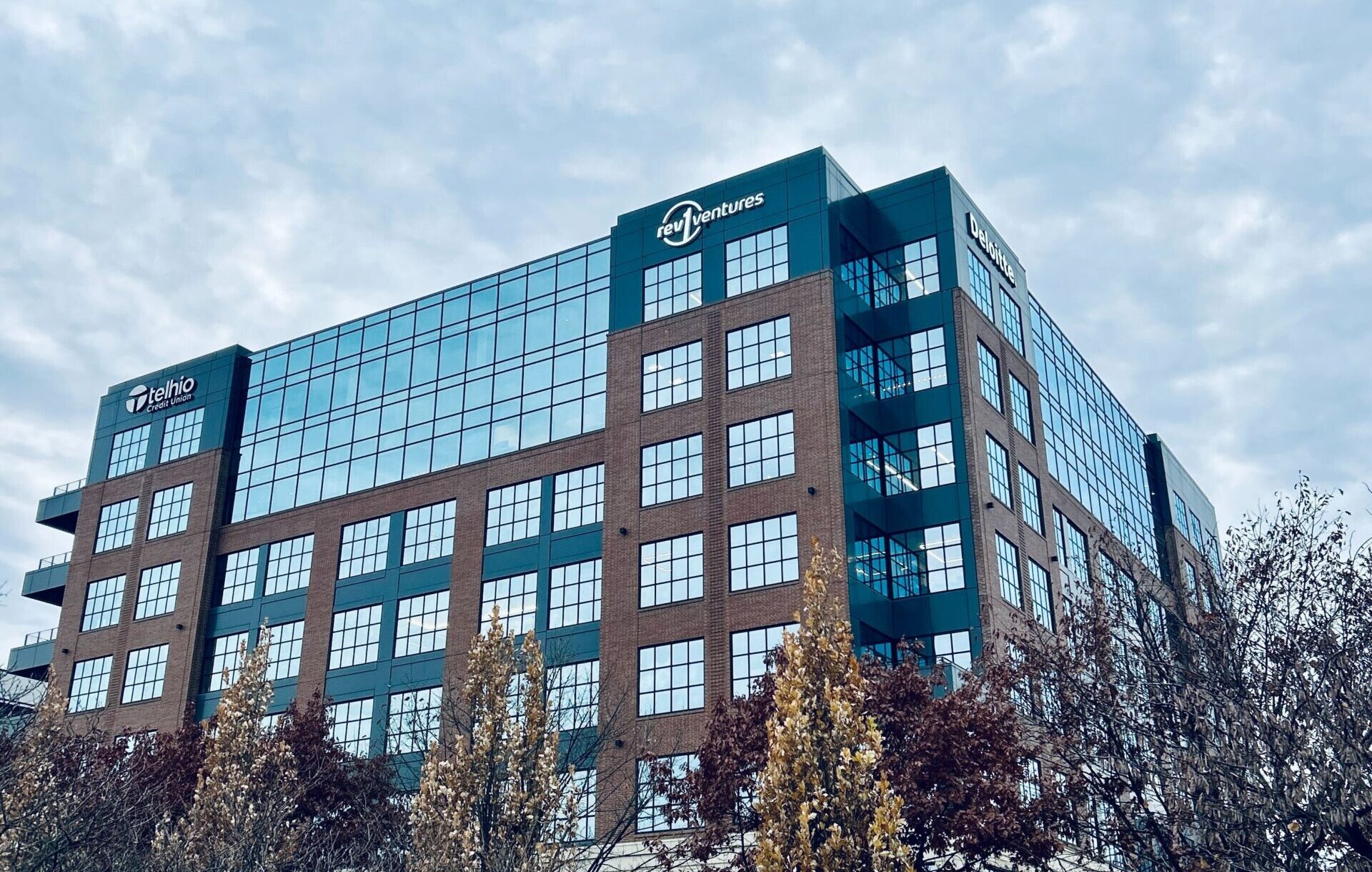
Rev1 now has two physical personalities. Rev1 Labs on Kinnear Road sits near Ohio State and houses life-sciences and advanced-technology teams that need more than a laptop. Rev1 at The Peninsula, opened as the new headquarters in 2026, is a downtown home for software, AI and advanced-tech founders. Its first floor favors lounges, day passes, events and small-team memberships. Six larger upstairs suites were designed for scaleups. Dedicated coding rooms came directly from company feedback.
President and COO Kristy Campbell made the distinction plain when the building opened: this was not generic coworking filled with unrelated freelancers. The point was proximity among people building venture-backed companies. That sounds like real-estate copy until one remembers Rev1's core product. The firm manufactures useful collisions. A building is simply the hardware version of its contact list.
The record is not spotless or universal. Rev1's selection criteria deliberately leave out ordinary small businesses, founders outside its sectors and companies without a credible path to scale. Life-sciences bets still face clinical risk. Public grants can be cyclical. Corporate partners may move slower than startups. Impact totals mix client revenue, capital and exits, useful for economic development but not equivalent to investment returns. And a network built in Columbus cannot be shipped like software.
The part another city can steal
The copyable idea is not “open an accelerator.” It is to inventory local advantages, assign each institution a concrete job and fund the connective work long enough for trust to compound. Universities supply research. Hospitals become commercialization partners. Corporations bring problems, buyers and matching capital. Government absorbs some early ecosystem risk. Operators mentor. Investors arrive after evidence, not before it.
The conditions are demanding. This only works where research institutions are willing to license inventions, corporate leaders will meet founders, public funders can tolerate long payback periods and a capable team can say no to companies that do not fit. Remove two or three of those pieces and the studio becomes a class schedule with a logo. Rev1's achievement is not that it made Columbus behave like Silicon Valley. It made Columbus behave more like Columbus - dense with institutions, allergic to spectacle and increasingly good at getting the right person into the room.
Keep digging
Explore the programs, people and latest numbers directly: