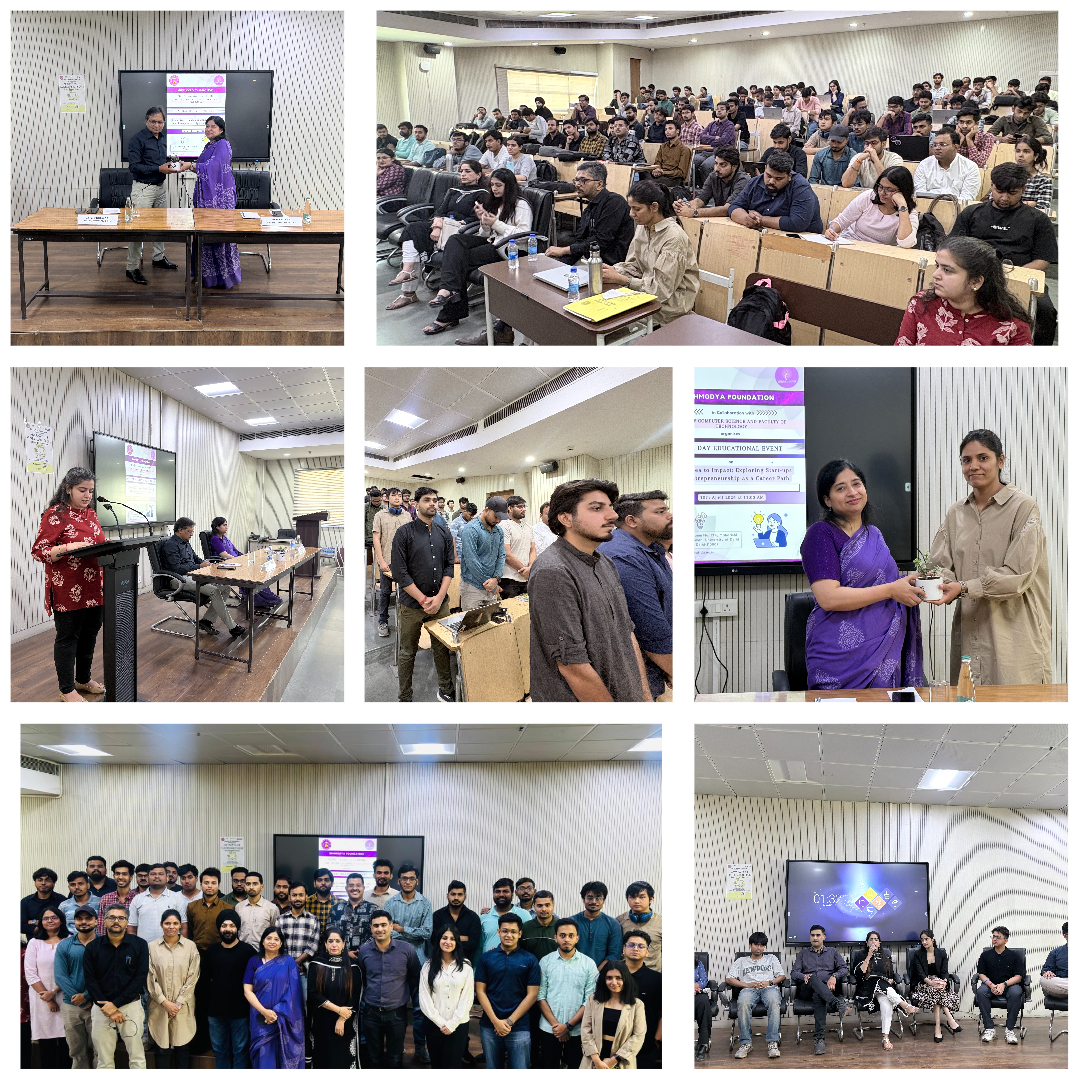
On April 10, 2026, students from the University of Delhi’s Department of Computer Science attended an event about entrepreneurship. Five startups incubated by Udhmodya Foundation joined a panel. The founders discussed their motivations, challenges and the skills their ventures required. Then came the useful bit: interested students visited incubated and pre-incubated teams. A career that had occupied the screen at the front of the room could now be encountered in person.
- Udhmodya is Delhi University’s nonprofit company for startup support.
- UDIT combines incubation and training for aspiring and early-stage founders.
- Its offer includes mentorship, shared facilities and connections to resources.
- Seed opportunities have selection criteria; joining is not a cheque.
The event report says demand prompted two phases, on April 10 and April 20. That is a modest detail, but a revealing one. Students wanted to see how an idea becomes work. Udhmodya’s proposition begins in that gap between being interested in entrepreneurship and knowing what to do on Monday morning.
A university with somewhere to put the idea
Udhmodya Foundation is a Section-8 company established by the University of Delhi. The company form gives its entrepreneurial ambitions an organisation; the nonprofit purpose makes supporting new ventures its reason for existing. Its name, the university explains, evokes a rising sun. An agreeable image, although a founder will eventually want something more practical than sunrise.
The university’s October 2024 account gives the practical version: two verticals, academic learning and support for innovation and entrepreneurship. By October 17 that year, it reported at least six incubated startups. That dated minimum is useful because it describes actual incubation, rather than the much easier business of announcing enthusiasm.
Startups incubated by 17 October 2024.
A dated university-reported minimum.
The distinction matters to anyone choosing support. A workshop can explain a business model. An incubator is supposed to help a particular team work on one. Udhmodya occupies the space between the university’s teaching mission and the recurring, untidy decisions of an early venture.
The name on the door is UDIT
Its incubation and training route is called UDIT. A July 2023 notice from Delhi University’s Sociology Department invited early-stage startups, innovators, aspiring entrepreneurs and people seeking help to scale their ventures. It described applications as continuously open, evaluated on a first-come basis. A named route is a small administrative courtesy with a large practical benefit: curiosity has somewhere to go.
The foundation publishes an offer of mentorship, coaching, training, networking, shared office space and labs. Its stated approach includes physical and virtual participation. It also aims to connect startups with investors, industry experts and other resources. Those connections can reduce the number of problems a novice founder must solve alone.
- 01Bring an idea
- 02Find guidance
- 03Develop the venture
- 04Connect to resources
For a first-time entrepreneur, the problem is often knowing which question deserves attention next. Is the customer clear? Does the team need a technical collaborator? Is the pitch explaining the business, or merely displaying the founder’s affection for it? Mentorship is useful when it turns that affectionate explanation into a testable proposition.
Money, with an asterisk
In October 2023, Udhmodya and the Career Development Centre, in collaboration with Samarth Bharat, promoted a Startup Accelerator Program and a two-day conclave. The announcement offered a “SUPER 25” route combining incubation, mentor connections and investor access. Knowledge partners named included ACE, SIIC at IIT Kanpur, Unnat Bharat Abhiyan at IIT Delhi and Delhi Technical University.
The advertised seed ceilings were specific: up to ₹5 lakh for the most innovative and scalable idea, social-impact idea and women-led innovative idea; up to ₹2 lakh for best startup ideas; and up to ₹1 lakh for sustainable and scalable ideas. These were the terms of that announcement, rather than evidence that every participant received money.
“Support and nurture new and early-stage enterprises to help them become successful and sustainable.”Udhmodya Foundation’s published mission
A founder can copy the discipline implicit in those categories: connect the idea to a defined purpose and explain why it can grow. Capital is useful, but a seed-award ceiling does not answer the harder question of whether somebody will buy the product again.
The less glamorous machinery
There is another way to understand incubation: read the job description. In June 2024, Udhmodya advertised a one-year contract for an incubation executive at a consolidated ₹300,000 annually. Duties included facilitating incubation, conducting entrepreneurship programs, coordinating stakeholders, scheduling meetings and managing documentation. That figure describes one advertised role, not the foundation’s operating budget.
It is an unusually concrete glimpse of the work underneath the word ecosystem. Somebody must arrange the meeting, keep the record and make the introduction happen. An institution can have excellent intentions and still lose a founder somewhere between a form and a calendar invitation.
The expertise also reaches beyond pitching. In April 2023, the foundation held an intellectual-property webinar with Roma Arora, head of intellectual property at Havells India, as the invited speaker. More than 70 people attended, according to the university. Protection and commercialisation belong in the same conversation: inventing something and making a business from it are related tasks with different demands.
Close enough to be useful
Udhmodya’s distinctive position is its university setting. Students, faculty, staff and other innovators appear in the institution’s stated ambitions. Instead of buying every connection separately, a founder can approach an organisation intended to join learning, facilities, advice and venture development. The strength of that arrangement depends on how well those pieces meet a particular team’s needs.
A prospective applicant should ask who will mentor the venture, which facilities are accessible, what the written participation terms require and how progress will be reviewed. Someone needing immediate commercial distribution or specialist equipment should check those needs directly. Incubation support cannot establish demand on a founder’s behalf.
The most portable lesson is the April visit’s sequence: discuss the work, meet the people doing it, then give interested students a next step. Any university can borrow that habit. Udhmodya makes the next step an institution. For the student leaving the lecture with an idea, that is a consequential piece of geography.