A sweet lime has a fairly predictable career: someone squeezes it, drinks the juice and throws away the remains. In Anantapur, Ushanna Shivaram has been investigating the discarded part. AIC-SKU describes his work on products from mosambi waste, including face masks and Mosambi Thandra. The leftovers, apparently, have ambitions.
- A university-based nonprofit helps rural ideas become businesses.
- Its route runs through faculty training, student programs and incubation.
- Support includes mentors, facilities and introductions to funding.
- Free early workspace can coexist with later financial obligations.
On 18 August 2026, the centre reported recognition for Shivaram and fellow grassroots innovator Sudhakar Babu Gariganti. The useful detail is the starting point: a material already close at hand. A rural business need not begin with a metropolitan problem imported into a village. It can begin with something the village is already throwing away.
Sweet-lime leftovers and the price of leaving
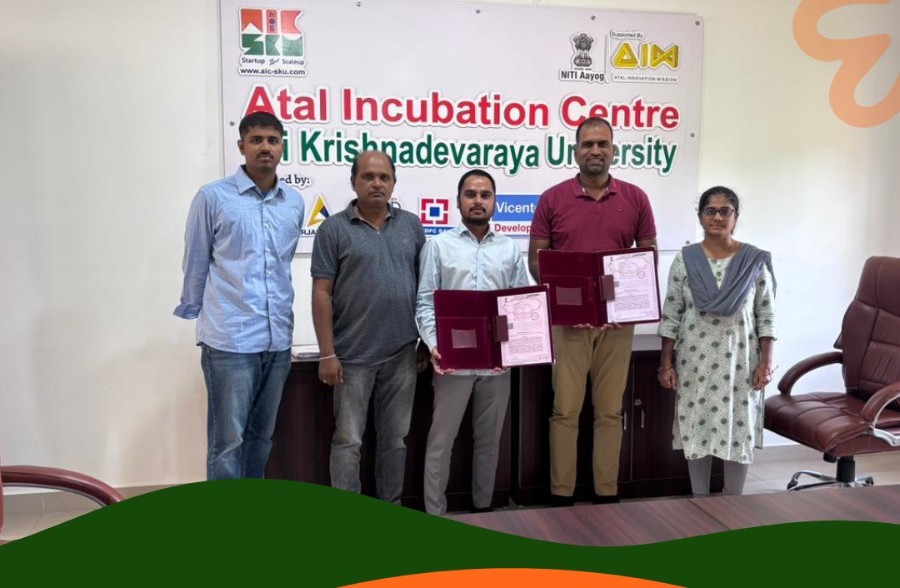
Atal Incubation Centre - Sri Krishnadevaraya University, usually shortened to AIC-SKU, sits within the university’s Anantapur campus. It operates as a Section-8 nonprofit company, supported by Atal Innovation Mission at NITI Aayog and the Andhra Pradesh Innovation Society. Its stated ambition is unusually geographical: help people build businesses where they are.
“We exist to reverse the talent migration”
AIC-SKU’s published vision
That sentence supplies a useful way to judge the enterprise. The relevant question becomes whether a student or local inventor can reach the next business milestone without losing access to home. Mentorship, workspace and a university connection are the proposed means. Local employment and economic development are the intended consequences, rather than outcomes established by the mission statement alone.
The centre’s focus areas are agritech and food processing, clean energy, circular economy and deep tech. Those headings make more sense when attached to its listed ventures: Weftcare works on agricultural-waste paper; Sudha Enterprises develops a corn picker; Muntaz Energy works on gravity-based energy storage. The portfolio also extends into software and healthcare. AIC-SKU helps the makers; these are their products.
The classroom needs a second door
A college can produce an ingenious project and still struggle to produce a company. AIC-SKU’s academic partnership model addresses that gap at the institutional level. It identifies faculty exposure, teaching loads and limited resources as obstacles. Its offer includes resource mapping, incubation planning, intellectual-property policies and training for the people who will supervise student innovators.
There is a sequence to the programs. Acharya develops faculty capacity. IGNITE introduces students to entrepreneurship. Vanthena provides pre-incubation, while Abhyuday covers the business tasks that follow an attractive idea: financial modelling, branding, compliance and intellectual property. Gear Box is the acceleration stage. The names are memorable; their value depends on the work between them.
- 01AcharyaEquip faculty
- 02IGNITEExplore entrepreneurship
- 03VanthenaDevelop the idea
- 04AbhyudayBuild the business
- 05Gear BoxAccelerate
Geethanjali Institute of Science and Technology documents the relationship in its own activity record. It lists faculty development, student entrepreneurship training and a pre-incubation agreement. This is the distinction worth noticing: an institution gets access to a recurring process, while a founder gets help with a particular venture. The incubator serves both.
Three months free. Read the next clause.
The economics are visible in a March 2025 agreement with NUTRIHOUSE, a student food venture. It offers no pre-incubation enrolment fee and free premises for three months. Continuation depends on performance and deliverables. It also specifies a 3% service charge on facilitated funding, a 5% royalty on IP generated during incubation and 3% company equity payable at exit. These terms apply to that agreement.
Free premises for NUTRIHOUSE’s pre-incubation period. Progress determines continuation; separate financial provisions apply.
The incubator itself rests partly on public money. Its 2025 Startup Mahakumbh exhibitor profile reports a ₹5.5 crore sanction, ₹4.4784 crore received from NITI Aayog in four tranches during 2018-2023, and a ₹50 lakh state matching grant. The sanction is a ceiling in this account; adding it to the disbursements would count the same funding twice.
This is a support organization with grants, university assistance and service-related income, rather than a conventional venture-backed software business. A founder should therefore ask two separate questions: what help is available, and what obligations accompany it? A reassuring price at entry does not answer the second question.
A filter before a fundraise
A June 2020 college record captures the screening process. Chandra Mouli reported that three of fourteen presented models showed commercialization potential: Startup Builder, Smart Notice Board and Trendy Nut. The note also proposed continued work with other teams. This was a shortlist, not a declaration that eleven businesses had failed.
The practical lesson is to invite scrutiny while changing an idea is still cheap. Build something testable, identify its buyer and let commercial questions interrupt the applause. AIC-SKU offers business-plan advice, technical guidance, technology-transfer support and investor connections. Its investor meetings name Arthayan and ICFAI among collaborators. Access to that conversation is useful; an investment decision remains the investor’s.
The numbers require similar discipline. A December 2024 parliamentary reply recorded 26 incubated startups. The centre’s live website lists 68 startups and MSMEs. Different dates and categories prevent a tidy growth claim. Neither figure, on its own, measures how many ventures became durable businesses.
A reason to build nearby
Today’s team page names Dr. C. Chandra Mouli as CEO and Dr. P. Jyothi as incubation associate. A 2026 AI enablement program with Samhita extends the offer to MSMEs adopting tools in existing operations. That broadens the audience beyond students preparing their first pitch.
A founder choosing support should match the problem to the expertise. AIC-SKU’s university network and rural emphasis suit ideas needing structured development and regional connections. A venture requiring specialist clinical infrastructure may find a medical incubator more appropriate. No amount of mentoring substitutes for a customer willing to pay.
What readers can copy is the sequence: find a local problem, recruit the right technical help, test commercial promise and set explicit deliverables. Keeping talent nearby requires such ordinary arrangements. Even sweet-lime leftovers need someone to ask what happens after the prototype.