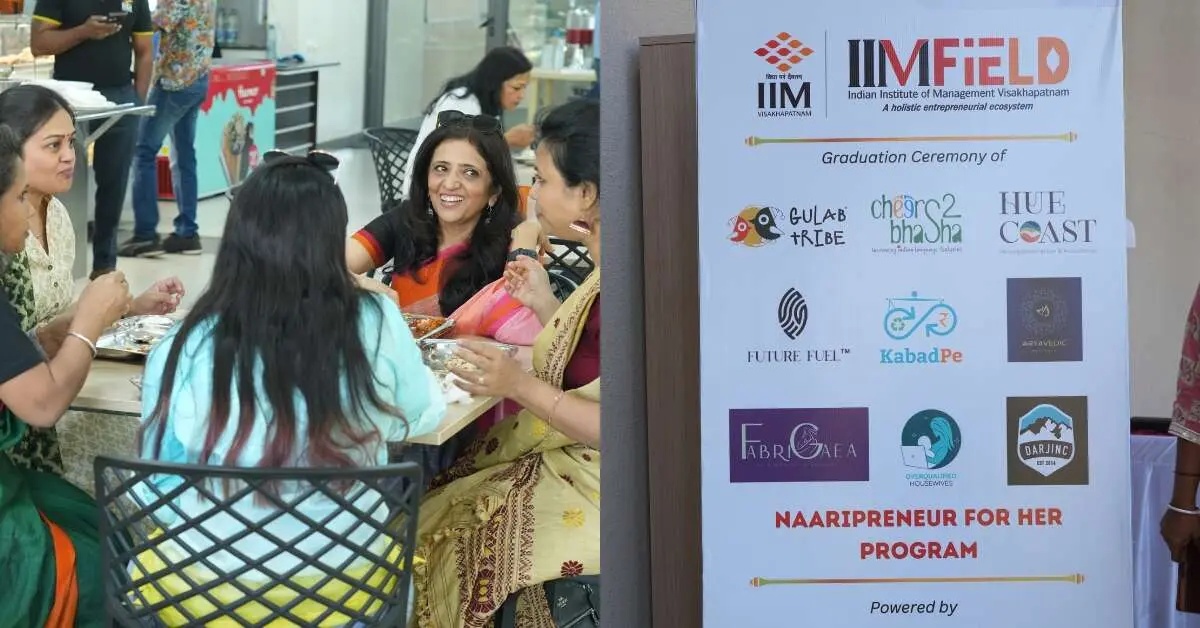
Twenty-seven startups graduated from IIMV FIELD’s Naaripreneur for Her program on March 7, 2025. Each had received ₹40,000 to help build a prototype. By graduation, 23 were generating revenue, according to reporting on the ceremony. Those are modest, useful numbers: enough money to try something, enough time to find customers, enough evidence to ask what happened next.
FIELD, the incubation and startup hub of the Indian Institute of Management Visakhapatnam, works in this territory between having an idea and having a business. Its founders might be developing a food product, a technology service or a social enterprise. They need help deciding what to sell, how to deliver it and which numbers matter. A persuasive pitch is welcome. A functioning business is the assignment.
The institution’s current website reports more than 200 incubated startups and more than 135 women entrepreneurs supported. These are cumulative activity measures, rather than a scorecard of surviving companies. Still, they help establish the character of a management-based incubator whose entrepreneurship work began with women, long before its latest rural enterprise initiative.
Women were the starting point
IIM Visakhapatnam began entrepreneurship activities in 2018 through the Women Startup Program, partnering with NSRCEL at IIM Bangalore. FIELD became a Section 8 nonprofit company in 2020. The sequence matters: the activity preceded the corporate wrapper. This was an institution building an entrepreneurship function, with women founders as an early constituency.
The original partnership supplied a progression from online business learning to pre-incubation and then incubation. FIELD’s published account records 25 women-led startups supported in 2018-19 and 20 in its next cohort. An institute newsletter later recorded 36 entrepreneurs joining the third cohort in July 2023. Its stated audience included women in tier-2 and tier-3 cities, where accessible business education was part of the proposition.
Today, FIELD’s board lists Prasad Dahapute as chairperson, M. Chandrasekhar as managing director, M. Shameem Jawed as director of operations and R. Sai Shiva Jayanth as director of finance. Jawed is also identified as CEO in the institute’s March 2026 Sampannakaari announcement. This is a company attached to an academic institution, with faculty expertise and program delivery closely connected.
₹40,000, followed by the hard part
Naaripreneur, backed by NBCC India’s corporate social responsibility initiative, extends the women entrepreneurship focus. Its first graduating cohort covered 14 states, according to local coverage. The 15-month design included ideation, business learning and incubation. Prototype money arrived within a longer process of developing the venture; the cheque was one ingredient.
The graduation reporting also credited the cohort with 158 direct jobs. Such figures deserve a precise reading. A revenue-generating venture has crossed an important threshold, but revenue alone says little about profit or durability. A job count describes reported activity at a particular moment. For a founder considering the program, the more transferable detail is the sequence: test an idea, build something, receive feedback, then review progress.
Graduating ventures reported as generating revenue
The next cohort has its own terms. FIELD’s published 2026 call targets up to 75 entrepreneurs for pre-incubation and up to 25 for incubation, within a program scheduled from May 2026 to March 2027. It advertises performance grants totaling up to ₹5 lakh for the top five startups. That is a shared award pool. It should never be read as ₹5 lakh promised to every participant.
The useful work is often unglamorous
FIELD’s service menu reads like a list of jobs a small company struggles to staff. It offers mentoring from faculty, alumni, entrepreneurs and domain experts; connections to investors and institutions; coworking and learning resources; and help with business communications. Discounted professional services cover tasks such as incorporation, accounting, legal work and intellectual property support.
There is also student help. IIMV postgraduate students can work as part-time interns or consultants on marketing and business development. Startup problems can become the subject of competitions, challenges and academic projects. For a founder short of time and specialist capacity, a carefully scoped business problem can be a productive way into that relationship.
That last point is an inference from the service design, but a practical one: arrive with a question that someone can investigate. A vague request to “help us grow” is harder to act on than a defined pricing, customer or distribution problem. The founder still has to judge the advice and do the work.

A food founder goes back to basics
Hapup provides a concrete example. In FIELD’s published account of the Women Startup Program, founder Shruti Ajmera Reddy describes joining during the pandemic. Her venture made cereal mixes for young children. Mentors from FIELD and NSRCEL, along with regular pitches every two months, gave her opportunities to revisit the business.
The account says Reddy and her team returned to product quality and standardizing manufacturing. That is a more revealing outcome than an inspirational graduation speech. The intervention described was operational: repeated questioning helped focus attention on whether the product could be made consistently. The founder credited that work with helping the company scale.
The lesson a reader can borrow is the review rhythm. Put assumptions in front of other people regularly, and let the discussion reach production and delivery. Incubation has limited value if feedback only improves the presentation. Here, the published example points to changes behind the product.
“the knowledge sharing among the cohort was the biggest take away for me”
Dr Sunita Chitlangia · Ecosaviour founder
In a testimonial published by FIELD
Who pays for the learning?
FIELD’s model combines different sources of support. NSRCEL’s Women Startup Program page names Kotak Mahindra Bank as sponsor. MTAR Technologies funded the Social Impactpreneurs program through CSR, while NBCC supported Naaripreneur. Government schemes add other routes. Each partnership brings a purpose and a set of eligibility conditions, so the offer changes with the program.
The incubator says it received approval for a ₹5 crore Startup India Seed Fund Scheme allocation, expected in three tranches. That money is intended for startup support. It is neither a valuation of FIELD nor evidence that the entire sum has reached founders. The program page currently says applications on the scheme portal are paused.
FIELD also advertises paid learning. Its April-June 2025 Mastering Startup Fundraising course was priced at ₹45,000 including GST for a team of up to three. The 30-hour hybrid format combined online sessions with a six-hour campus negotiation simulation. Power Moves for Founders lists ₹300 per participant per session, including GST, with dates yet to be finalized.
These prices answer a narrow question: what particular learning offers cost. They do not establish a universal incubation fee. A founder’s real commitment also includes time, preparation and attendance. The sensible unit of comparison is the individual program and its terms, especially when grants, training and investment instruments appear on the same website.
FIELD’s Social Impactpreneurs design makes that staged approach unusually explicit. It proposed an initial virtual ideation bootcamp for up to 100 applicants, a two-month pre-incubation stage for up to 50 ventures, and a year of incubation for up to 25. Participants prepared a lean canvas and pitch video before progressing. Prototype and seed support depended on progress. For another incubator, the reproducible idea is to reserve increasingly intensive help for ventures that demonstrate readiness, while letting a broader group receive early business education.
150 enterprises, a longer clock
Sampannakaari gives FIELD a different kind of assignment. Launched on March 8, 2026, with Andhra Pradesh’s Society for Elimination of Rural Poverty and support from the Ministry of Rural Development, it targets 150 women-led self-help group enterprises. The institute announced ₹6.33 crore in financial support through zero-interest soft loans or grants.
The program is designed around existing enterprises and an 18-24 month incubation period. Its published selection process moves from background checks for the top 500 applicants to a challenge-fund competition for up to 250, then 150 incubation places. The capacities describe a planned funnel, not completed admissions. Branding, marketing and enterprise management sit alongside funding and market connections.
18-24 months of planned support for selected enterprises
There is a telling detail in the application support: Telugu and English brochures, explanatory videos, a phone helpline and local assistance with forms. Accessibility here includes the paperwork. The design suggests that reaching rural businesses requires practical help before formal incubation even begins.
A place between the classroom and the market
FIELD describes itself as sector-agnostic, while identifying logistics, marine businesses, health and wellness, and tourism as regional areas of interest. Its market position comes from management expertise, targeted entrepreneurship programs and access to an institute’s people. Founders can also consider organizations such as T-Hub, which offers technology, business and fundraising support. NSRCEL is both an alternative program provider and a FIELD partner.
Fit still depends on the venture. FIELD’s archived NIDHI Accelerator design addressed companies with market validation and growth ambitions, with six months of acceleration and further follow-up. Its Social Impactpreneurs program used successive bootcamps before year-long incubation. Moving a founder into the wrong stage would miss the purpose of those distinctions.
The technology route also separates needs by maturity. Under its published TIDE 2.0 offer, FIELD listed grants of up to ₹4 lakh for entrepreneur-in-residence support and up to ₹7 lakh for ventures at proof-of-concept stage or beyond, alongside a year of incubation. The displayed application deadline was in August 2025. These are examples of the institution’s program history, and of why a founder should check the latest call before building a financing plan around an advertised ceiling.
A business seeking immediate cash cannot assume a selection-based program will fund it on demand. A founder who needs specialist technical facilities should check actual access before joining. FIELD’s strongest offer is intelligible without grand claims: bring a business problem, work on it with other people, and return with evidence that something has improved. The next customer remains the founder’s to win.
Keep the conversation going
Explore FIELD’s website, its incubation services, Sampannakaari and Naaripreneur. Read the founder story collections and graduation coverage.
Follow LinkedIn, X, Instagram and Facebook. Watch FIELD on YouTube or the Sampannakaari application and program videos.